
Lighthouses of Nova Scotia: A photographer’s journey along Canada’s Atlantic coast
I recently booked myself a trip to Nova Scotia, Canada, bringing along all my camera gear. As with my earlier island-sojourn in Malta, there’s something irresistible about being near the sea when you live in landlocked Switzerland. Nova Scotia isn’t quite an island, but with its thousands of kilometres of rugged coastline, it evokes that same sense of escape and horizon.
From a photography perspective, one of the joys of the coastline is witnessing a proper sunset. In Switzerland I’m lucky to see golden-hour skies from my living room, but I rarely watch the sun drop behind the horizon over open water. On Nova Scotia’s shores, I waited through golden hour, watching the fiery red ball descend, while the sky shifted through orange, purple, and red—always looking for a lighthouse to frame in the foreground.
Below are some highlights and lessons from photographing Nova Scotia lighthouses on my trip.
Peggy’s Cove Lighthouse (Peggy’s Point)
Peggy’s Cove is iconic—the lighthouse is one of the most photographed in Nova Scotia and indeed in Canada.
On my second evening, I arrived well before sunset to scout for a reflection in a tidal pool. I then paused for dinner at the Sou’Wester (which sits on the car park), hoping timing would align. It did—but in classic travel fashion, I forgot exactly where the pool was. I found a spot near another photographer and captured a sliver of the lighthouse’s reflection.
Tourists milled about, strolling in front of my vantage point and asking me to snap photos of them. (Always an amusing reminder: yes, my expensive gear is for lighthouses, not human portraiture!). As light faded, I leaned on modern post-processing to remove distractions. The sky turned from orange to deep violet and red, and I nearly missed the stunning sky behind me until someone kindly pointed it out.
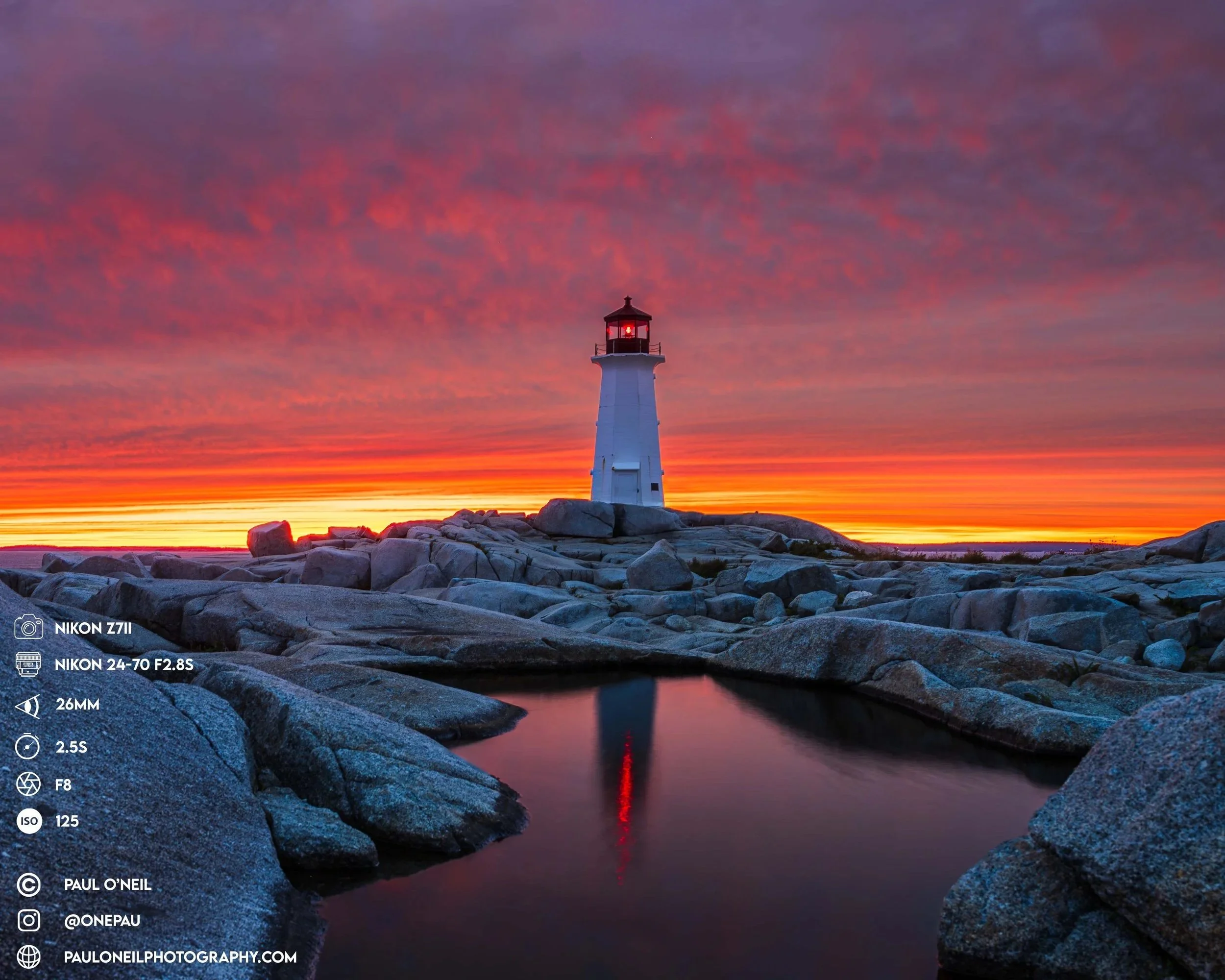
Peggy’s Cove lighthouse
Shot at dusk during September with the lighthouse reflected in a tidal pool
Baccaro Point Lighthouse
A couple of hours’ drive from Halifax lies Baccaro Point Lighthouse, near the southernmost tip of mainland Nova Scotia (in Cape Sable). I stayed in Barrington Passage at the charming Salty Shores Inn & Café (only two rooms—quaint but comfortable). After a lobster dinner at Kat’s Lobster Shack, I drove ~20 minutes to Baccaro Point.The site is relatively uncluttered: apart from a radar station and occasional cars, there isn’t too much to distract. I composed with care and waited as the sun first appeared behind the tower, then later sank into the sea behind it. I captured two distinct moods in the same location.

Gilbert’s Cove Lighthouse
I photographed Gilbert’s Cove during daylight. This lighthouse is lower and squat in stature, which presents compositional challenges. Shooting from the car park gives little variety, and in the morning, the sun’s angle (behind and to my right) was not ideal—even with a polarizer. I tried shooting from the beach with seaweed piles in the foreground, but none of the shots resonated with me. Sometimes, a location simply doesn’t yield the magic you hope for.
Gilbert’s Cove lighthouse, Nova Scotia
Kidston Island Lighthouse (Baddeck)
In Baddeck, I aimed for Kidston Island Lighthouse, which lies on an island in the Bras d’Or Lakes. Wikipedia The lighthouse is only accessible by boat (a ferry operates in summer). I found a land vantage point (via the Location Scout app) across the lake. One complication: the boardwalk was damaged and fenced off, so I set up along the roadside path.I tried multiple compositions. Fortunately, light hit one side of the lighthouse beautifully, so I focused on that. The golden hour itself was somewhat subdued, but I was glad to have explored alternate angles earlier.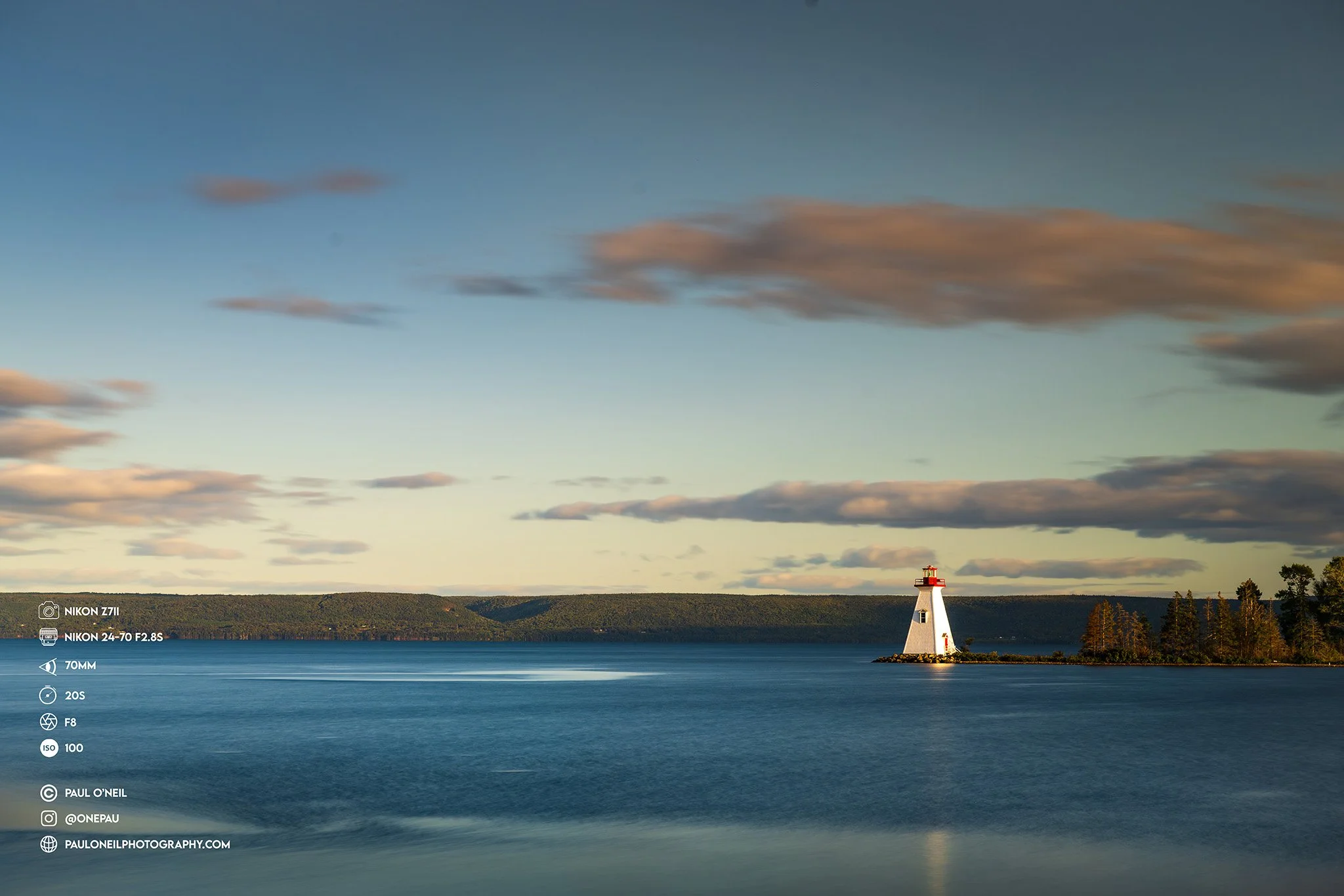
The lighthouse at Kidston Island, in the Bras d’Or Lake just across from Baddeck, in Nova Scotia
Louisbourg Lighthouse
While visiting the Louisbourg Fortress Museum, I also photographed the nearby lighthouse. This is a fairly busy site: it's within day-trip range of Sydney (and cruise ships), so coach loads of tourists arrive early. But many tours leave on schedule, giving you windows of relative solitude.I used Location Scout again to identify a spot that was a little off the beaten path—one that many visitors won’t notice. There are also a pair of red wooden chairs there that can serve as compositional anchors.
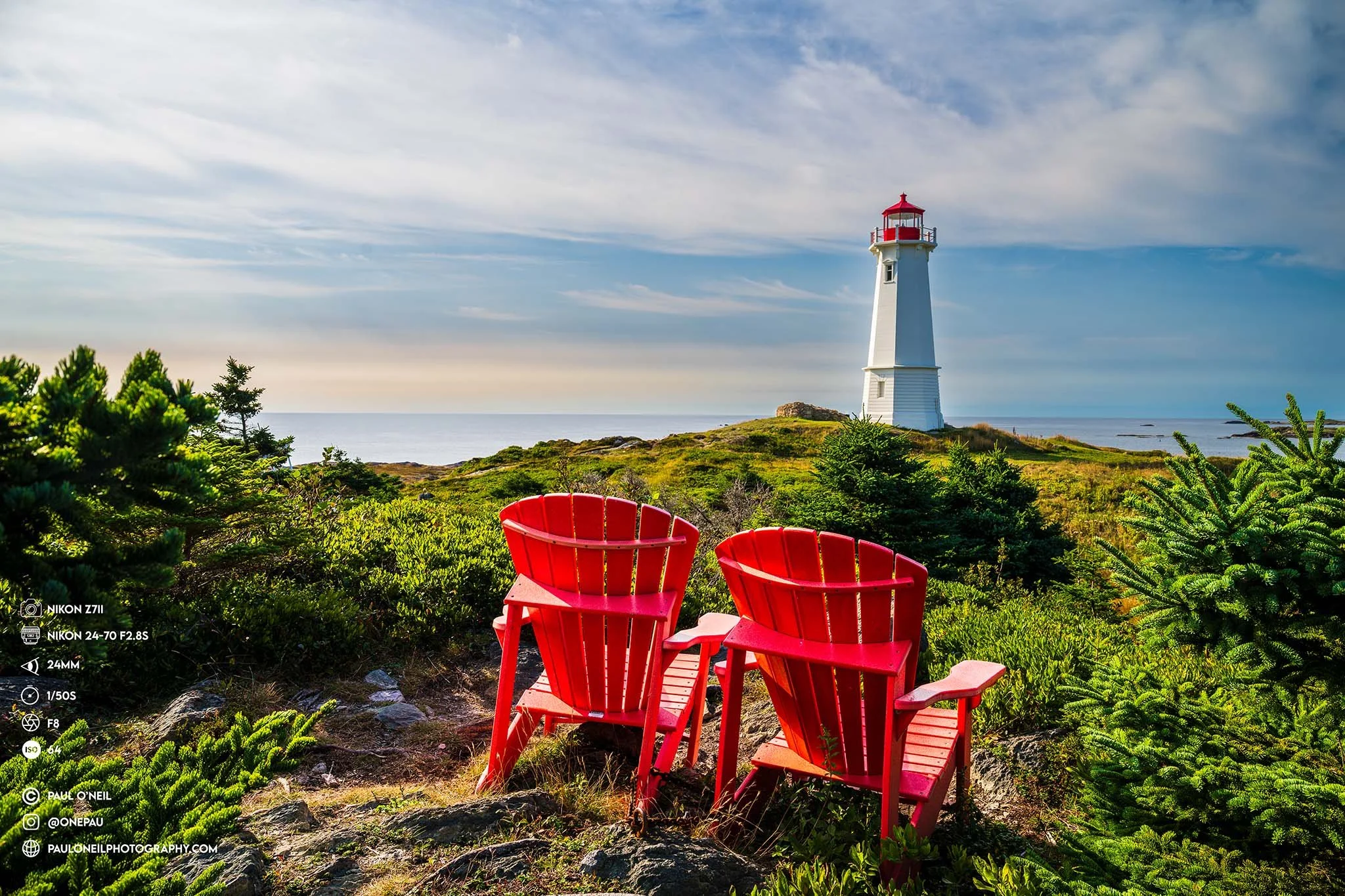
Louisbourg lighthouse
Low Point Lighthouse
Low Point is more remote and harder to locate (you park at the end of a road and hike). But that also means fewer crowds at sunset—although I still saw local and Canadian tourists and some ATV riders. Composing was a bit tricky: wide angles revealed undesired trails and vegetation. Still, I captured a shot where the last rays of sun reflected off the terrain as the sun dipped below the horizon.
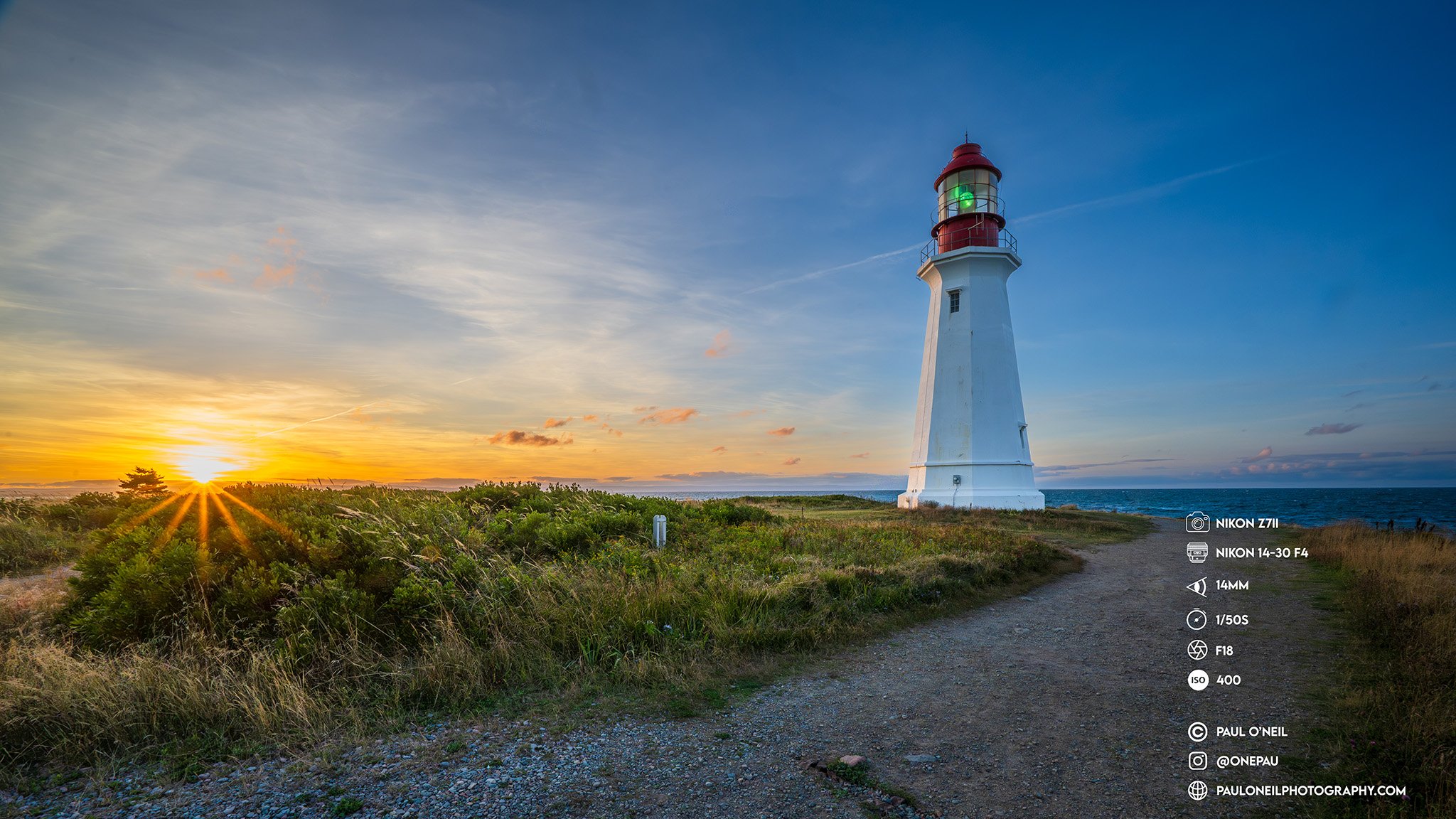
Low Point lighthouse at sunset
Nova Scotia lighthouse photography tips
Tripod
Yes, it's a no-brainer for landscape photography but it can be a pain if you're travelling - especially long haul. I have a quite big and heavy (despite the carbon) Rollei C6 model that has stood me well over time. Remember, however, that you are going to be shooting on the coast and it can get very windy. In these situations, even a tripod is not much use. Unless you are looking to capture shots like the last two above, where the shutter speed is not too slow, a tripod in the wind is not going to help you get a sharp shot (unless you carry around separate sandbags to weigh it down with). In these cases you are better of cranking up the ISO and going for a faster shot. Forget about long exposures to flatten choppy waters!Filters
I always carry a selection of filters with me and my filter adapter attaches to a screw-on circular polariser. I have mixed feelings about the polariser: sometimes it's great for adding saturation, other times it just gets in the way by darkening only a portion of the sky. You really need to have the sun hitting the lens at just the right angle for it to work. I have a lot more success with my graduated ND filter for the kind of shots shown above. Even at sunset and during golden hour, the sky will still be lighter than your foreground, so it is great to be able to compensate for that. Addtional ND filters (ND8, ND 64 and ND1000 in my case) allow you to cut out the light and smooth water.CCleaning gear
I am my own worst enemy out in the field. I switch lenses without paying attention to wind or dust (the Nikon is a pain here as, unlike the Canon, the sensor is exposed when you change lenses unless you follow the cumbersome procedure of removing the battery while the camera is on, in which case the curtain covers the sensor) and when I open up the aperture beyond F11 I often see the results of my carelessness in the form of dust spots on my shots. Look after your lenses and your camera's sensor and pay extra attention when switching lenses in the field, particularly when you are in windy, salty or dusty environments.Planning
This is the most time-consuming but the most crucial aspect. I had a schedule and a rough idea of what I wanted to shoot but was subject to the weather. So if the weather is good you need to be ready to go, set up and shoot without worrying about anything else. I use the Location Scout application to find spots. The contributors sometimes give you useful tips for shooting a particular location and there is always a map showing where the sun rises and sets. As a avid Photopiller, this app is my go to for a number of things: sunrise and sunset planning, moon phases, night AR view for the Milky Way and exposure calculations when shooting long exposures with filters.

Five must-see photo locations in Malta and Gozo for 2025: Hidden gems and iconic views
Explore the best photography spots in Malta and Gozo for 2025, including Il-Karraba Ridge, Valletta's architectural marvels, and the Marsalforn Salt Pans. Perfect for landscape and architectural photography lovers.
I visited Malta and Gozo in early May. For someone who lives in a landlocked country, the opportunity to explore an island that measures less than 30km long and 15km wide, plus the smaller island of Gozo, offers numerous opportunities to combine coastal landscape photography with historical architecture and some unusual urban photography. Despite iconic photo locations such as the Azure Window collapsing in recent years due to natural erosion, Malta and Gozo continue to captivate photographers with their natural beauty. If you're planning your 2025 photo journey through these Mediterranean gems, here are five must-visit photo locations based on my own experience on-location.
1. Il-Karraba Ridge, Għajn Tuffieħa – Sunset Spectacle by the Sea
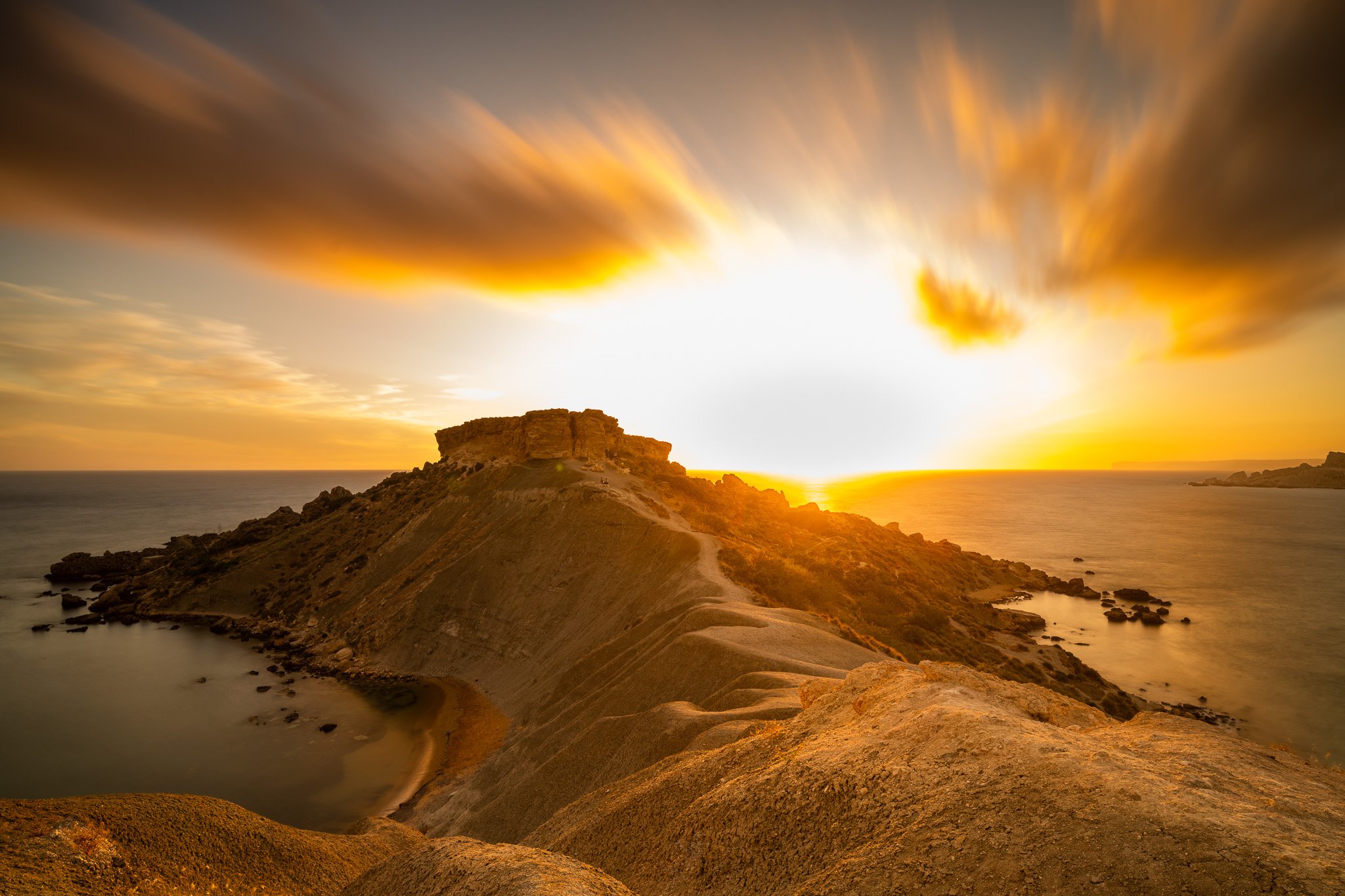
Il-Karraba ridge at sunset. Nikon Z7ii, 14-30mm f4. Shot at @20mm, f8, ISO 100, 25 seconds.
Nestled between Għajn Tuffieħa Bay and Ġnejna Bay, Il-Karraba Ridge offers one of Malta's most breathtaking coastal landscapes. This clay cliff formation is a dream for sunset photography. The unique terrain, combined with the golden Mediterranean light, provides endless compositional opportunities—from minimalist silhouettes to sweeping wide-angle shots. The cracked soil in particular offers endless opportunities to create leading lines. I faced the usual challenge of an underexposed foreground and an overexposed background, adding my own layer of complexity by shooting long exposures. A tripod and filters are essential here, and my trusted graduated neutral density filter helped to take out some of the highlights. In my final edit I deliberately kept some of the blown highlights for a pretty aggressive look. As this spot faces west, it attracts a lot of people for the sunset. Get there early, take some time to scout for a good spot and then wait. I stayed in the same spot for around an hour.
2. Parliament Building, Valletta – Architectural Geometry
Designed by renowned architect Renzo Piano, Valletta's Parliament Building is a masterpiece of contemporary architecture harmonizing with Malta’s traditional limestone aesthetic. Its bold geometric façade creates compelling patterns, perfect for architectural and abstract photography. The stairs on the right-hand side of the building offer great potential for some candid street photography if you can catch people at the right time as the sun casts a diagonal shadow across the stairs. Unfortunately, the hordes of tourists groups and cruise ship visitors seem to head straight down the main street and miss this architectural marvel. I did all my Valletta shots relatively early in the morning and the light was great. I deliberately take only my 50mm prime lens for street photography because it forces me to consider my composition. In this case I honed in on the façade to highlight the intriguing shapes and geometric patterns.

A close-up of the façade of the Parliament Building in Valletta. Nikon Z7ii, 50mm f1.8. Shot at f8, ISO 160, 1/640 seconds.
3. Marsalforn Salt Pans, Gozo – Ancient Grids at Golden Hour

The salt pans at Marsalform shot at sunrise. Nikon Z7ii, 14-30mm. Shot at 30mm, f8, ISO 64, 1/250 seconds.
Located on Gozo’s northern coast, the Marsalforn Salt Pans are not only culturally significant but also visually mesmerizing. Carved into the coastal rock and still in use today, these salt pans offer a striking checkerboard pattern that reflects the changing sky. The coast here runs east to west and I got there in time for sunrise. There was not much in the way of a golden hour but if you have a polarising filter you can catch the early-morning sun reflecting off the pools. This is a protected site so you cannot simply wander around the salt pans looking for the best composition. There is a concrete pathway half-way along the coast where you can set up to look east for the sunrise. But as always with sunrises, don’t forget to look behind you as the sun lights up the coast looking westwards.
4. Typical Maltese architecture
You cannot fail to notice the typical style of Maltese appartment blocks with their distinctive coloured protrusions. Taking a street photography approach and armed only with my 50mm prime lens, I wanted to capture only this essential element of the Maltese style, without any extraneous details. If you wander around Valletta early in the morning and frame your shot looking upwards, even if you are surrounded by tourists and traffic, you can capture a moment in time that features none of them.

No self-respecting building in Malta is complete without a brightly painted wooden extension pinned to its façade. Look up, find the colours and shoot. Nikon Z7ii, 50mm f1.8. Shot at 50mm, f8, ISO 160, 1/640 seconds.
5. The red tower and sunset by an old NATO radar station
If you plan well and scout your locations in advance, you can get two good golden hour and sunset shots here. The first is the striking St. Agatha’s Tower, whose dark red adobe-style finish comes alive in the orange glow of golden hour. Head further down the road to the very end and, if you wander around a bit, you can find several composition to catch the setting sun.

An evening shot of the Red Tower in Malta, Nikon Z7ii, 50mm f1.8. Shot at 50mm, f8, ISO 64, 1/250 seconds.

Sunset with a ramshackle hut in the foreground. Nikon Z7ii, 50mm f1.8. Shot at f8, ISO 64, 1/250 seconds.
Malta has a great bus network but if you’re planning sunrise and sunet shots it probably won’t help you much. I hired a car from the airport, where there is a good selection of companies with reasonable rates. The weather while I was there was not great and included a day of torrential rain and as the population is neither used to that or equipped for it I found myself behind a car whose tyres did not have enough profile to drive up a gentle hill in the rain! Driving in the centre of Valletta is not easy, even with your choice of Apple Car Play or Google Maps, so be warned. The ferry to Gozo runs 24 hours, however, so you can get a very early morning crossing to catch the sunrise locations.
Let me know in the comments if you’ve been or if you plan to go and what you thought/think.