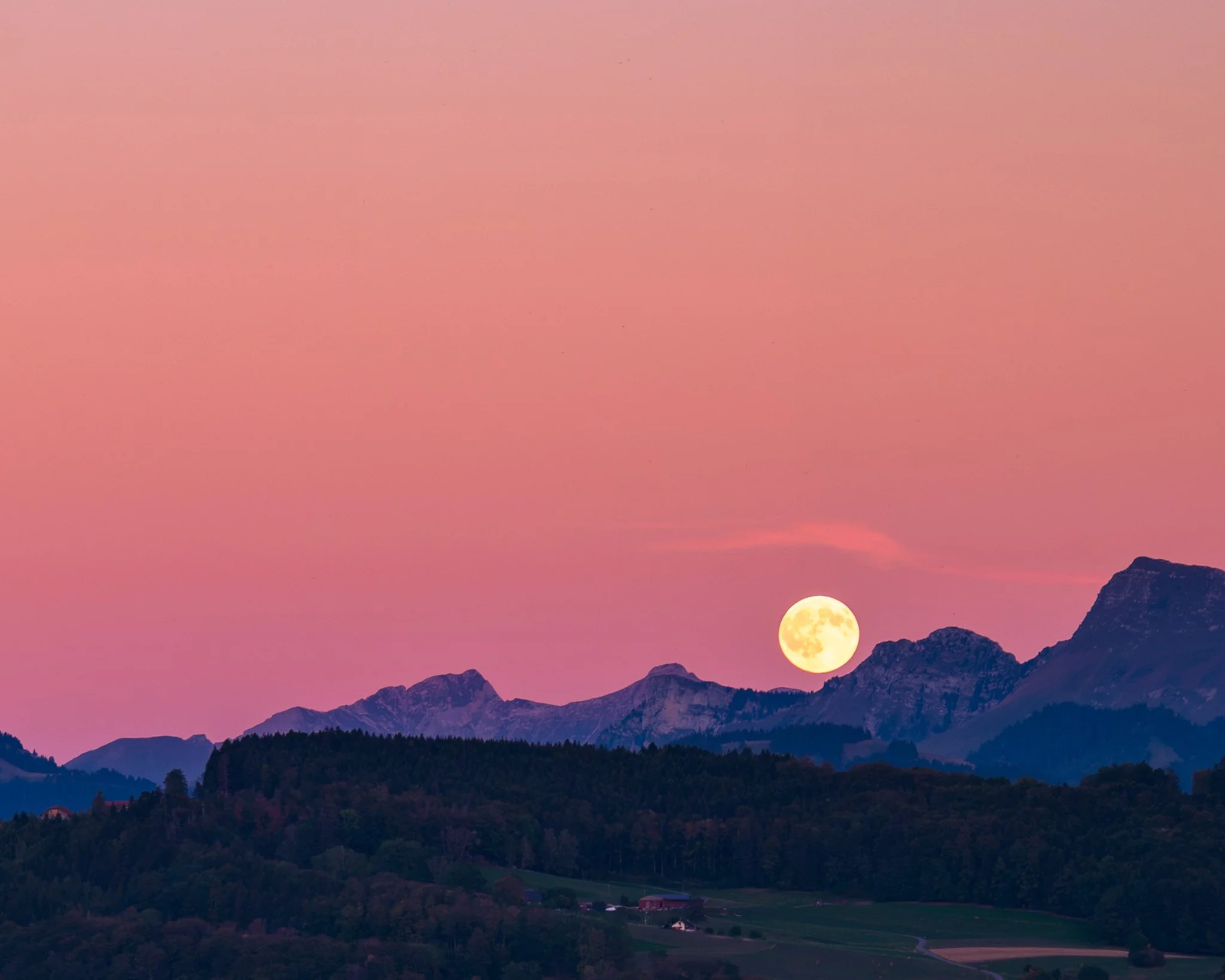
Photographing the Harvest Moon
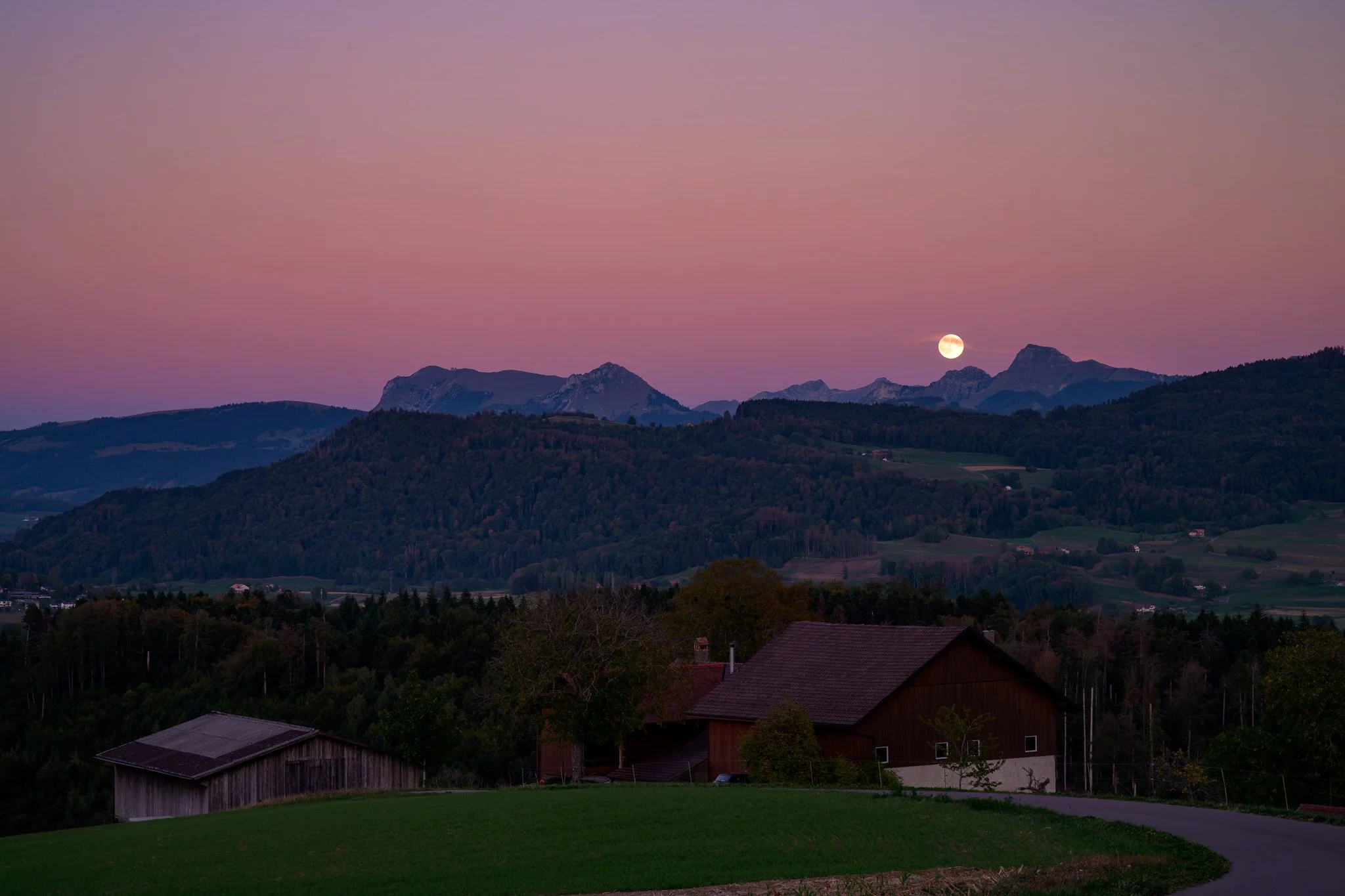
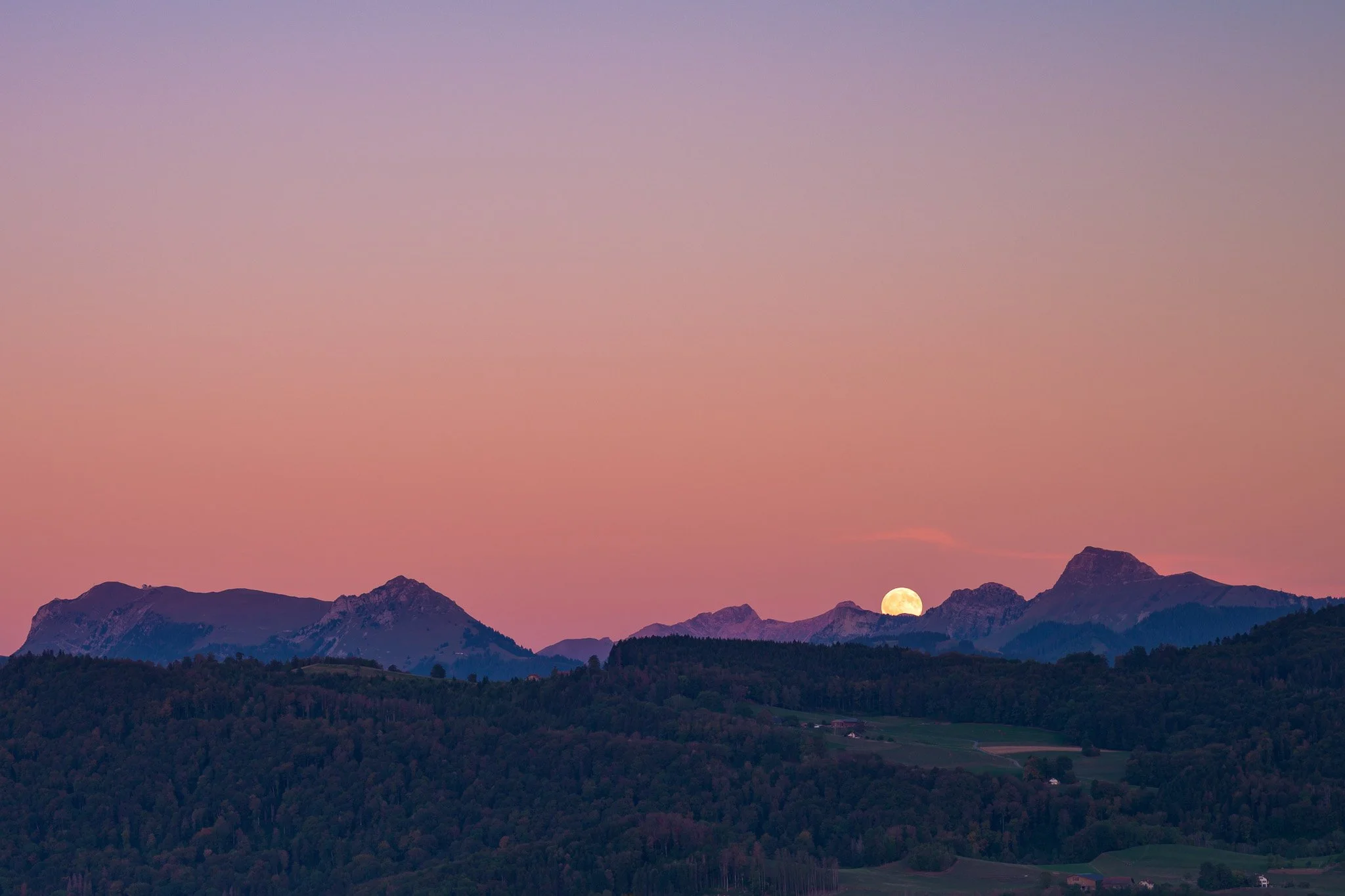
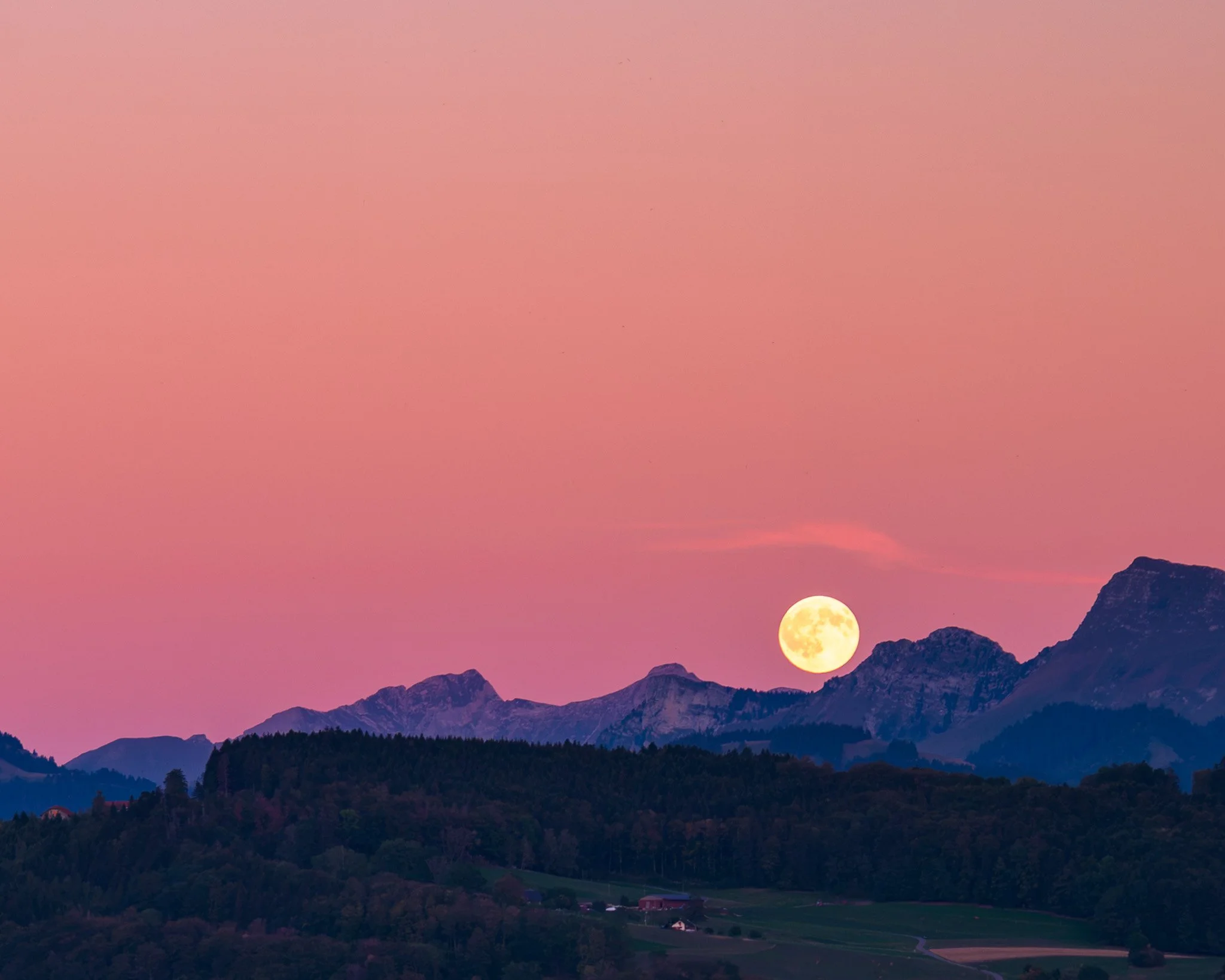
I finally managed a relatively successful shoot of the harvest moon just a short drive from where I live. Unsurprisingly, planning was the key to this shoot, as well as some luck with the weather - almost too much luck as some clouds might have given the shots a bit more atmosphere.
Planning is everything when shooting the harvest moon. Ideally, you need to catch it as it is rising and if you can get it rising behind something interesting, so much the better. I’ve tried a few times and been unsuccessful for two main reasons:
Not getting the exact location of moonrise right. I was in the right place for my composition but the moon wasn’t. Even using an app like Photopills you need to make sure that your phone is calibrated to get the night AR view right (make sure you also set the closest focal length in the app to the one you have on your camera!).
Blowing out the higlights, leavng the moon as a bright white disc with no detail. This is probably the toughest one, but I think I finally cracked it last night.
One of the downsides of living above Lausanne is that it’s difficult to find a clear horizon. If you are down at Lake Geneva, by the time the moon rises it could be too bright for a landscape shot (but might be OK if you are shooting with a telephoto lens) and if you climb up a bit above the lake then your eastern horizon is littered with mountains.
So the trick was to find a composition where I could get the moon rising above some of those mountains. I finally did it with a view from near the Tour de Gourze, which is only a 15 minute drive from my house. The eastern view from the tower itself is obscured by forest, but if you walk back down the road (or in my case all the way down through the forest) you will find some open views east looking towards the Dent de Lys - the first mountains of the pre-Alps on the border between the cantons of Fribourg and Bern.
For once I was ahead of my schedule, so I had plenty of time to scout, double and triple-check the exact moonrise location, find a composition and set up. I’d missed a shot the previous day where the moon rose 15 minutes earlier - before sunset - so this was a second chance. After a short wait, where minutes felt like hours, I finally got a glimpse of light just as the moon peeked above the Dent de Lys so I was able to fire off a load of shots.
This was definitely the best time to do it. As soon as the moon got clear of the mountains, the light was too dominant and its surface features were quickly blinded out. Catching the moon as low as possible while there is still some residual sunlight but before it can dominate the sky was the key - especially with no clouds in the sky.
Unlike previous attempts, these shots only needed minimal editing. The mixture of golden and blue-hour colours in the sky is perfectly natural and even the moon itself hardly needed any editing. Apart from some basic edits, I just added a bit of dehaze and noise reduction to improve the contrast. It was the first time I had used the Nisi natural light filter for something other than Milky Way work, so perhaps that made a difference.
Mamiya RB 67 sample images
There is a rule with the RB67 that took me a few rolls to accept: if something is not working, the problem is almost certainly you and not the camera. I have proved this to myself several times now, once while loading film at home and once rather more publicly in the middle of a shoot.
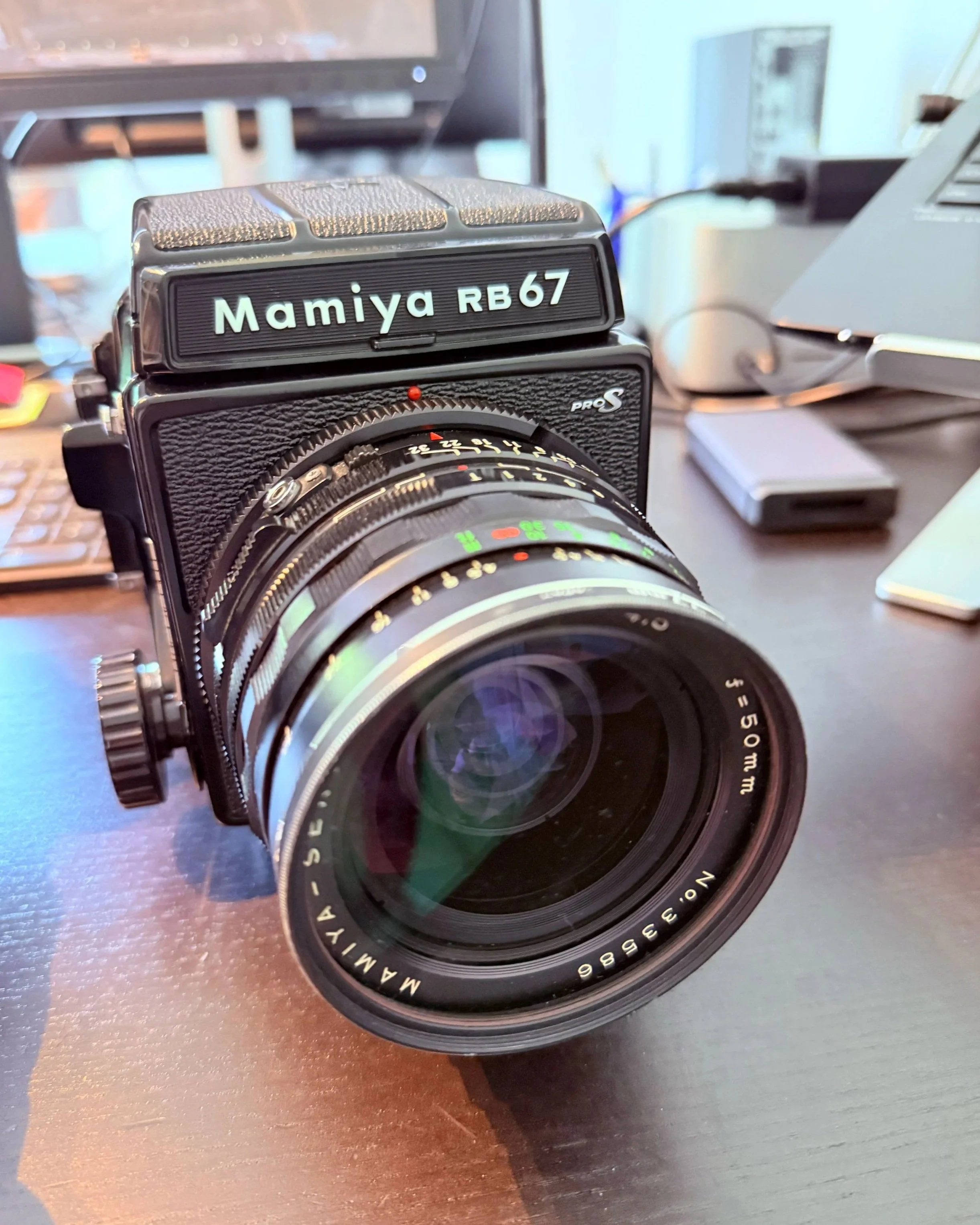
My Mamiya RB67 came from Japan, where there are still plenty on eBay, sold either as bare bodies or bundled with a lens or two. It was quoted as being in good condition, it arrived packed as though it were being shipped to the moon, and it matched the description. It came with the 50mm Mamiya Sekor lens, which suits me because I mainly shoot landscapes.
Landscapes and the RB67 are, admittedly, two antagonistic ideas. The camera is big, bulky and heavy, and a roll of 120 film in 6x7 gives you ten shots. Ten. If you want more than that in a day you carry a second back, which means carrying more weight up the hill in order to take more photographs of the hill.
But the back is also the reason to own one. Two backs means two film stocks going at once, and I like to have black and white and colour loaded and to switch between them depending on what the light is doing. The back also rotates, which is what the "RB" stands for, so you shoot portrait or landscape by turning the back rather than the whole camera. On something this heavy that is not a minor convenience.
There are no electronics anywhere in it. There is not even a light meter. That, combined with the sheer bulk, forces you to slow down at every stage: loading, composing, metering, shooting, and eventually finding somebody who will still develop 120 film for you.
Loading is where I have come a cropper twice. Releasing the back is simple enough, with sliders marked "Lock" top and bottom, and a little tab underneath that opens it. What catches you out is that the back then comes apart into two pieces, the external cover with the dark slide and the internal film holder, and that the film has to pass behind the holder before it goes onto the take-up spool. Wind until the arrow on the film lines up with the arrow on the back, close it, and it stays light sealed for as long as the dark slide is in.
Metering leaves you two options. The sunny 16 rule works well enough (set your shutter to one over your film speed at f16), but the fastest speed on the RB67 is 1/400th of a second, so anything above ISO 400 leaves you stuck. Otherwise there are apps. I use Lightme, which let you spot meter and has a zone scale if you want to be more deliberate about it. Either way you then dial the settings straight onto the lens against the red dot, which after a digital body feels satisfyingly like operating machinery rather than a computer.
Composing takes the most getting used to. With the waist-level finder you lift the hood and look down at the image on the mirror, and there is a loupe that pops up for more precise focusing. Shooting landscapes on the 50mm I have simply left focus on infinity and it has been fine, but for anything closer you focus by turning the knob on the left, which racks the bellows in and out. Best of all there is a lever that locks focus once you have it, so a knock cannot lose focus for you. In fairness, if you knock this camera you are more likely to injure yourself than to affect the shot.
Point and shoot it is not. The order matters: wind on, cock the shutter, pull the dark slide, then fire. Leave the dark slide in and nothing happens at all, which is a sensible failsafe when you only have ten frames to lose. What is less forgiving is the little lever under the winding lever. Pushed forward with a red dot showing, the double exposure protection is off, and the shutter will fire whether or not you have wound on. I did not notice this for an entire roll.
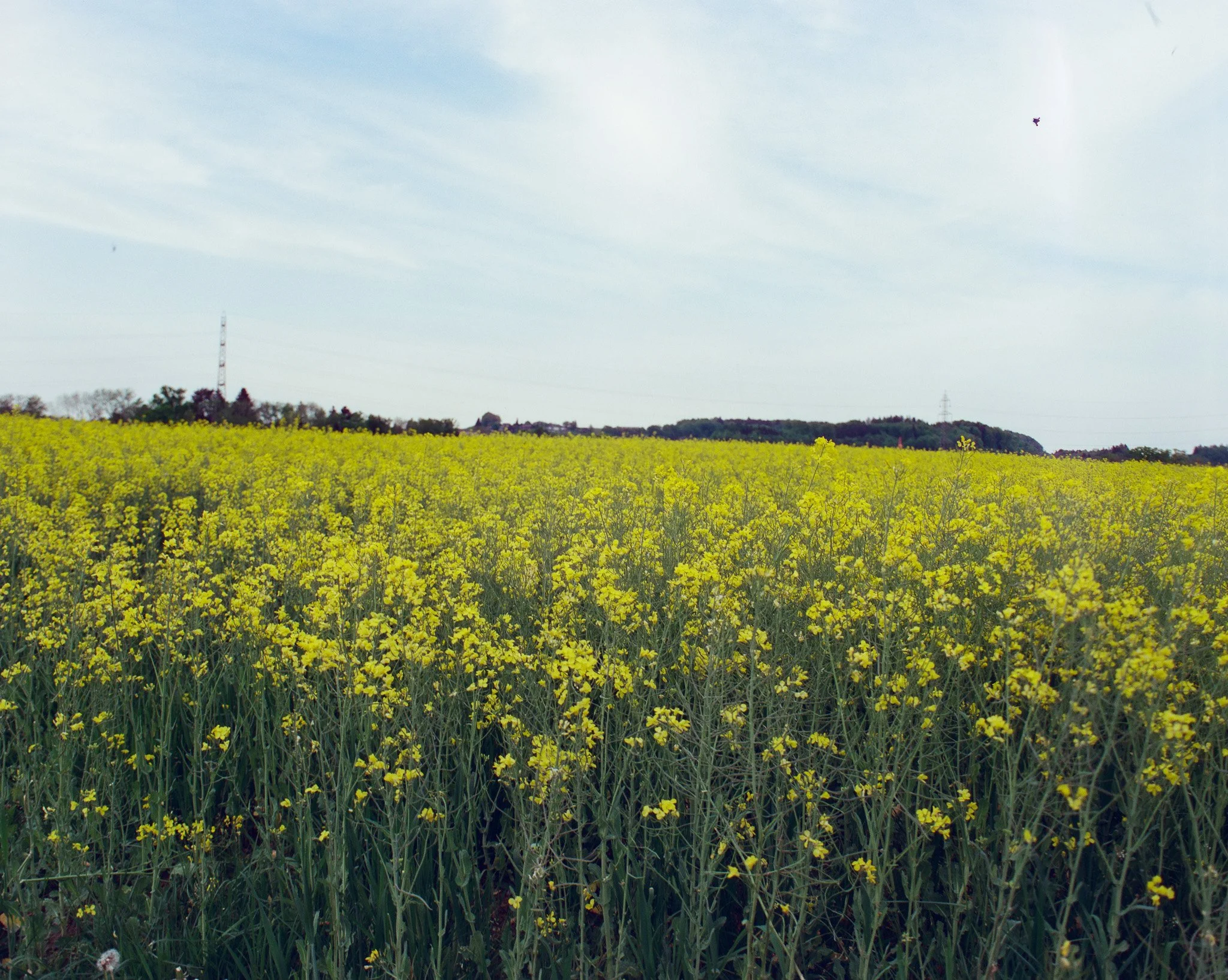
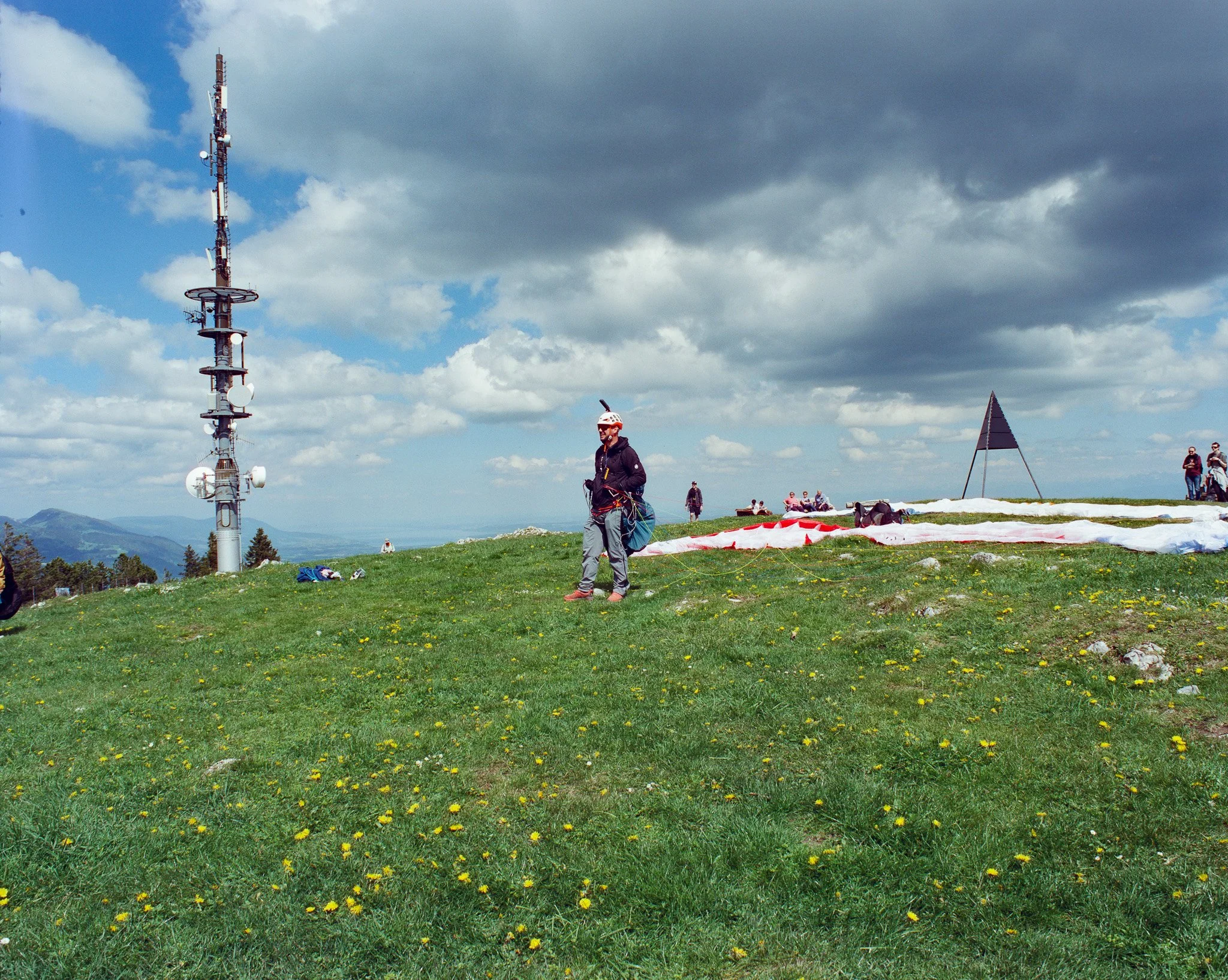
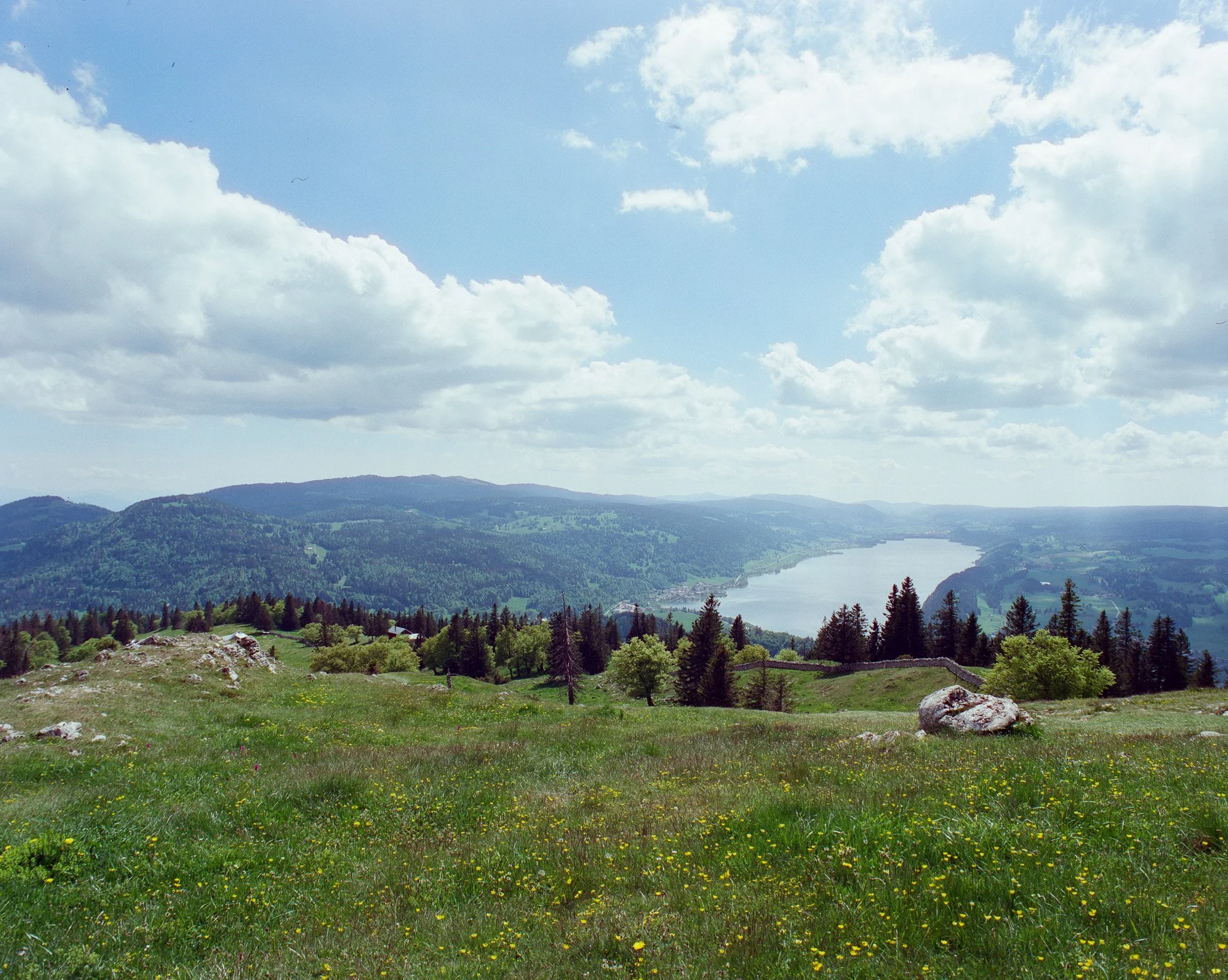
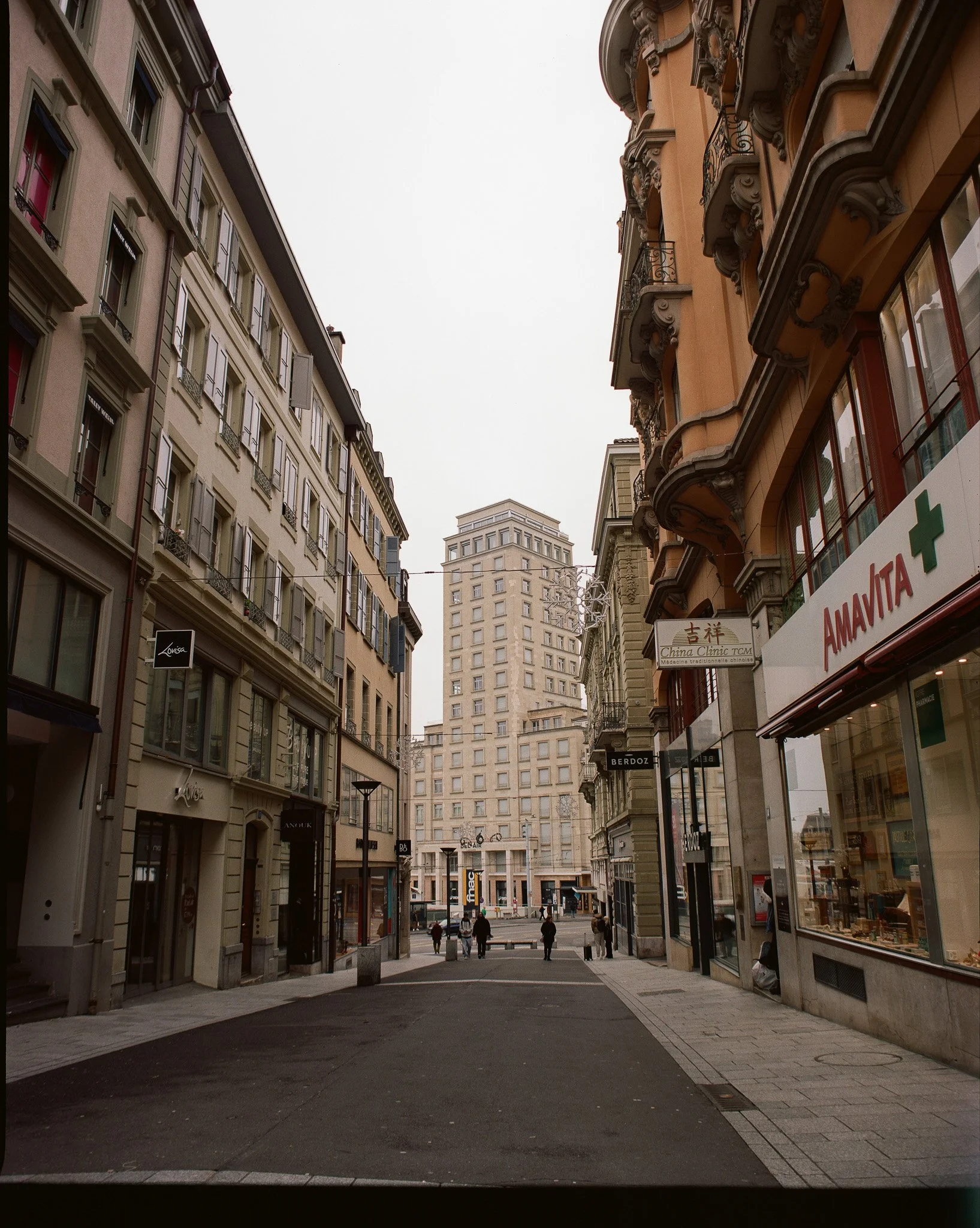
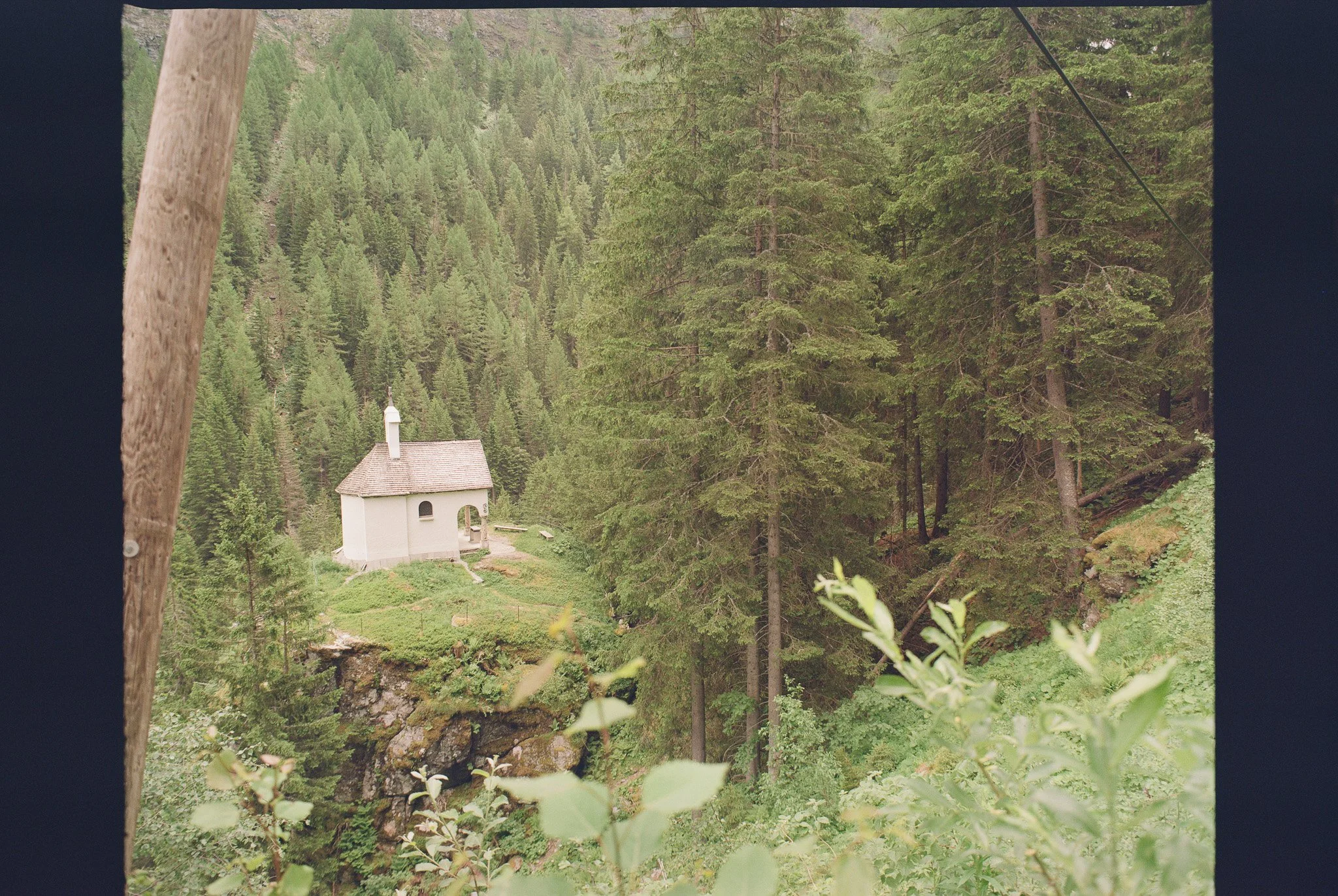
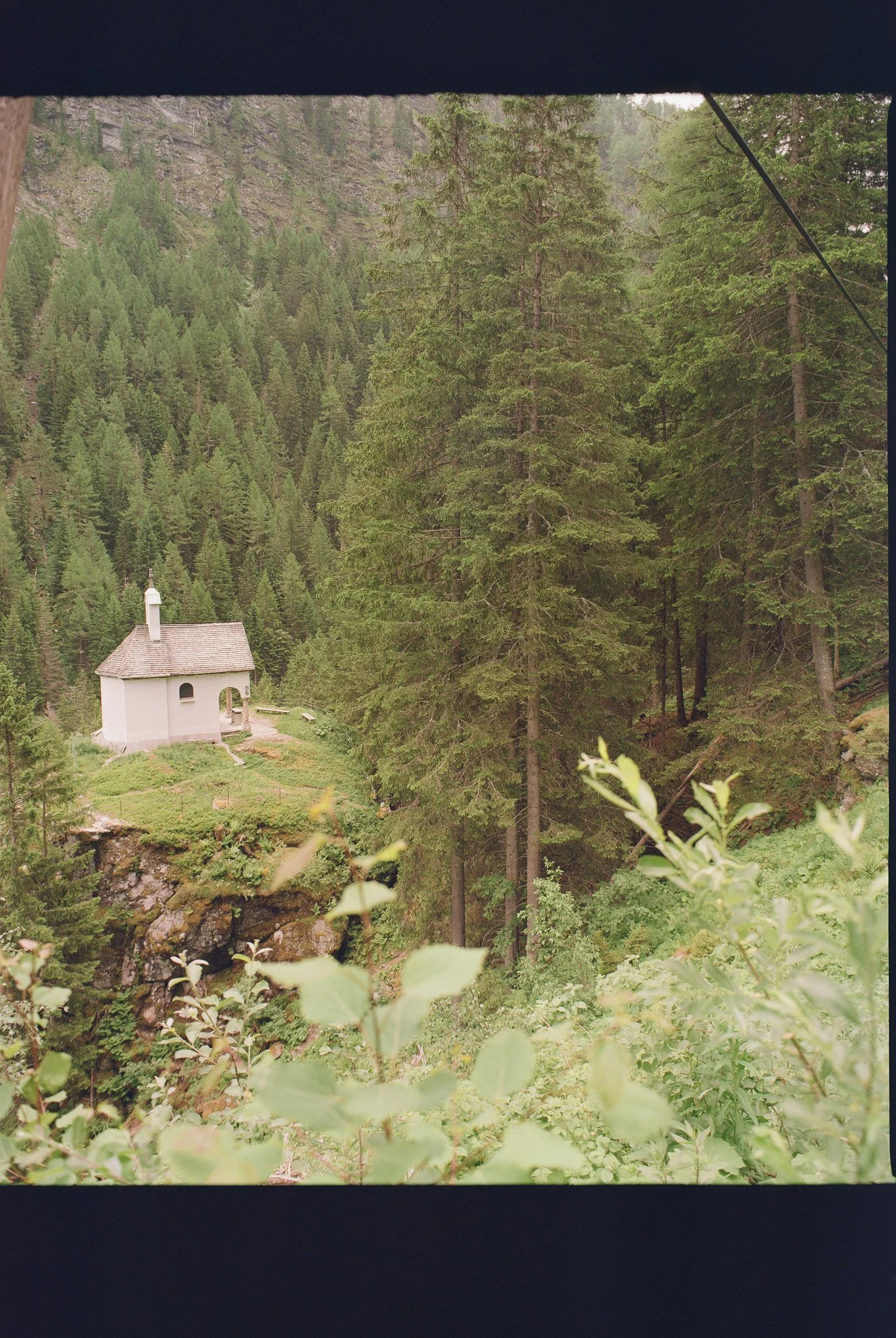
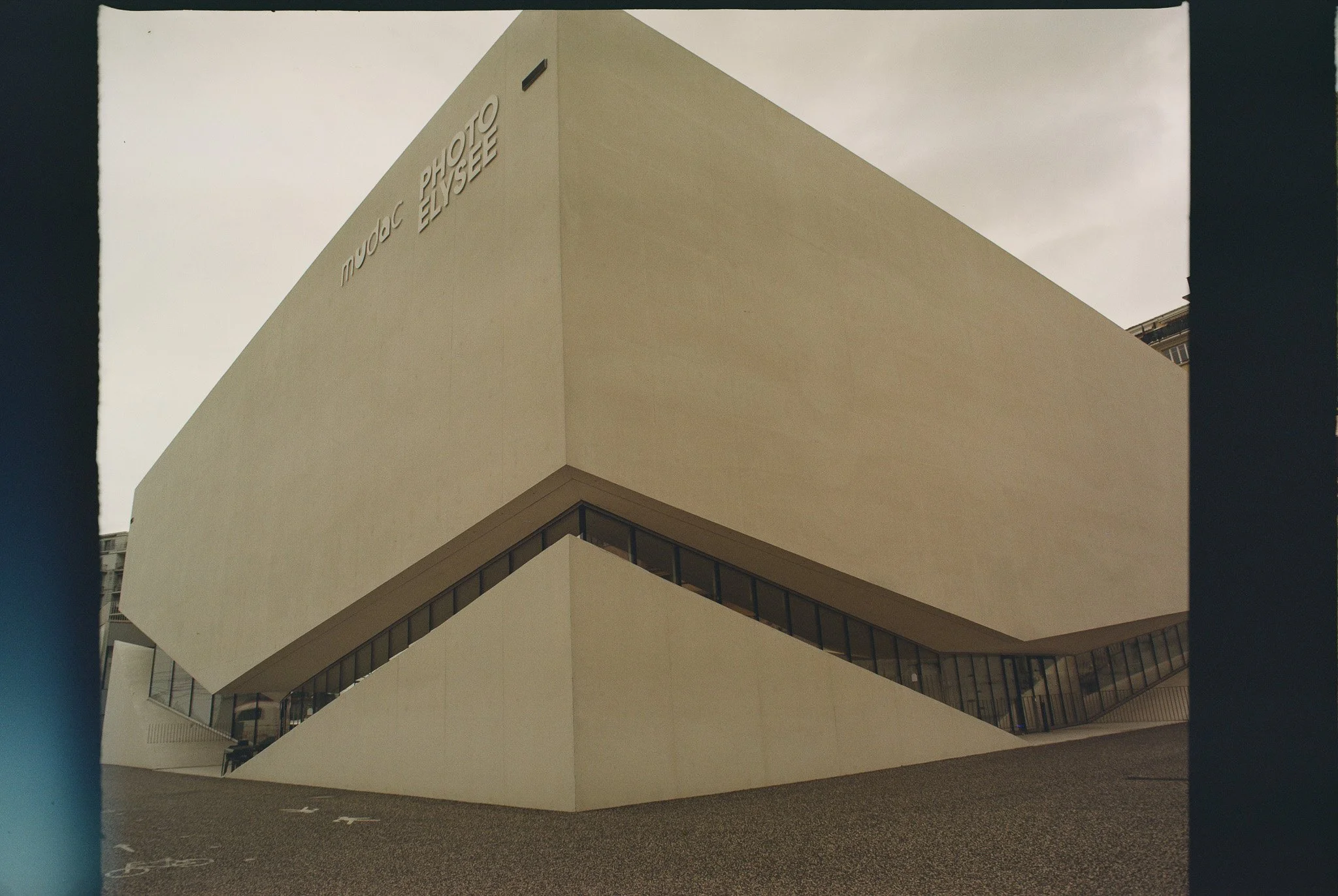
Now that I have shot a few rolls in colour and black and white on the Mamiya RB 67, I can share some sample images. The camera is too big to carry around on my landscape shoots along with all my other gear, as I am often hiking in mountain terrain over relatively long distances. However, I have taken it with me when I know there would be an opportunity to shoot without carrying it too far.
My general impression is that the 50mm lens is OK but not great for landscape photography unless you have fantastic light. I’ve tried with a variety of films without any major differences in the final result. I would love to try closer work with longer lenses as these seem to produce much better results based on what I have seen online.
Trying a ChatGPT photo challenge
I’m lucky enough to live on the doorstep of a UNESCO World Heritage Site (the terraced vineyards of Lavaux) and just a stone’s throw from sweeping views across Lake Geneva and to the French and Swiss Alps beyond.
Whilst this is a dream for a landscape photographer, it’s also easy for me to fall into the same trap - always shooting the same wide angle shots of the same area. On a recent afternoon with glorious sunny weather I couldn’t pick from several destinations to try to shoot something a bit different, so I asked ChatGPT for help. Here’s the prompt I used
Select a random location in the canton of Vaud for me to explore and photograph this afternoon. As an experienced photographer, I specialize in landscapes, so please choose a spot that offers visually interesting scenes. Note that I will not be shooting during the golden hour, so consider locations that provide great photographic opportunities throughout the day. Make sure to include any relevant details about the landscape features, accessibility, and any must-see spots within the area.
With its usual confidence and authority, ChatGPT very quickly pointed me in the direction of a viewpoint just before Chardonne in the very heart of those Lavaux vineyards.
Never one to leave it there, ChatGPT followed up with:
If you want, I can also give you:
a “bad weather” Vaud photography destination,
a more wild/alpine alternative,
or a highly specific photo challenge for Lavaux to make the outing creatively harder.
So I opted for the specific photo challenge and here’s what it gave me. I think it’s a great way to challenge yourself and look for compositions that you wouldn’t normally think of. Just the fact of having a brief that forces me to think in a particular direction made a big difference for me. I’m posting the photos under each category so you can judge how well I did.
Challenge: Create a cohesive 9-image series with these exact constraints:
Only shoot between 35mm and 70mm
No ultra-wide establishing shots
No cropping afterward beyond minor straightening
Every image must contain at least 3 distinct depth planes
No people as primary subjects
The lake must appear in at least 6 images
Shoot the entire series handheld
The goal is to make Lavaux feel immersive rather than panoramic.
The 9 Required Frames
1. “The Barrier”
Use:
a vine row,
railing,
wall,
or staircase
to partially obstruct the view.
You want tension between blocked foreground and open landscape.
The result:
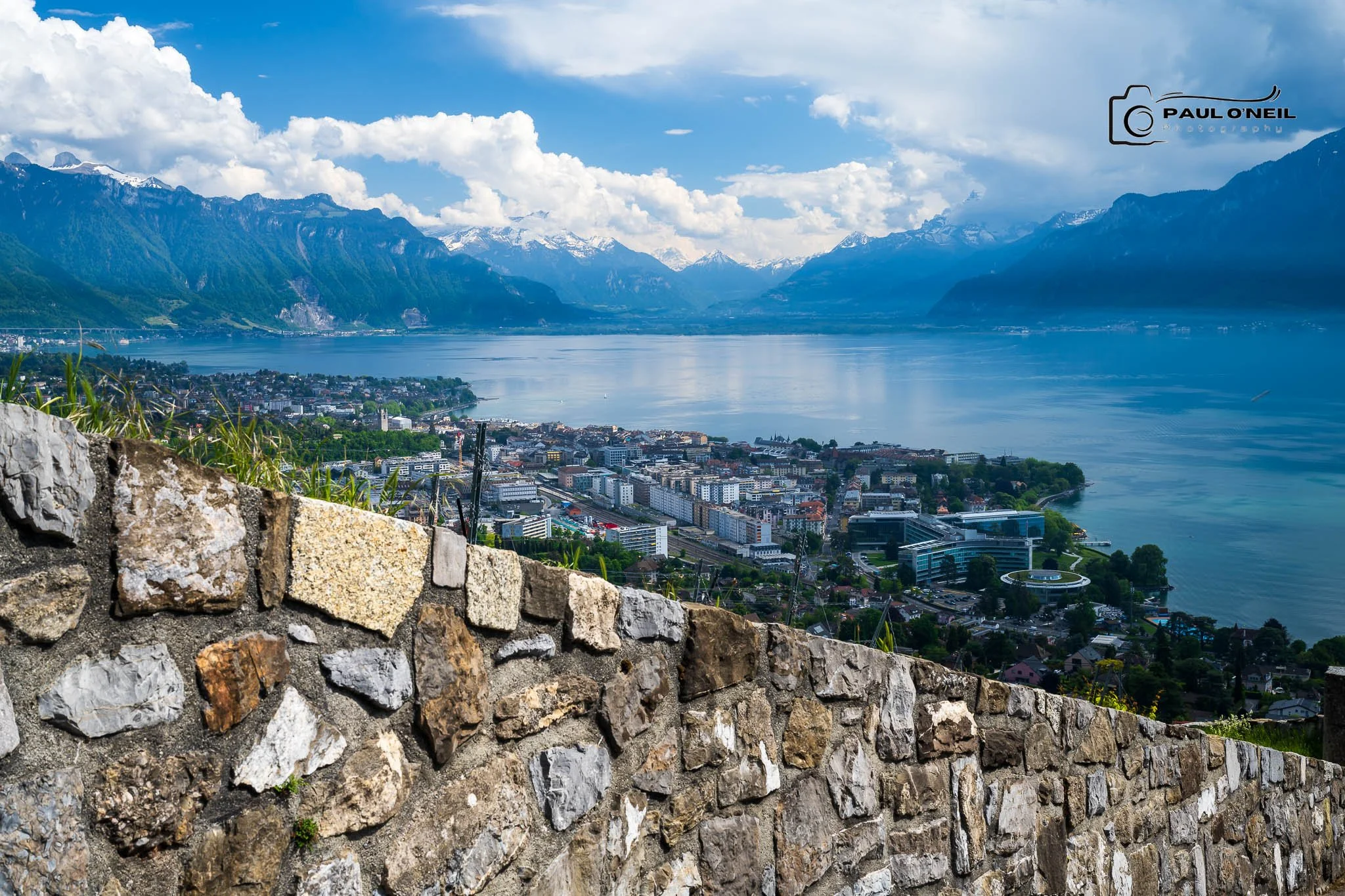
The stone wall of the terraced vineyard creates the tension in the view down to Vevey (with the Nestlé headquarters visible), across the lake to the mountains beyond.
2. “Three Blues”
Capture:
sky,
lake,
mountains
as three distinct tonal blues.
The result:
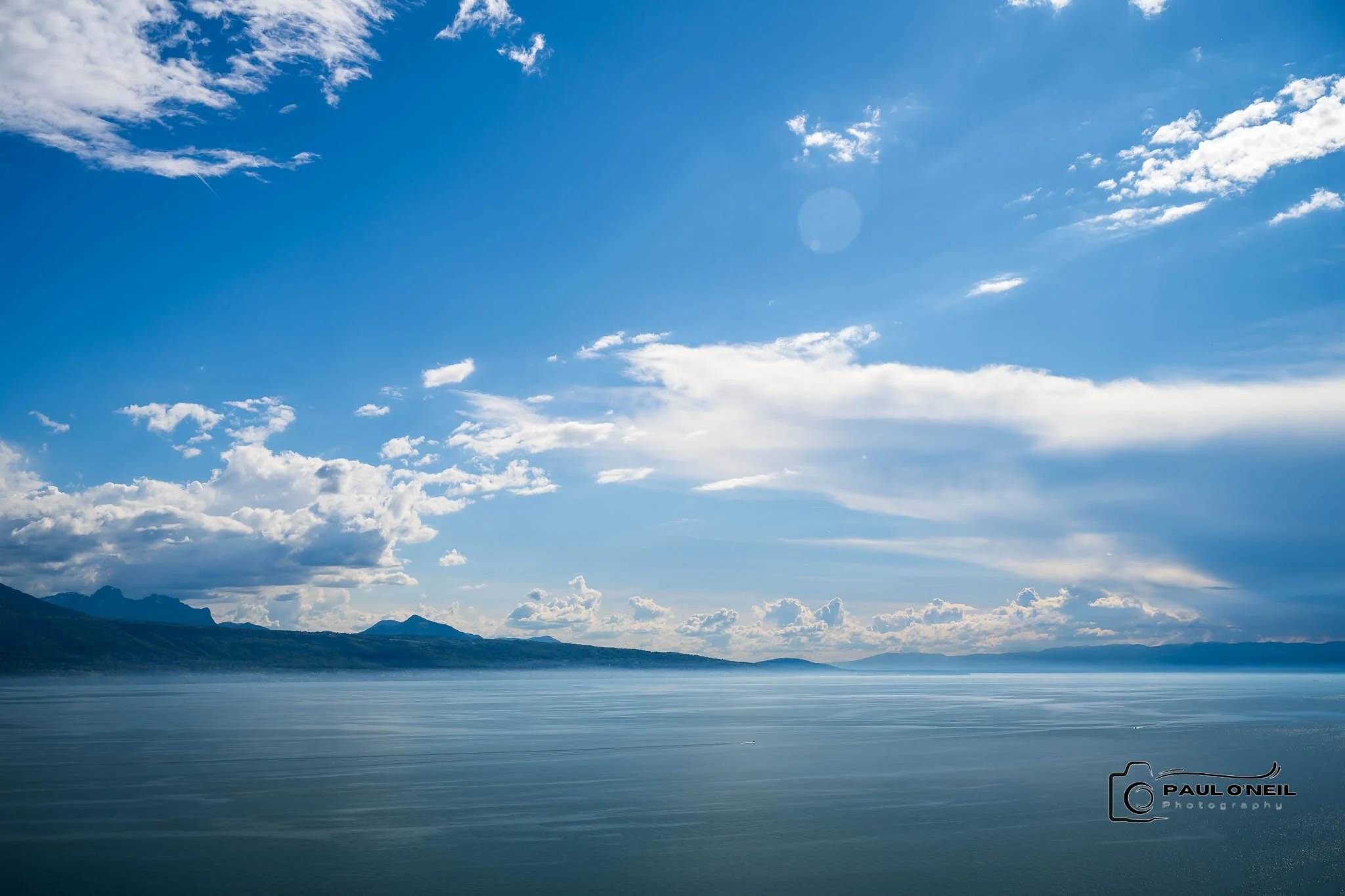
An image where blues dominate, from the stippled surface of the lake to the outlines of the mountains and a bright blue mid-afternoon sky.
3. “The Impossible Horizon”
Create a frame where the vineyard slope makes the lake horizon feel visually wrong or tilted.
Use diagonal terraces aggressively.
The result: This was my least favourite image from the entire shoot. This was the challenge I found most difficult to interpret. How do you do this without making the image look ridiculous? As a landscape photographer I am meticulous about having the horizon straight, so this just felt totally counter-intuitive.
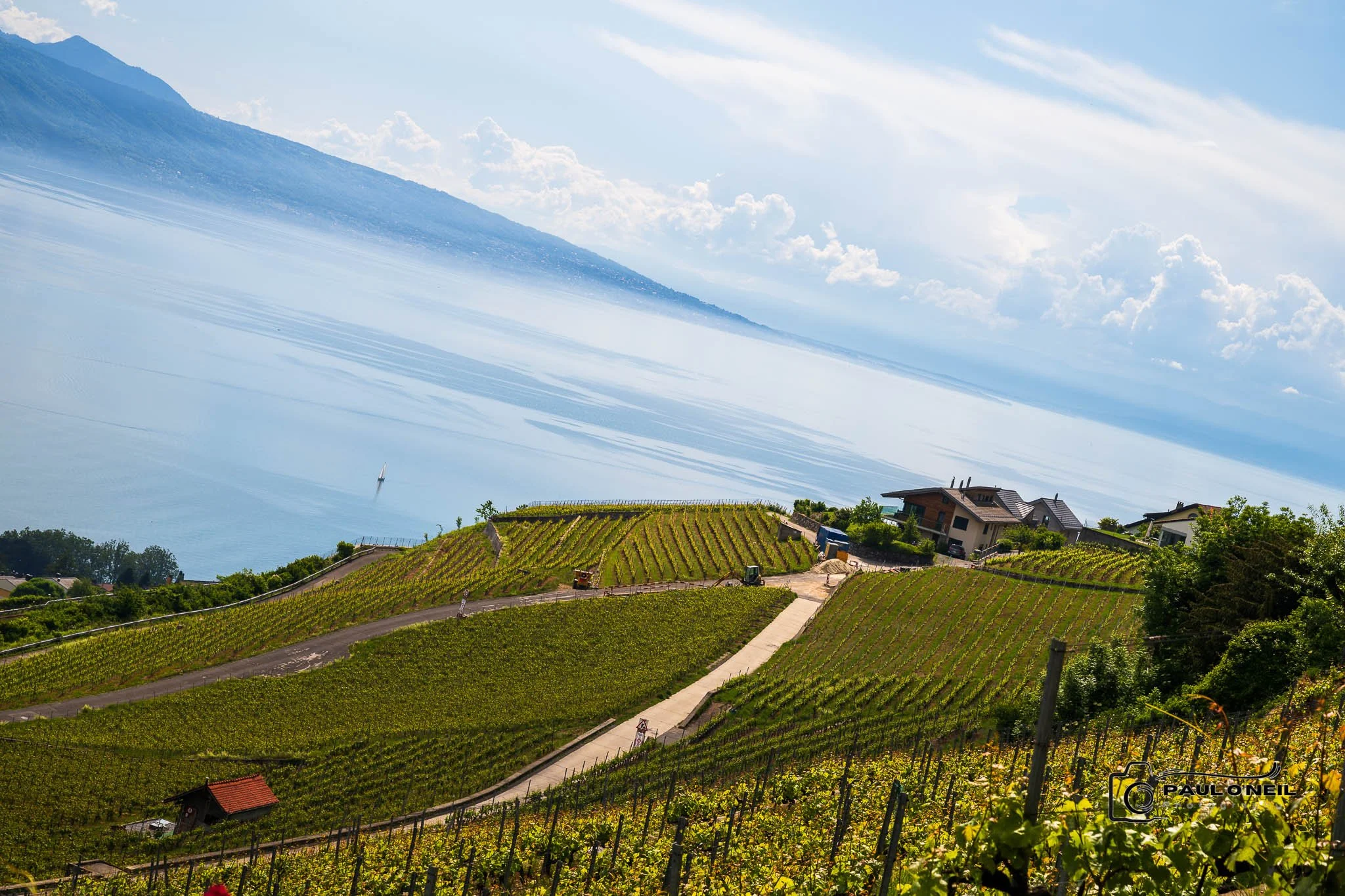
A distorted horizon looking across Lake Geneva.
4. “Human Absence”
Photograph evidence of humans without showing any people:
tools,
rails,
tractors,
wine crates,
chairs,
tracks,
utility lines.
The result:
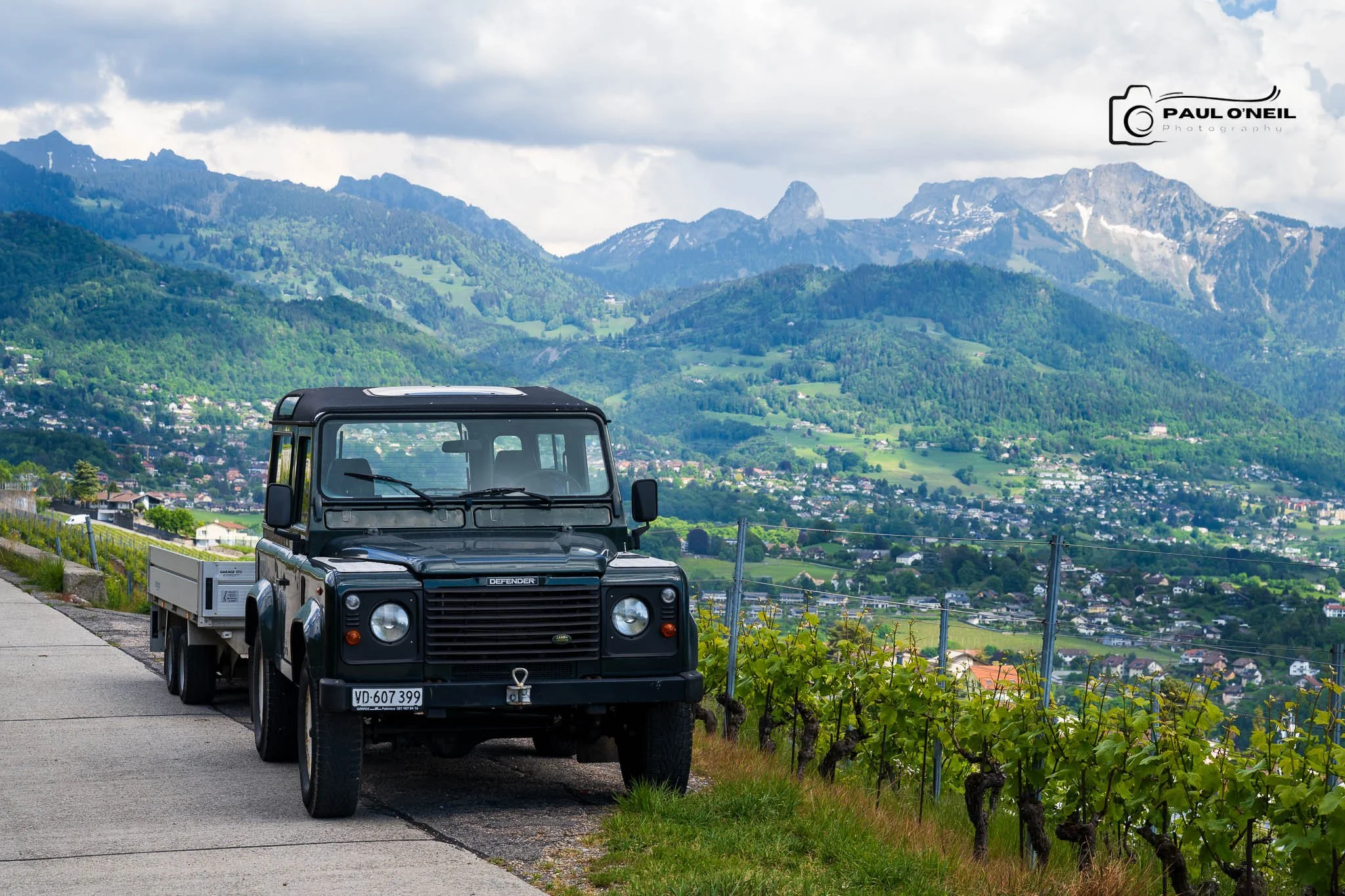
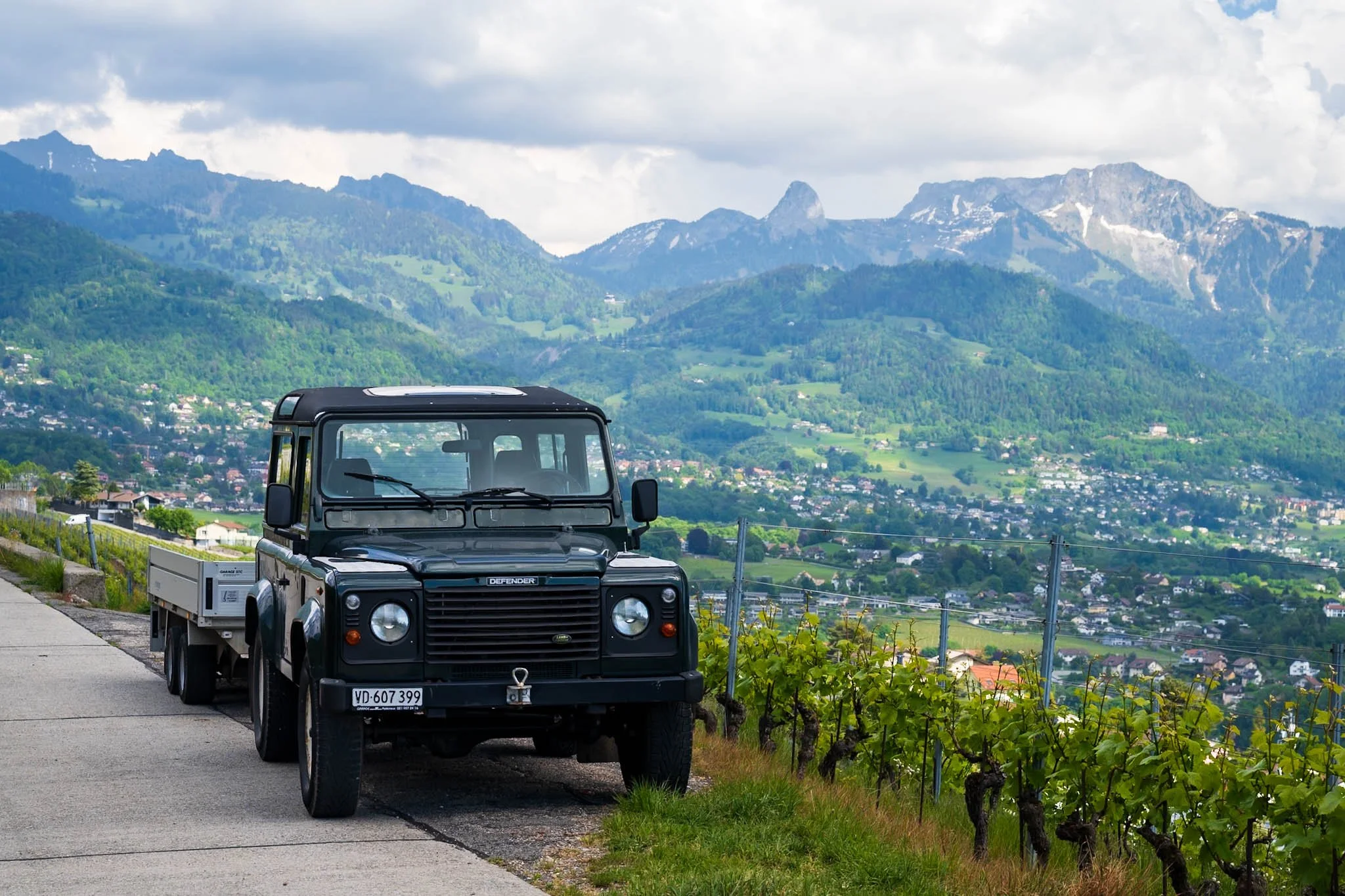
The Land Rover Defender as the ultimate utility vehicle. It had been used to transport some machinery that was working loudly in the vineyards in the background.
5. “Layer Collapse”
Find a composition where:
foreground vines,
middle villages,
and distant Alps
appear visually flattened despite only having 70mm.
6. “One Colour Dominates”
Create a frame where one color occupies roughly 70–80% of the image:
deep green vines,
pale blue haze,
grey stone,
silver lake reflections.
Minimalism over spectacle.
The result:
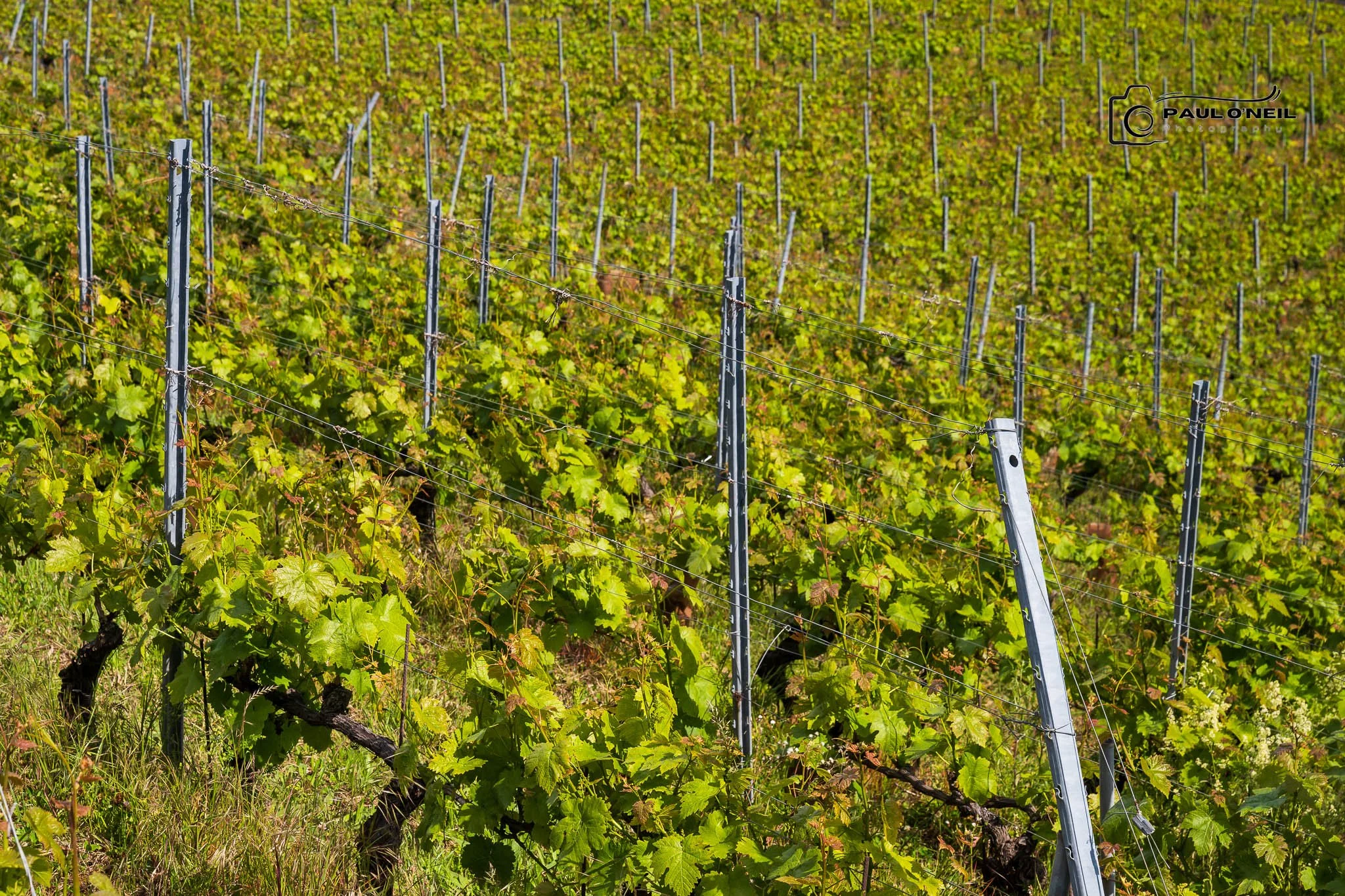
A relatively easy shot with the vines in leave and the spring grass growing around the roots.
7. “The Quiet Geometry”
No dramatic scenery.
Only:
repeating vine posts,
terrace curves,
shadows,
stone textures.
Almost abstract.
The result:
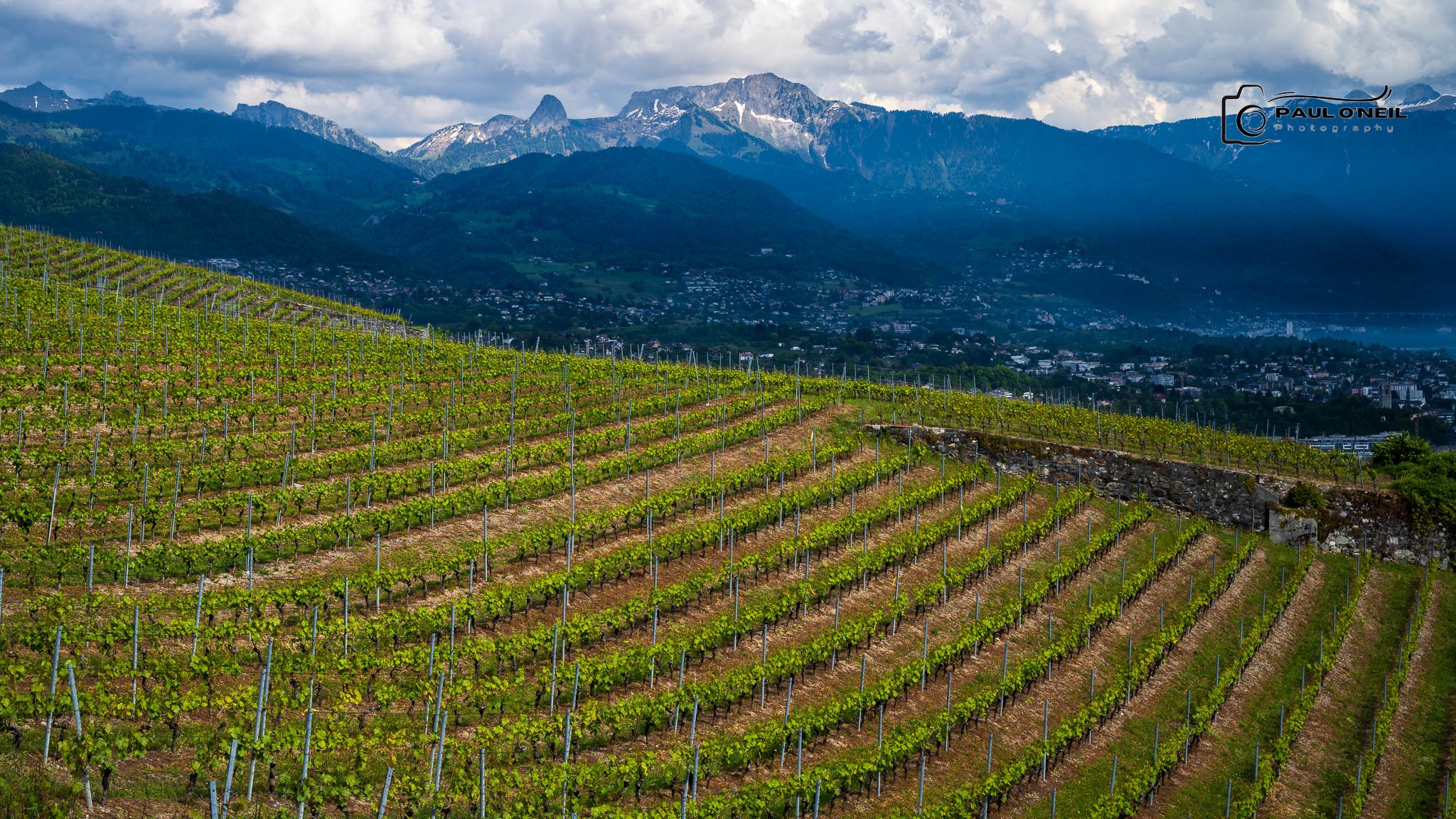
Emphasising the diagonal lines of the vineyards against the backdrop of the Vaud pre-alps.
8. “The Hidden Lake”
The lake cannot dominate the image.
Instead:
reveal only fragments of it through vines, buildings, or gaps.
Make viewers discover it slowly.
The result: Pushed a bit to the extreme but the shot was begging to be taken.
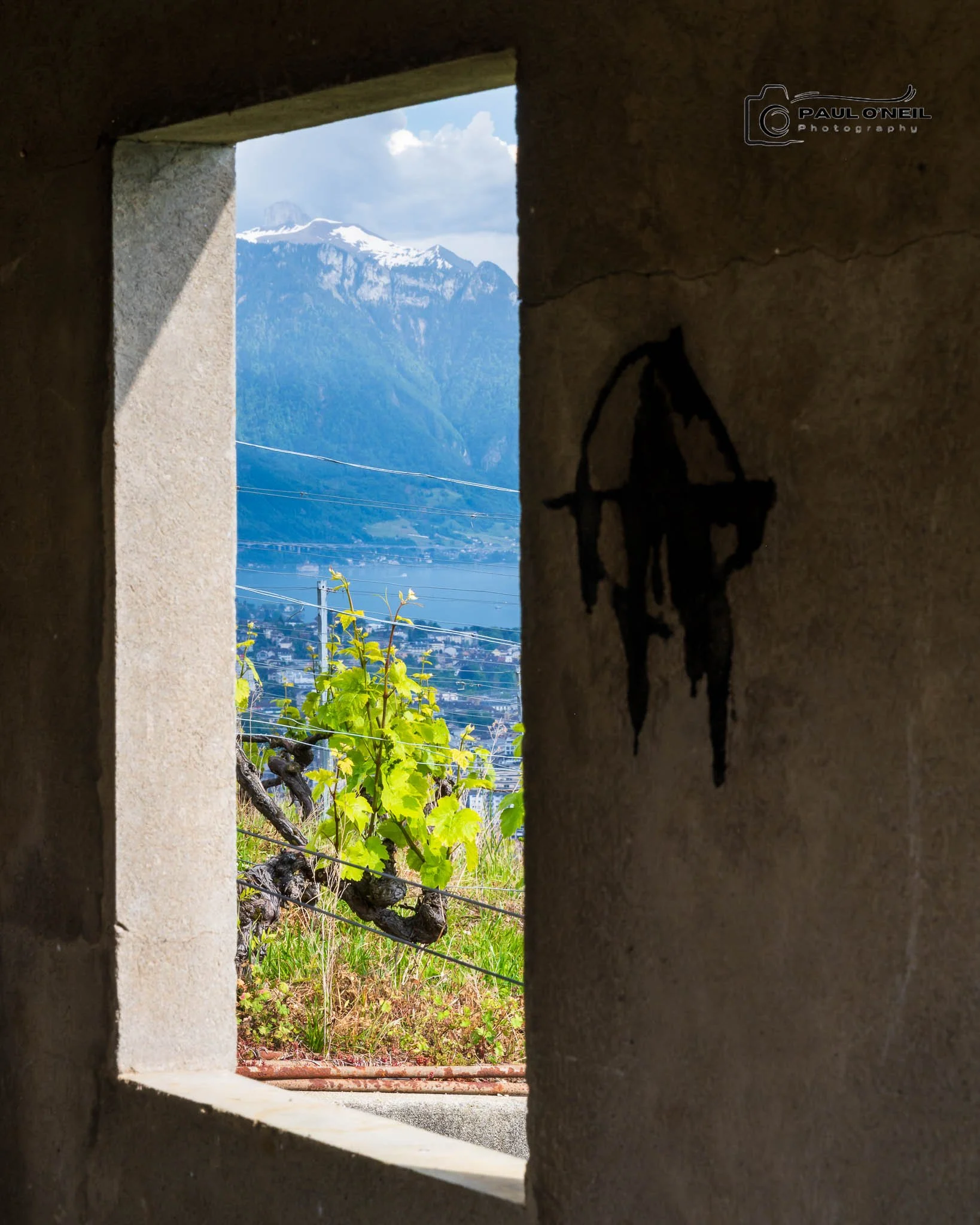
The vines and the lake revealed through an opening in a small hut set in the vineyards.
9. “The Final Frame”
End the series with the strongest sense of atmosphere, not the grandest view.
Look for:
haze,
distant rain,
reflective pavement,
wind in vines,
low clouds over the French Alps.
Mood beats spectacle.
The result: The shot I didn’t think I would get on a bright sunny afternoon. Suddenly there was a gathering of haze and - yes - distant rain approaching across the lake. Shortly after the shot was taken there was a brief shower.
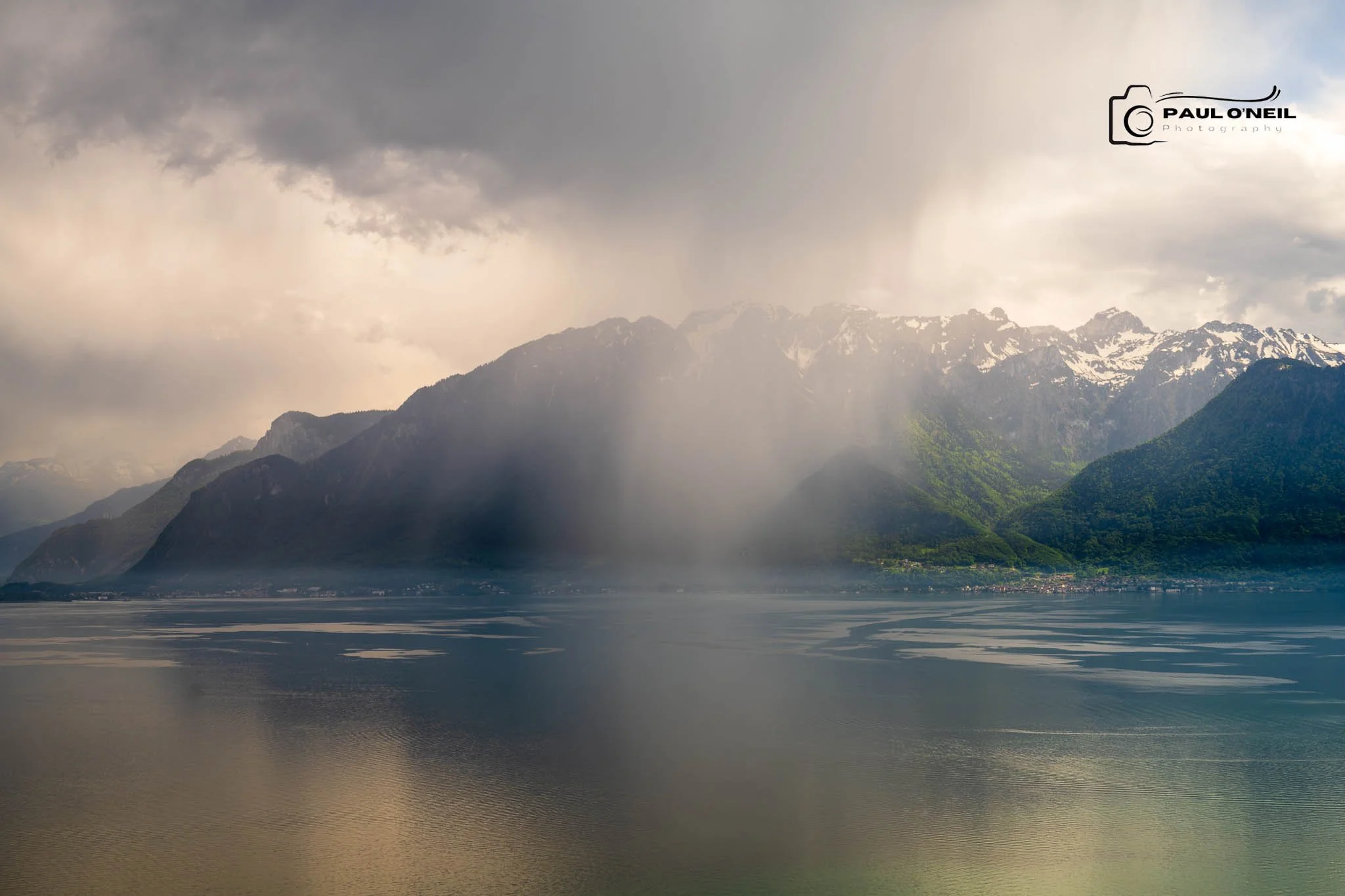
The haze of a short shower approaching across the lake.
Extra Difficulty Mode
For the whole outing:
avoid standing still more than two minutes in one spot
shoot fewer than 80 total frames
no checking images for the first 30 minutes
I managed to respect this, although I might have looked at a couple of images in those first 30 minutes. But otherwise I kept moving and shot well under the 80 total frames. As suggested by ChatGPT, it did indeed force stronger instinctive compositions.
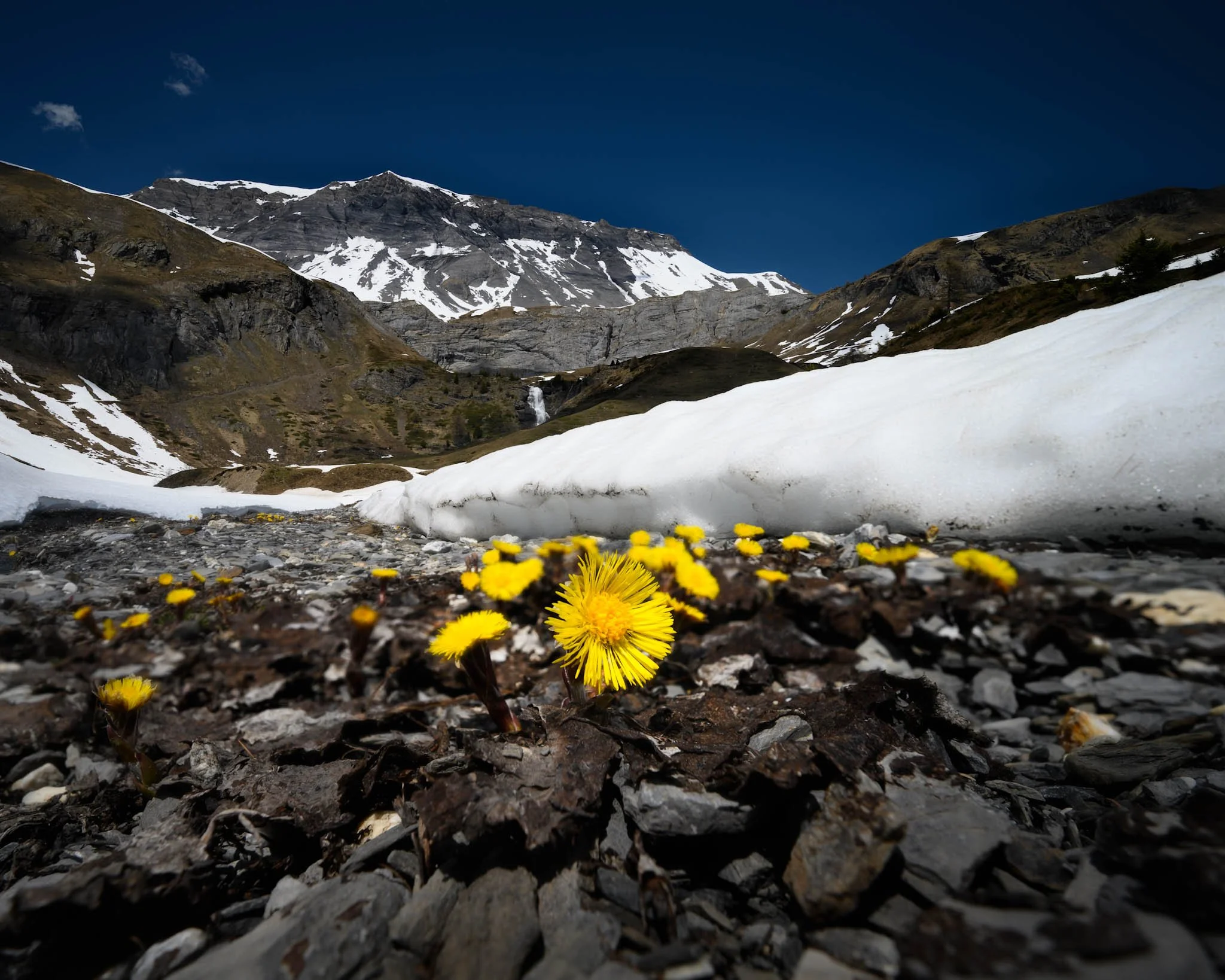
Spring in the mountains - combining macro and landscape photography with a single lens.
I always seem to find myself in the mountains at that awkward time when spring has sprung down in the valleys but there is still a fair amount of snow around 2000 metres altitude. My recent hike up from Aminona, the small village near Crans-Montana that inexplicably allowed three skyscrapers to be built on the mountainside (and is now compounding the error by building a huge luxury resort next door), was no exception. While the resort may be bustling in winter, in early spring you have it largely to yourself. Having parked in the free car park that looks like something you would see in an urbex photographer’s gallery, I set off towards the Cascade de la Tièche equipped with my Nikon Z7II, tripod and 14-30mm F4 wide angle lens. As always the first few kilometres uphill were tough, and they got even tougher as I encountered the first of the remaining snow drifts. Just after the first waterfall at around 1970 metres the going got much tougher, with nothing but snow and the river visible and no discernible paths. I tried to follow the route of the path as indicated on the map but ended up veering off up the Montagne du Sex (!) just to make sure that I would get a view of the waterfall when I rounded the summit.
Luckily, as I got back down there were patches of grass and even a small welcoming committee of marmottes, who still seemed a bit dozy after their winter sleep and were happy to stand immobile as long as I did the same. As I only had my wide angle lens with me it seemed pointless risking scaring them off by getting my camera out of my rucksack, so I took some shots on the phone and got a great result.
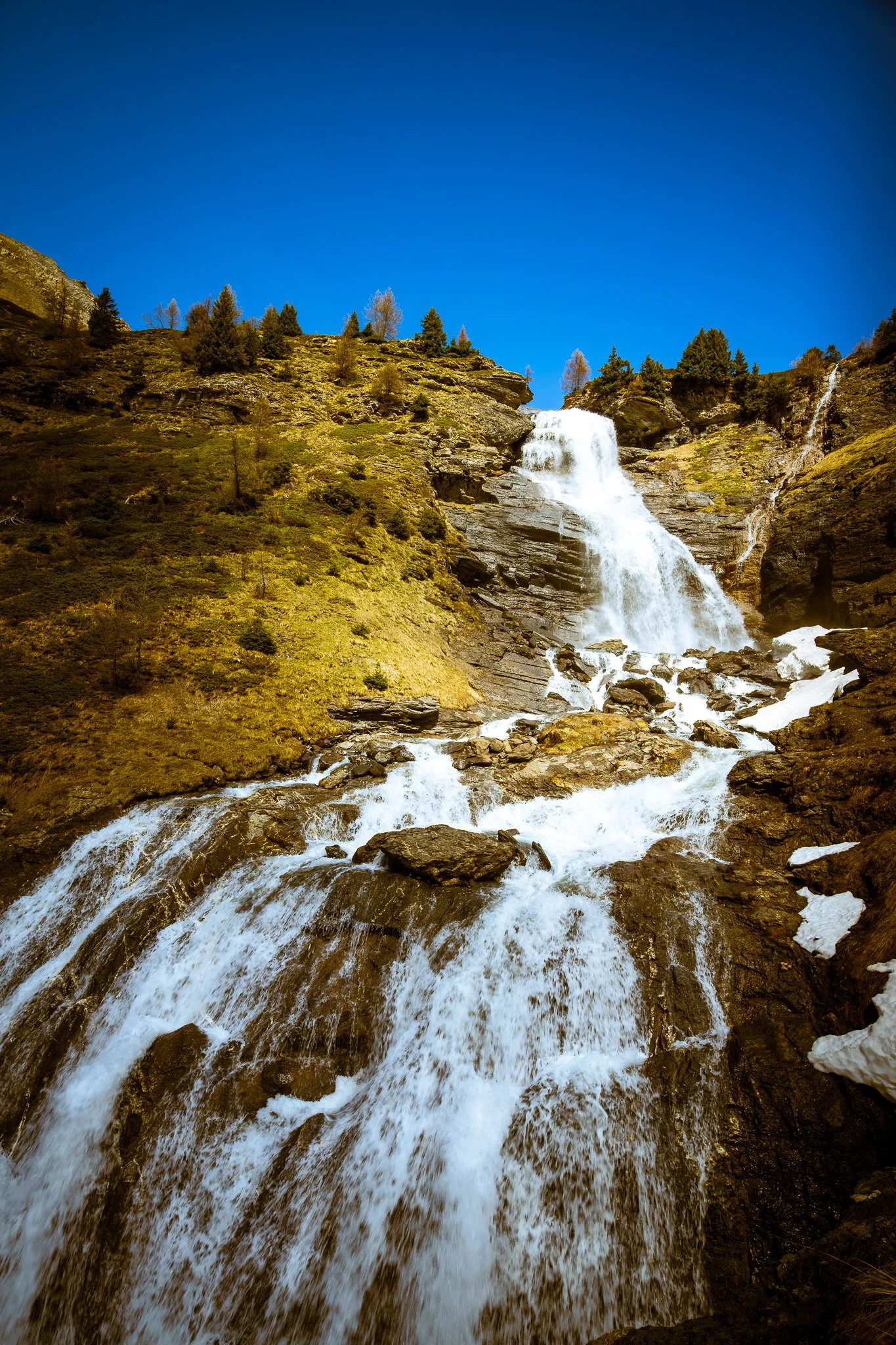
Cascade de la Tièche
I was also lucky that there were some nice shafts of sunlight reflecting off the waterfall by the time I did get the camera set up at around noon. I tried a few compositions and chose a vertical one as my favourite in the edit.
Annoyingly I had left my filters back home and only had the polarising filter screwed on, so I couldn’t get the water silky smooth. But I’m quite pleased with the final result because you get some impression of the power. The viewpoint is also good because you are looking right over the waterfall.
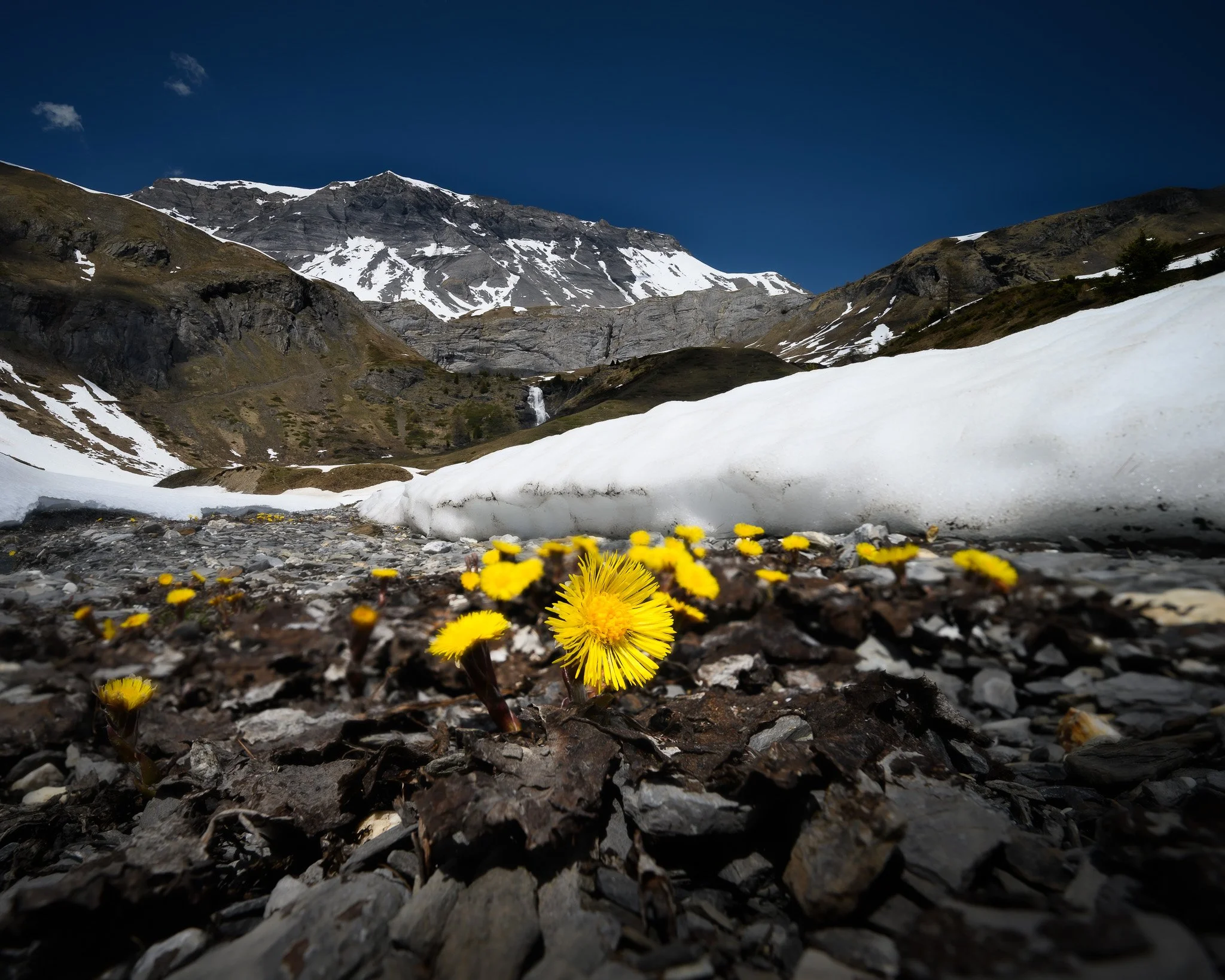
Almost as an afterthought on the way back down, realising that it was much easier to skirt the edge of the river, I stopped to try something a bit different. I found a shallow part of the river and managed to set up on a small bank in the middle of the gushing rapids to try to frame some flowers against the imposing mountain backdrop. The lowest tripod setting was still way to high so I ended up dangling my feet off the river bank and laying the camera as flat as I could on the ground (I hate focussing and framing using the screen so I will go to great lengths to be able to look through the viewfinder - and yes, I know that is also a screen).
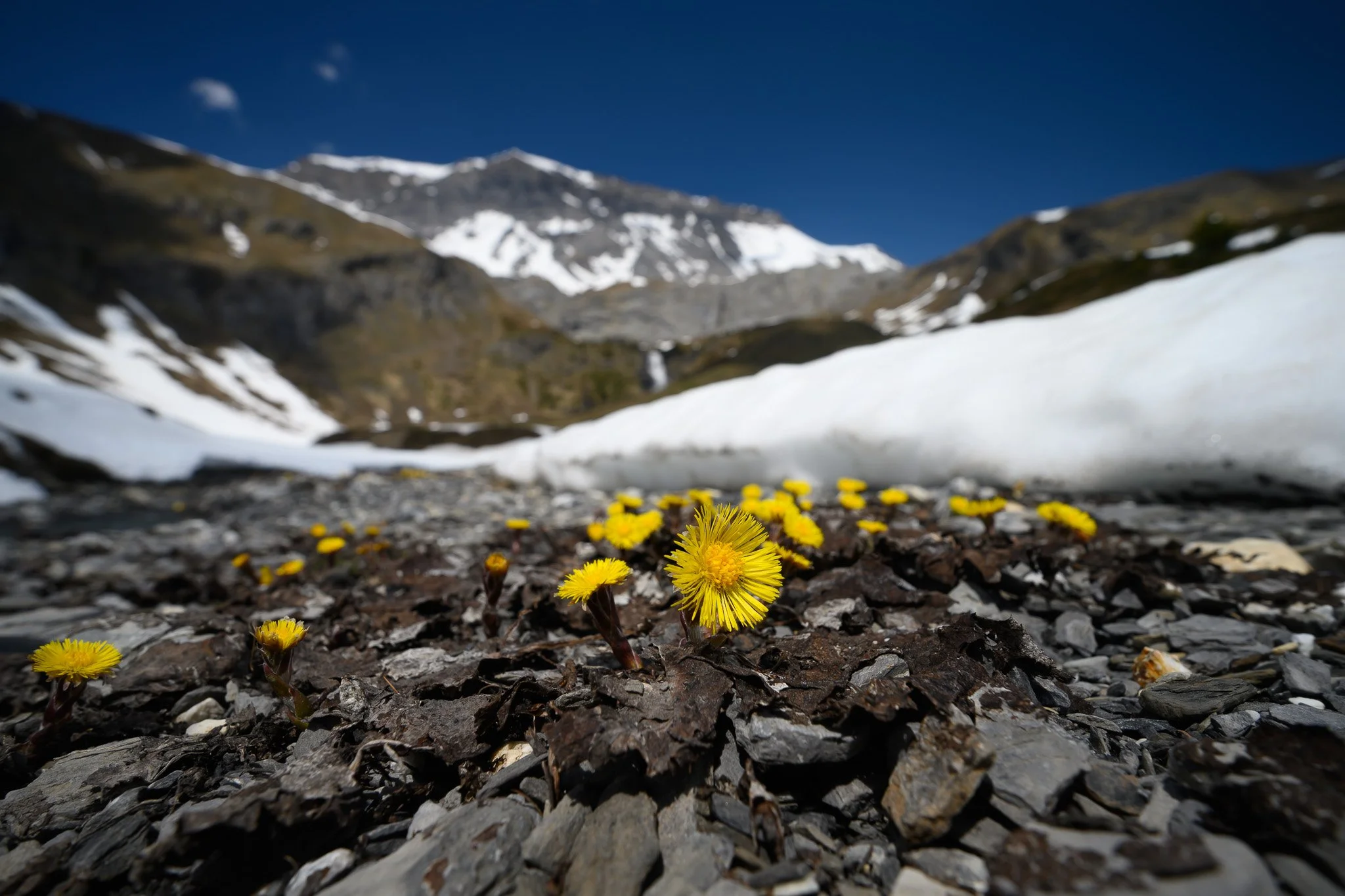
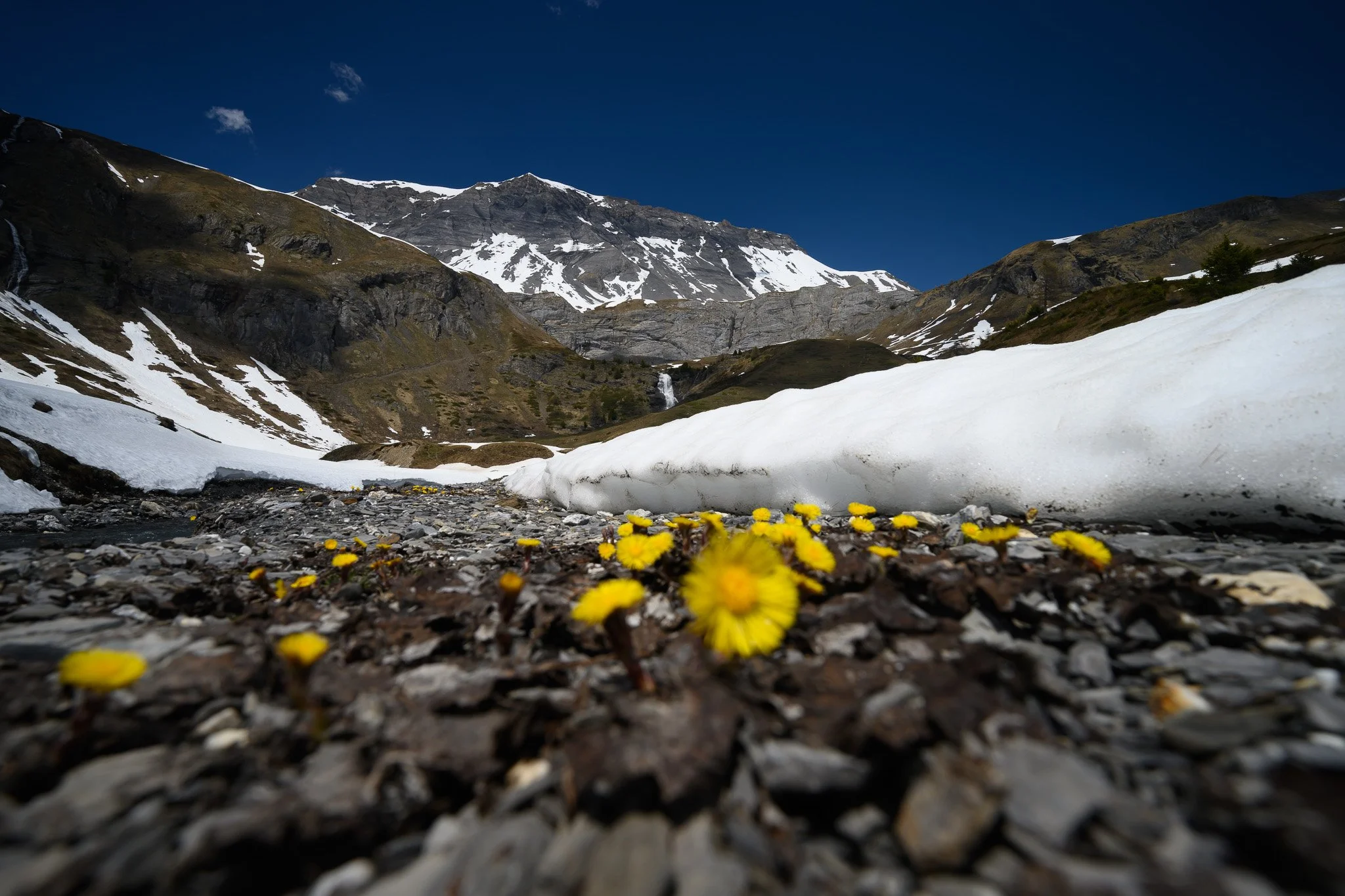
Because I only had the wide-angle lens with me I didn’t have any great hopes of success. But how I was wrong. I was really surprised at the lens’s close focusing capability and, once I had made sure that my shadow wasn’t entering the frame, shot a few frames. Not bad. I chose a solitary flower as my main subject and then shot two frames, one for the foreground and one for the background, to make sure I had everything in focus.
When I got home the auto blending feature in Photoshop wasn’t much use so I just used a layer mask to bring the flower and the area around it into focus and here is the result - an unexpected bonus from what was intended as a waterfall shoot (although you can still just make out the waterfall in the distance). I have included the foreground and background frames for comparison.
Soviet Tbilisi: A different city hiding in plain sight
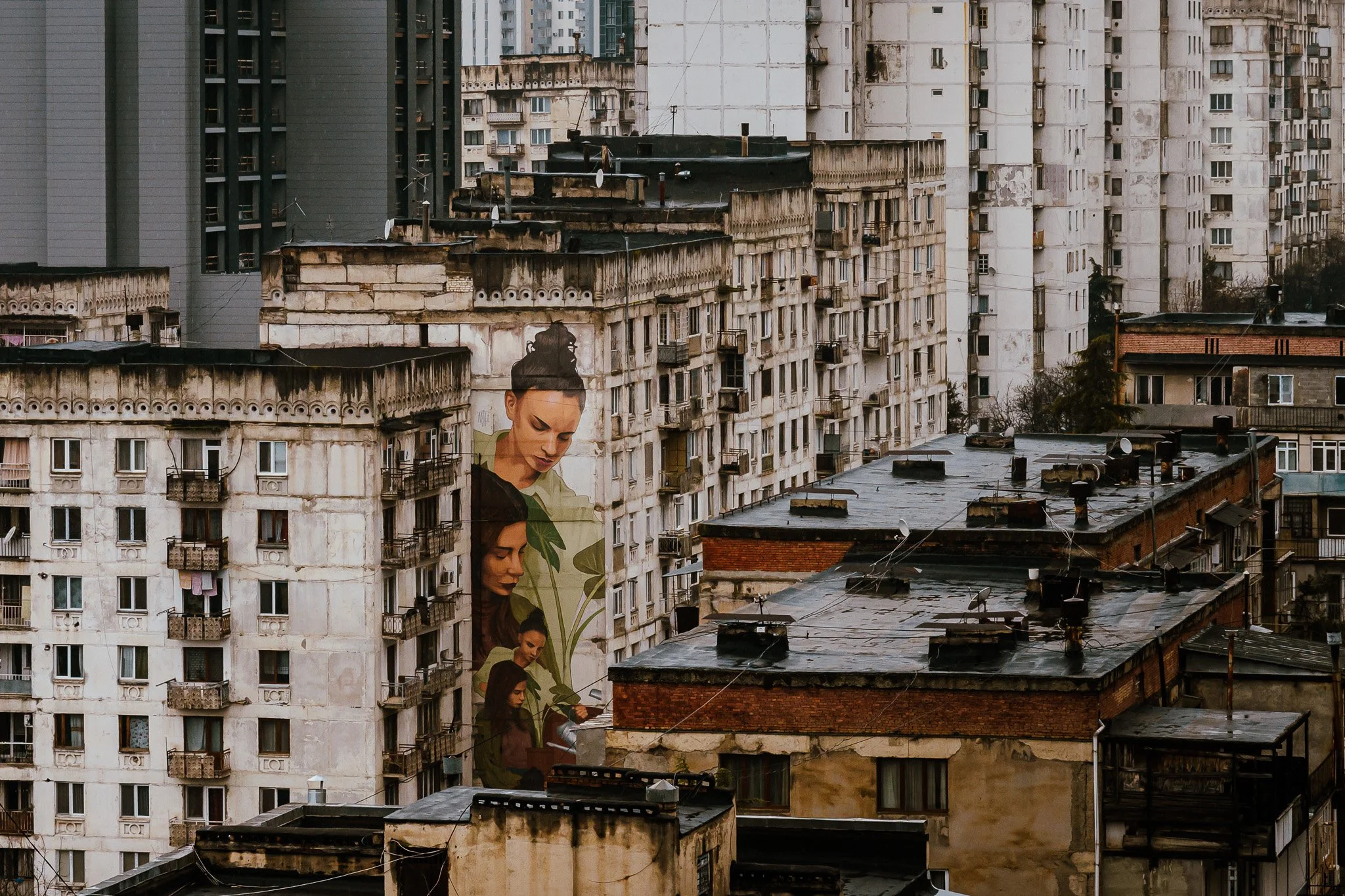
Most visitors to Tbilisi come for the old town. The cobblestone lanes, the carved wooden balconies, the domed sulphur baths — these are the images that fill the travel feeds and the guidebooks. They are not wrong, exactly. That part of Tbilisi is genuinely beautiful. But it is also restored, polished and increasingly built around the expectations of the people photographing it. If you want to understand what Tbilisi actually is — the full, contradictory, occasionally brutal sweep of it — you need to go looking for the other city. The one made of concrete.
My Soviet architecture day was the highlight of the trip, and I say that as someone who arrived with high expectations. What I did not anticipate was quite how alone I would be at most of the locations, nor quite how much the guide's knowledge would add to what I was seeing.
The tour
I joined the Urbex and Soviet Tour, bookable via GetYourGuide or directly through friendly.ge. It meets at the fountain outside Avlabari metro station, which is straightforward to find. As I was the only person who booked the tour on the day in question, the guide kindly offered to pick me up at the hotel. The tour is by private car with an English-speaking local guide — mine was excellent: deeply knowledgeable about the Soviet period, genuinely enthusiastic, and attuned to the fact that the photographers in the group needed time to compose, not just a moment to point and shoot.
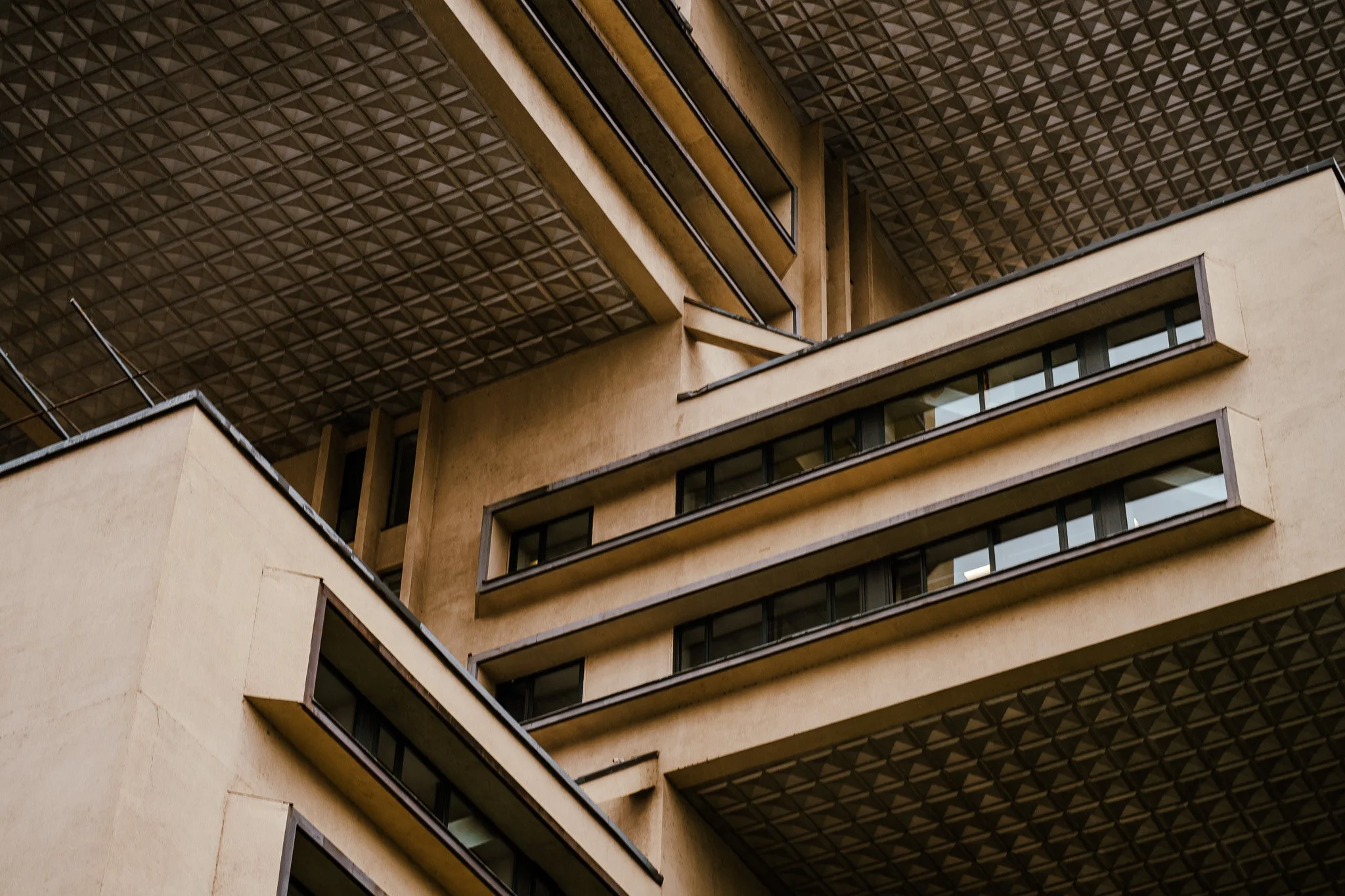
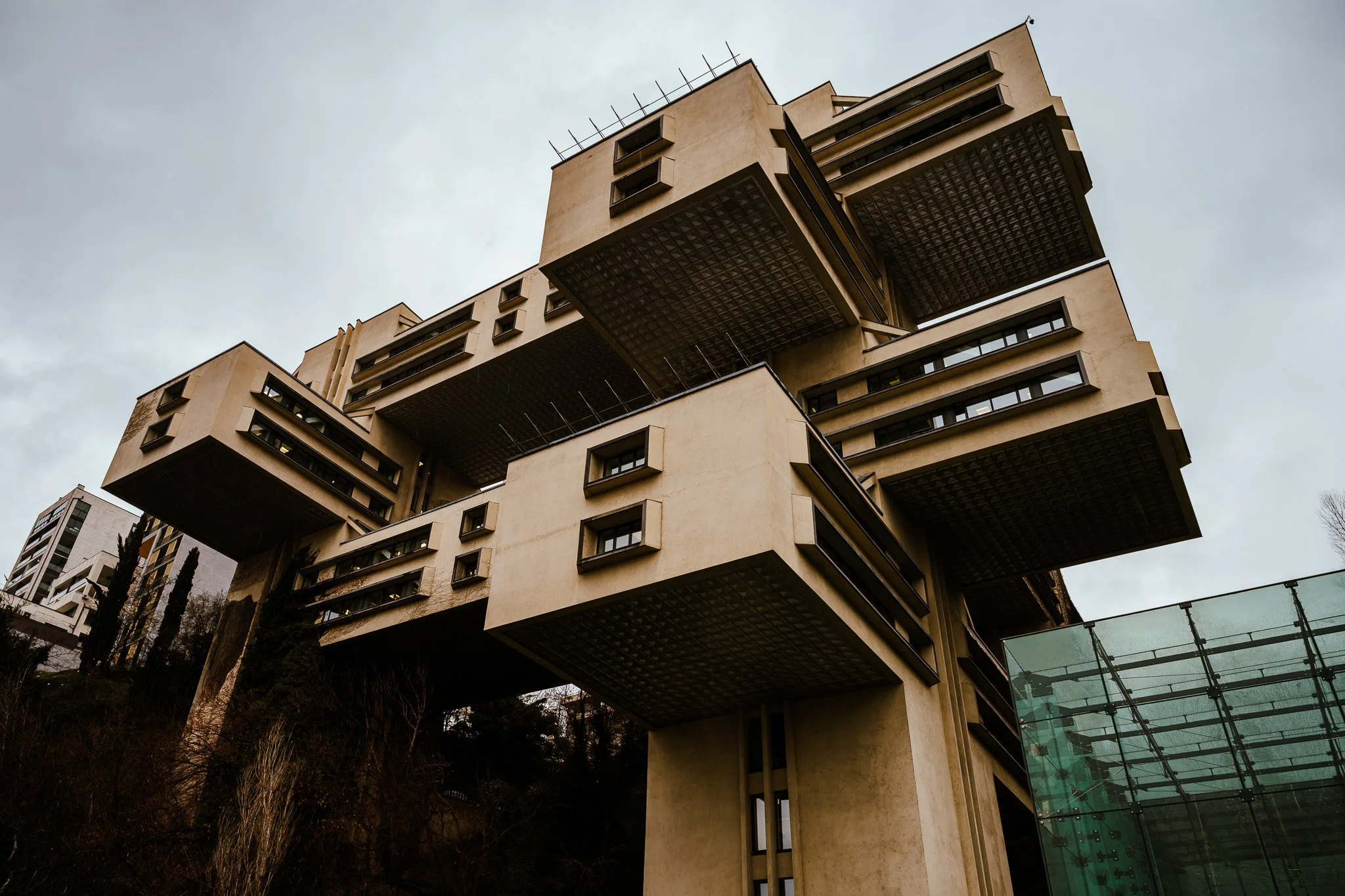
The itinerary covers a range of sites spread across the city, most of which you would struggle to find independently without local knowledge. These include the underground Bolshevik printing press — where the scale of the hidden operation only becomes apparent once you are standing inside it — the exterior of the former Ministry of Roads, a towering piece of Brutalist architecture that still looks like a building from a science-fiction film, the Skybridge towers (more on these below), and the Chronicles of Georgia monument at the edge of the city.
Allow a full half day. Budget roughly $50–80 per person.
What surprised me
The honesty of it. This is not a sanitised heritage tour. The guide does not present Soviet Tbilisi as quaint or merely photogenic — there is a real history here, involving real people, and it is told with nuance.
The other surprise was the solitude. At virtually every stop — the ministry building, the Skybridge, the peripheral monuments — we were the only people there. Not the only tourists. The only people. This is a city of 1.2 million and these extraordinary structures stand largely unvisited. For a photographer, that kind of access — unhurried, uncontested, with space to move around a subject and wait for the light — is rare.
The Chronicles of Georgia
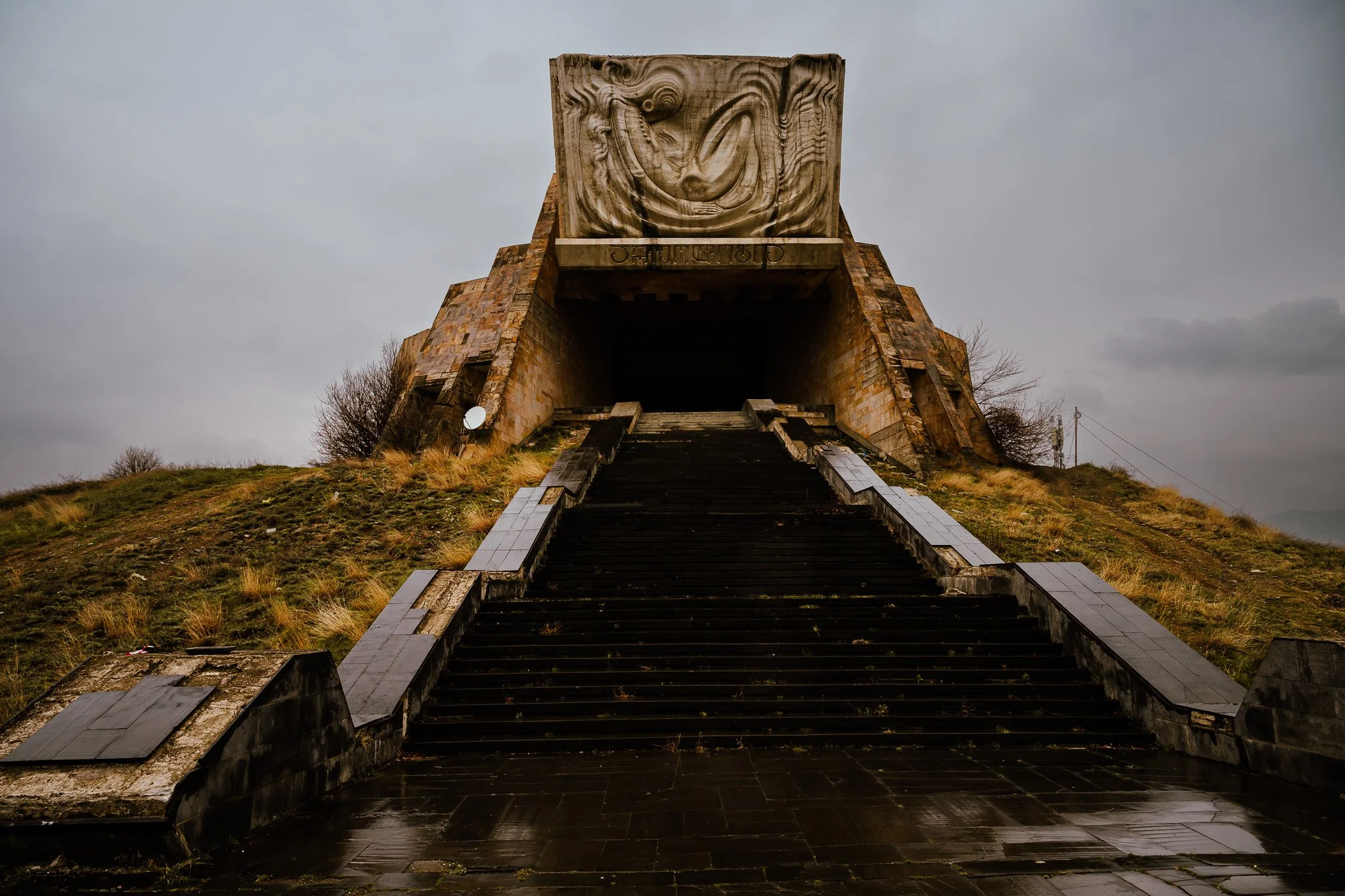
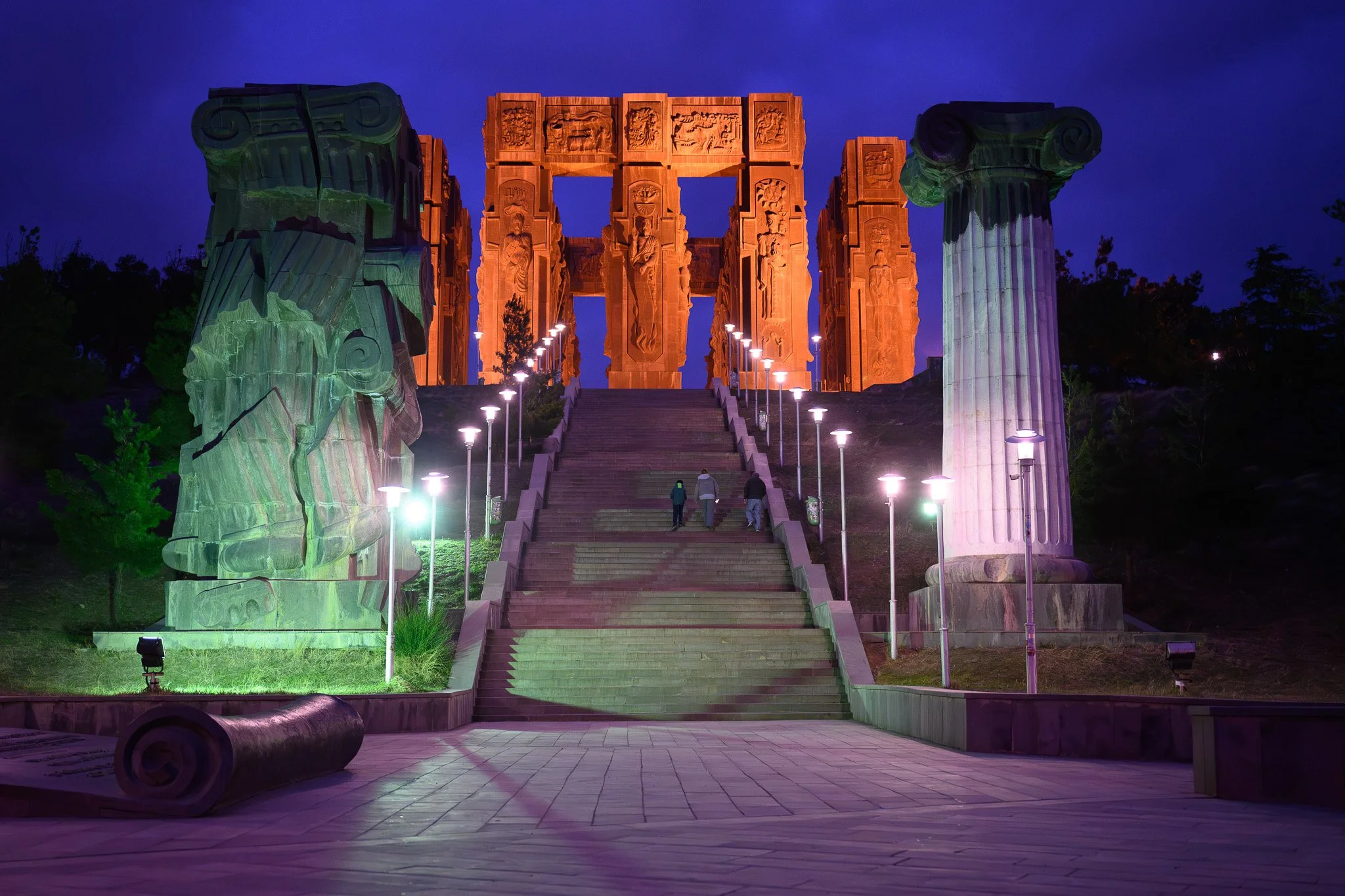
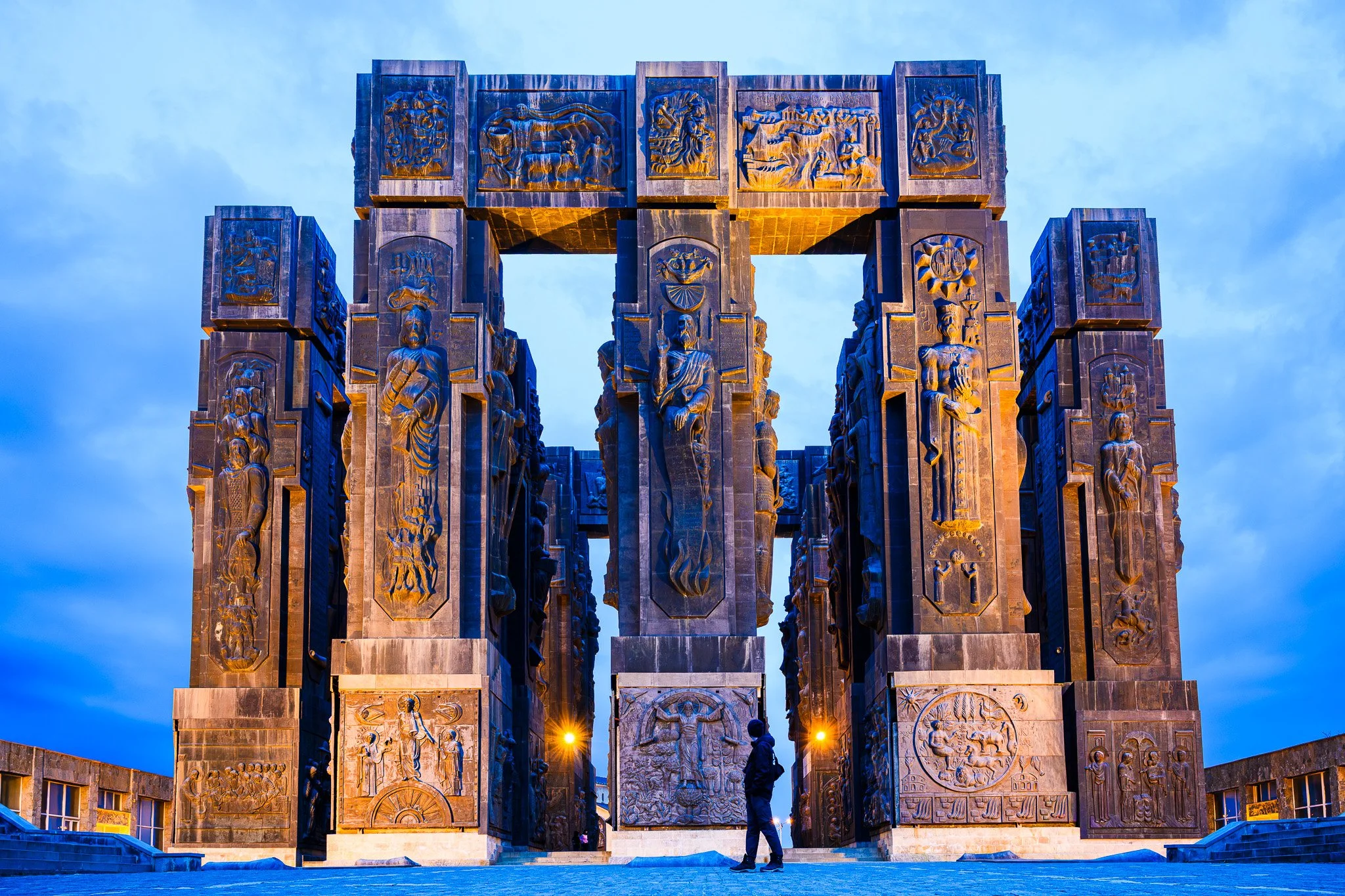
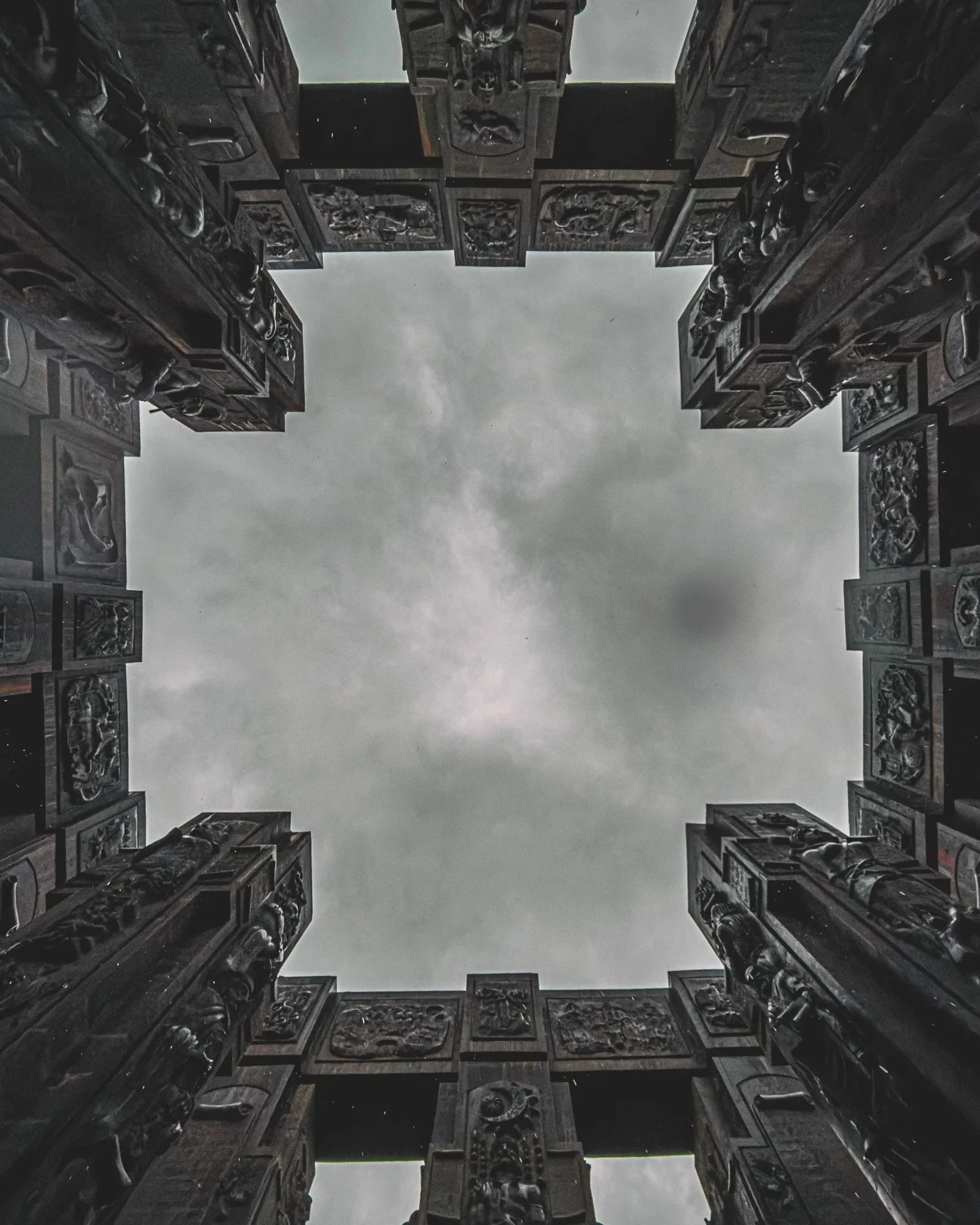
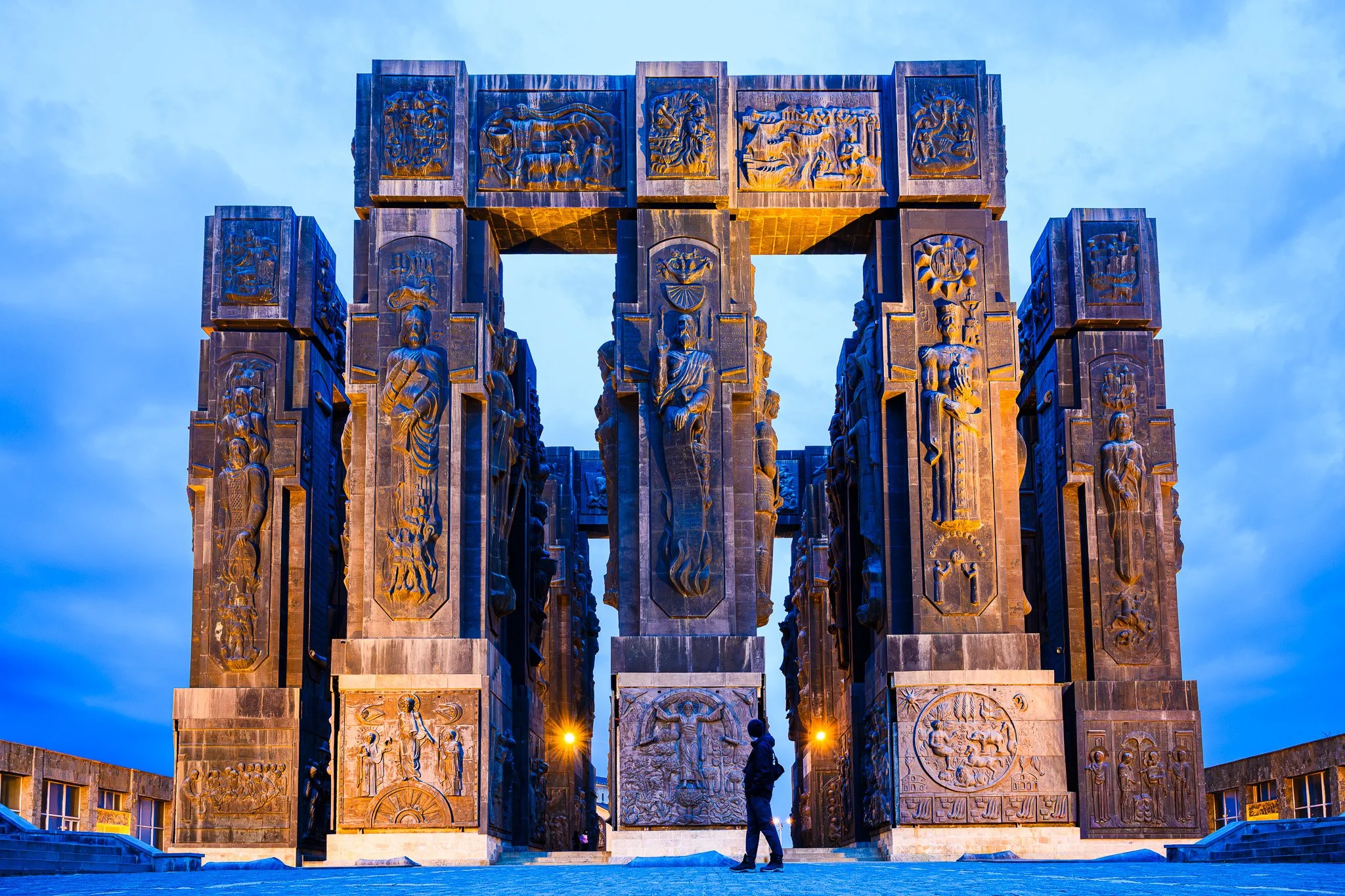
The one exception to that solitude was the Chronicles of Georgia and it is worth addressing directly because it changes the nature of the shoot. This is a monumental complex of 16 columns, each 35 metres high, carved with scenes from Georgian history and Orthodox Christianity. It is extraordinary. It is also, by some distance, the most visited site on the tour.
At the Chronicles, you will share the space with other visitors — a mix of Georgian families, tour groups, and other international travellers. The monument is open 24 hours and sits above the Tbilisi Sea reservoir with sweeping panoramic views. None of this diminishes its power as a photographic subject, but it does require a different approach. The standard reaction shots of people standing before the columns can be very good. So can tight abstract details of the carved stonework. But if you want the place to yourself, arrive at dusk when the day-trippers are thinning out, or return very early the following morning. In this case if you have a tripod, try some long exposures to remove any people in a completely natural way. I visited the Chronicles a second time independently of the tour to get the golden and blue-hour shots.
Suggested settings at the Chronicles of Georgia:
At golden hour, work around ISO 200, f/8, and expose for the stone rather than the sky — the sky will look after itself. For blue hour and night work, drop to ISO 400–800 and let your shutter run long: 4–20 seconds depending on your desired movement in the water below. A tripod is essential for the latter.
The Nutsubidze Skybridge
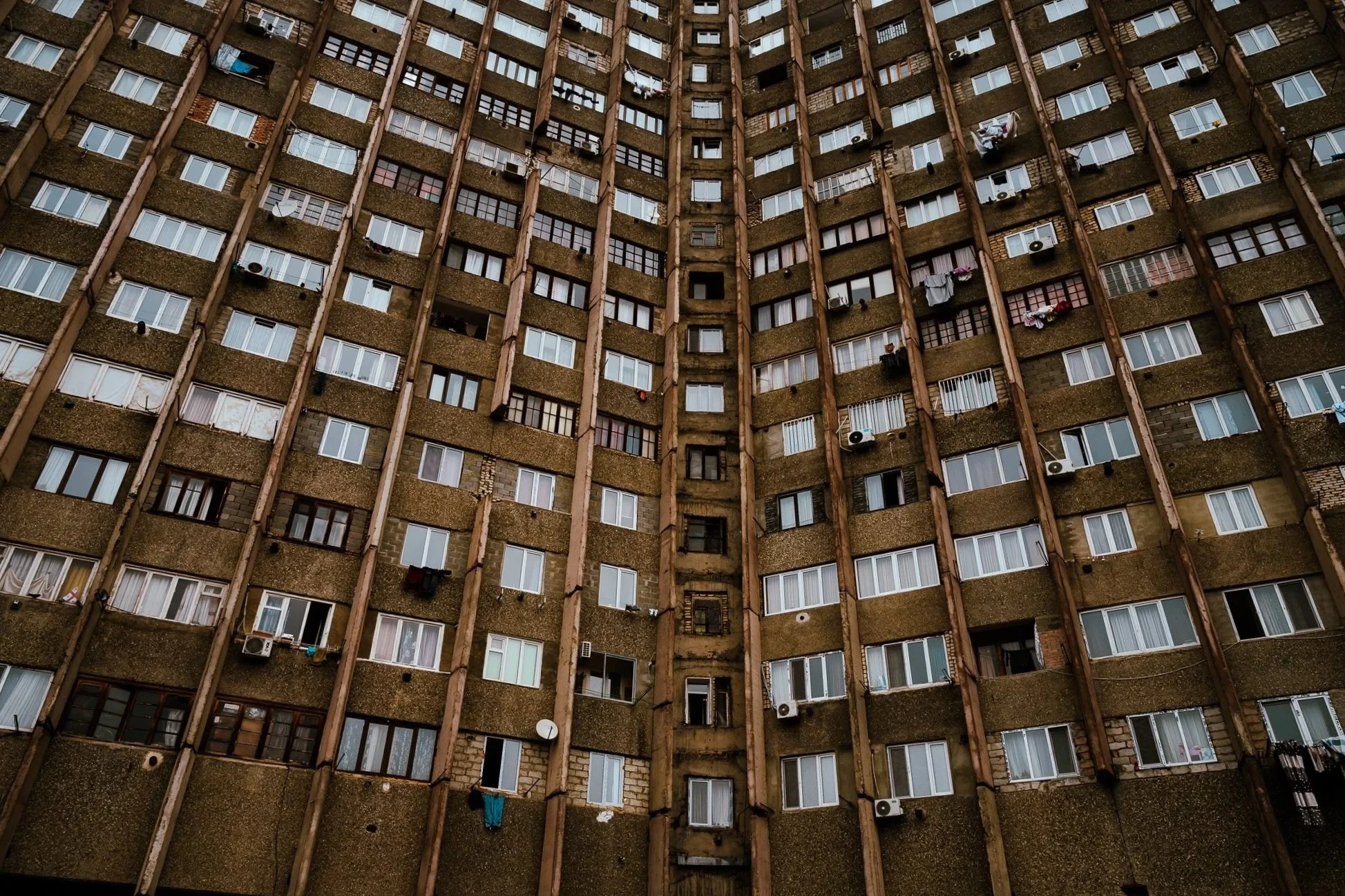
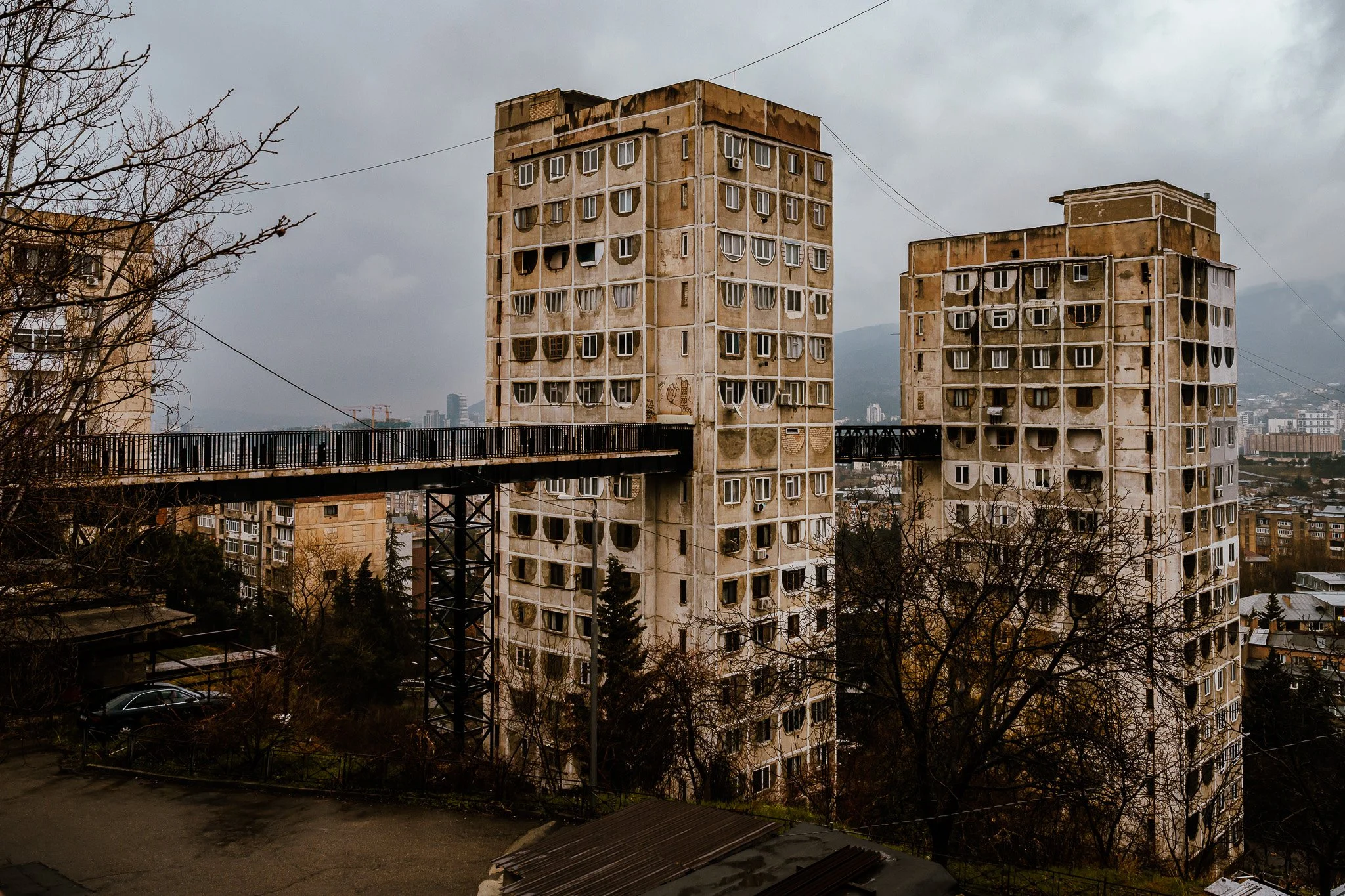
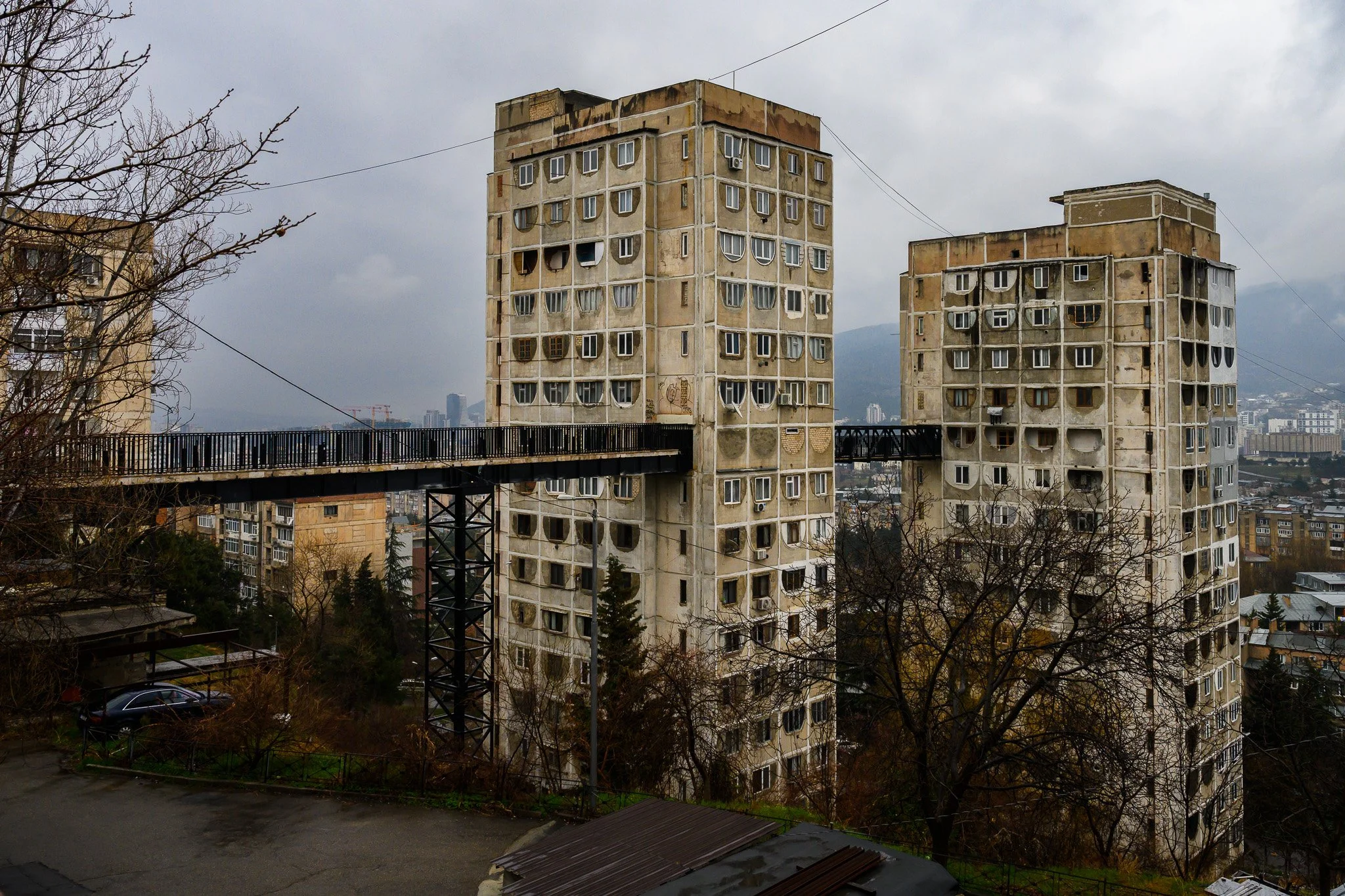
The Skybridge towers deserve their own mention, because they are unlike anything else in the city. Three identical 16-storey Soviet apartment blocks, built for employees of a research institute in the 1970s and 1980s, connected to one another by aerial walkways. From street level they are imposing; from the bridge walkway itself, the scale of the surrounding city opens up in a way that catches you off guard.
The guide may well include the Skybridge as part of the main tour. If so, go back independently in the evening. The towers at golden hour, with long shadows thrown through the connecting walkways and the mountain backdrop catching the last light, are worth the return trip. After dark, long exposures from street level — with the lit windows of the towers reflected in whatever wet ground you can find — produce something genuinely atmospheric.
A small, practical detail: there is a lift operator who lives in a tiny room next to the public lift. There used to be several operators working in shifts but now the lady does this all on her own and has essentially made her office her home, complete with a washing machine in the corridor. You have to pay to use the lift and the hint that other intrepid tourists have come before you comes in the form of English notices and the modern touch of a WhatsApp number if you need to contact the operator. I was lucky because the lift had only recently reopened after some maintenance, which required sending technicians from Turkey.
Why it matters
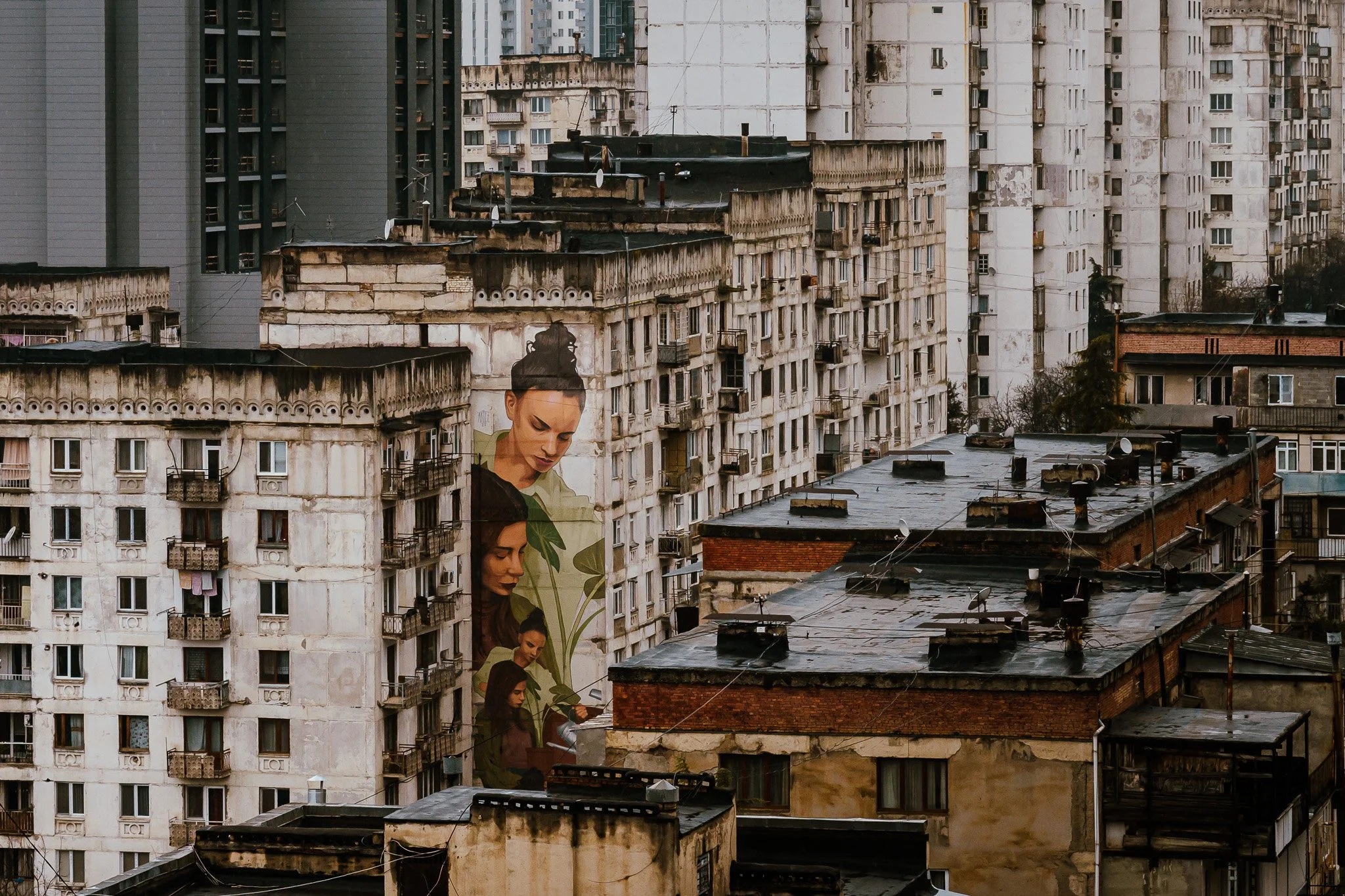
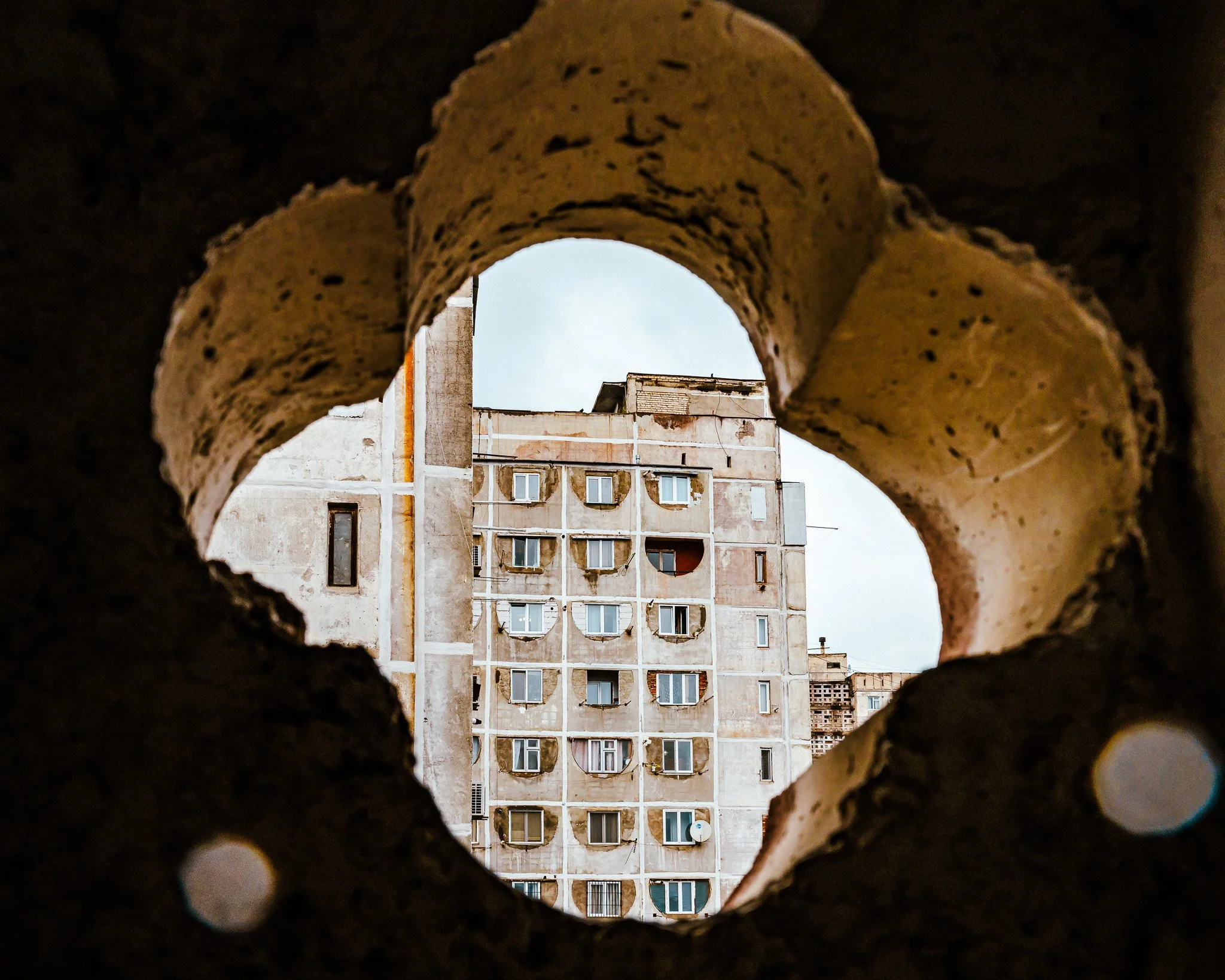
There is a tendency in travel photography to seek out the exotic or the beautiful, and to treat the ugly or the difficult as a backdrop rather than a subject. Soviet Tbilisi resists that tendency. The buildings are not picturesque in any conventional sense, yet on closer inspection at the Skybridge complex you can see inverted horseshoe shapes surrounding the balconies, which are a symbol of good luck, as well as decorative openings in the facade. The histories attached to them, however, are complicated. But that is precisely what makes photographing them worthwhile — and what makes this particular side to the city, with its crumbling concrete and its extraordinary human stories, worth your time.
You will come back with images that look nothing like anyone else's photographs of Tbilisi. That, in itself, seems reason enough.
Related articles:
— Tbilisi: A photographer's guide to Georgia's extraordinary capital
— Early mornings in Tbilisi: Markets, bus stations and honest expectations
— Golden hour and beyond: Modern Tbilisi and the classic shots
Tbilisi: A photographer's guide to Georgia's extraordinary capital
If you’re looking for a city that’s off the beaten track and which has its own places that are off the beaten track, then Tbilisi is the place for you. Soviet brutalism is still visible alongside medieval fortress walls, crumbling balconied houses sit next to a glass-and-steel towers and bridges and — if you are ready and willing to seek them out — people go about their business without a care in the world for the photographer who can blend in.
I visited Tbilisi in March 2026 — four full shooting days in a city I'd been wanting to visit ever since Easyjet started offering a direct flight from Geneva. This is my overall guide to the trip: the logistics, the structure of my shooting days and the honest assessment of what works and what doesn't. Separate articles will cover specific subjects in more detail: the Soviet and brutalist architecture tour, the early morning market shoots and the golden hour and nightscape opportunities around the city's more familiar landmarks.
Getting there
The four-hour flight from Geneva to Tbilisi is one of Easyjet’s longest but it went without a hitch. An early morning departure from Geneva gets you to Tbilisi airport in the early afternoon, leaving you time to catch the golden hour on your first day.
Getting to and around the city
There is no Uber in Tbilisi but there is Bolt, which is more or less the same apart from not being able to tip your driver. This was a big shame as I really felt for the guy who was stuck in traffic for over an hour for a journey that should normally take less than half that. As he explained to me via Google Translate, the patriarch of the country’s orthodox church had died and many of the main roads in the heart of the city were closed, causing gridlock — an inconvenience that would affect the rest of my stay.
The death of Ilya II was a big deal. He had led the church since 1977 and thus essentially steered this very religious nation through a fair amount of upheaval, through Soviet times, civil wars and on to a kind of independence (20% of Georgia’s territory is still occupied by Russia). It was not surprising, therefore, that so many people wanted to pay their respects. I did venture as far as the back of the queue of people waiting to file through the Holy Trinity Cathedral to gauge the level of “interest” and I was surprised by the sheer variety of religious costumes on display from people who had travelled in from all over the country.
The metro is genuinely useful for reaching locations in the outer residential districts that would otherwise require a significant Bolt fare. A single top-up card costs 2 GEL at any station and journeys cost 1 GEL each (so you have to pay at least 3 GEL but that single journey can last up to 90 minutes), making it one of the cheapest metro systems in Europe or Asia. Over the weekend I was there, the metro was free of charge to allow mourners to pay their respects. For early morning shoots — when you need to be somewhere at 06:30 and the light won't wait — Bolt is the better option. Even with the major traffic disruptions, drivers were quick to call or WhatsApp me to explain the traffic situation.
Where I stayed
I booked the flight and the hotel months in advance. Unfortunately, the hotel (The “one family boutique” hotel - it doesn’t have a website but you can find it on Booking.com) contacted me less than 24 hours before my arrival to inform me that it was still undergoing maintenance and that they recommended I cancel and book elsewhere. I think this was a blessing in disguise as my alternative accommodation at the Glarros Old Town put me right in the heart of the old town, with many interesting sites (photographic and tourist) accessible on foot. It cost twice my original booking, but the main thing was that they had a room available at the last minute and, at 200 Swiss francs for four nights, was totally reasonable given the high-quality room.
The light in March
This is worth addressing upfront, because it shapes everything. Mid-March in Tbilisi sits just before the equinox, which in practical terms means civil twilight begins around 06:55, sunrise at approximately 07:30–07:35, and the morning golden hour runs until about 08:30. In the evenings, golden hour begins around 18:50, with sunset at roughly 19:40 and blue hour extending to about 20:10. The city is on UTC+4, so adjust accordingly when planning from home.
What this means for a four-day trip is that your productive shooting window runs from roughly 06:45 in the morning to 20:15 in the evening — and the very best light bookends the day. Structure your days around this and you'll come home with far stronger work than if you treat it like a standard city break.
The shape of the trip
Over four days I organised my time around a simple principle: the early hours belong to the streets and markets, the middle of the day to walking, exploring and the paid tours, and the late afternoon to positioning myself for golden hour. Night shooting, where conditions and energy allowed, extended the day further.
Day one was an arrival day with an afternoon and evening shoot, taking in the Chugureti district and its mixture of urban decay and street art, then the streets around Tbilisi Central Station before heading to the Metekhi cliff for sunset.
Day two involved a stroll around the old town, another quick peek into Chugureti and then a cable car ride up the Narikala cable car for a city view, followed by a walk back down through the old town. Although I knew I would be visiting it on the paid tour, I got a Bolt out to the Chronicles of Georgia for some golden and blue hour shots.
Day three was taken up mainly by the Urbex and Soviet Tour of Tbilisi, which I booked on GetYourGuide. This is a group tour but since I was the only person who booked it on that day I got the bonus of being picked up at my hotel. My guide was in no rush and gave me a running commentary throughout the five-hour trip. He was clearly used to taking photographers around and showed me some great urbex sites and even knew some handy photography tips (for example, which flagstone marks the exact centre of the Chronicles of Georgia and the convex mirror you can shoot into to get a reflection of the entire Nutsubidze skybridge complex). I thoroughly recommend this tour. I also found an Urbex Tour offered by Camp Caucasus but they never replied to my email enquiry.
Day four started with an early-morning metro ride to the Didube bus station, where the promise of hustle and bustle as people waited to board intercity buses proved to be a disappointment. Moving quickly on to the Dezerter Bazaar. Here too, expectations surpassed reality: while the market stallholders were active and men with carts were busy ferrying goods around, there was little in the way of customers. On the way back to the hotel I stopped by the sulphur baths that gave the city its name (Tbilisi literally means “hot water”). After checking out the queue of mourners I took another cable car, this one to the Mtastsminda Park for some golden hour views across the city.
Day five was a gentle final morning along the river before the midday departure.
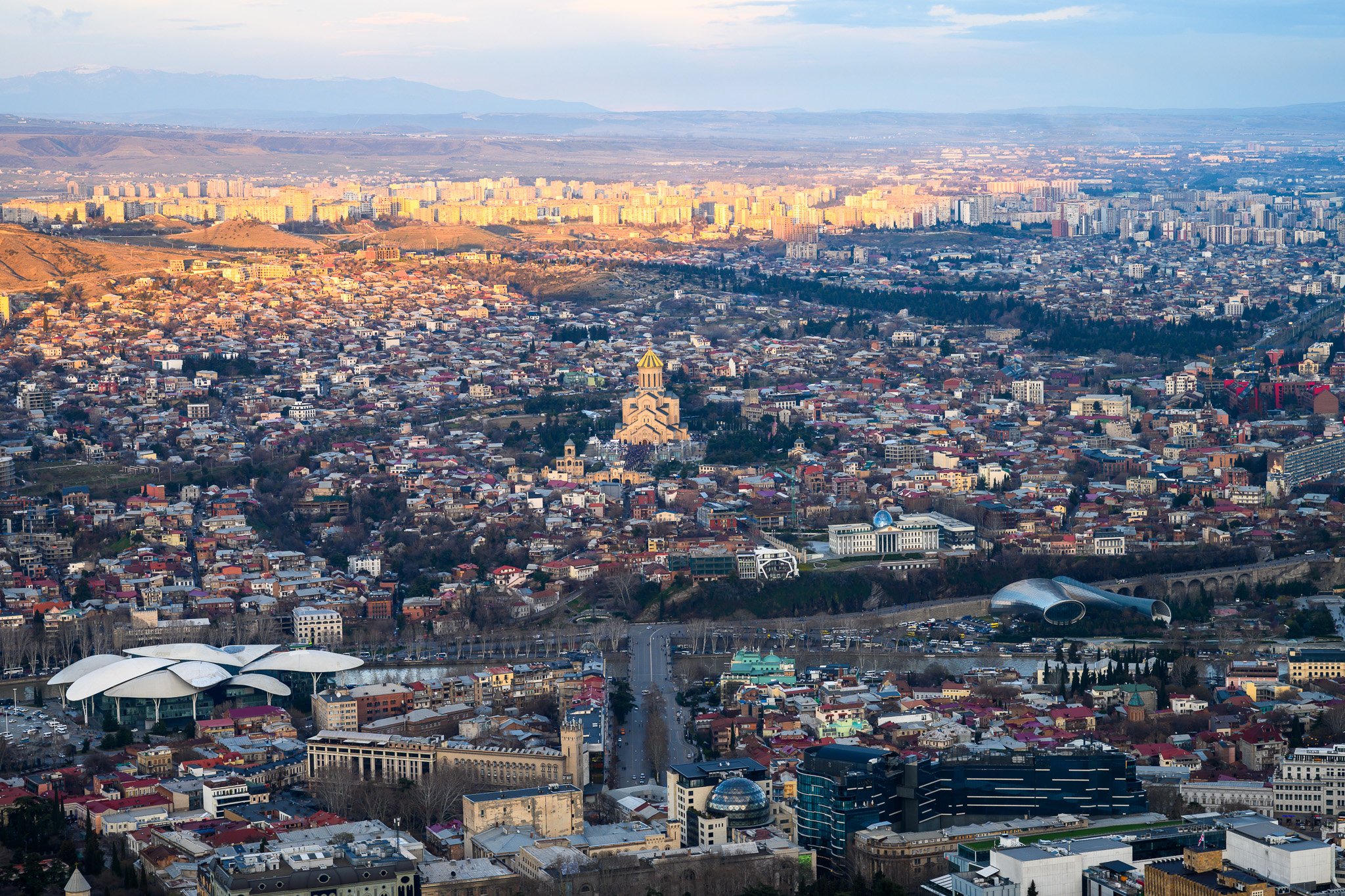
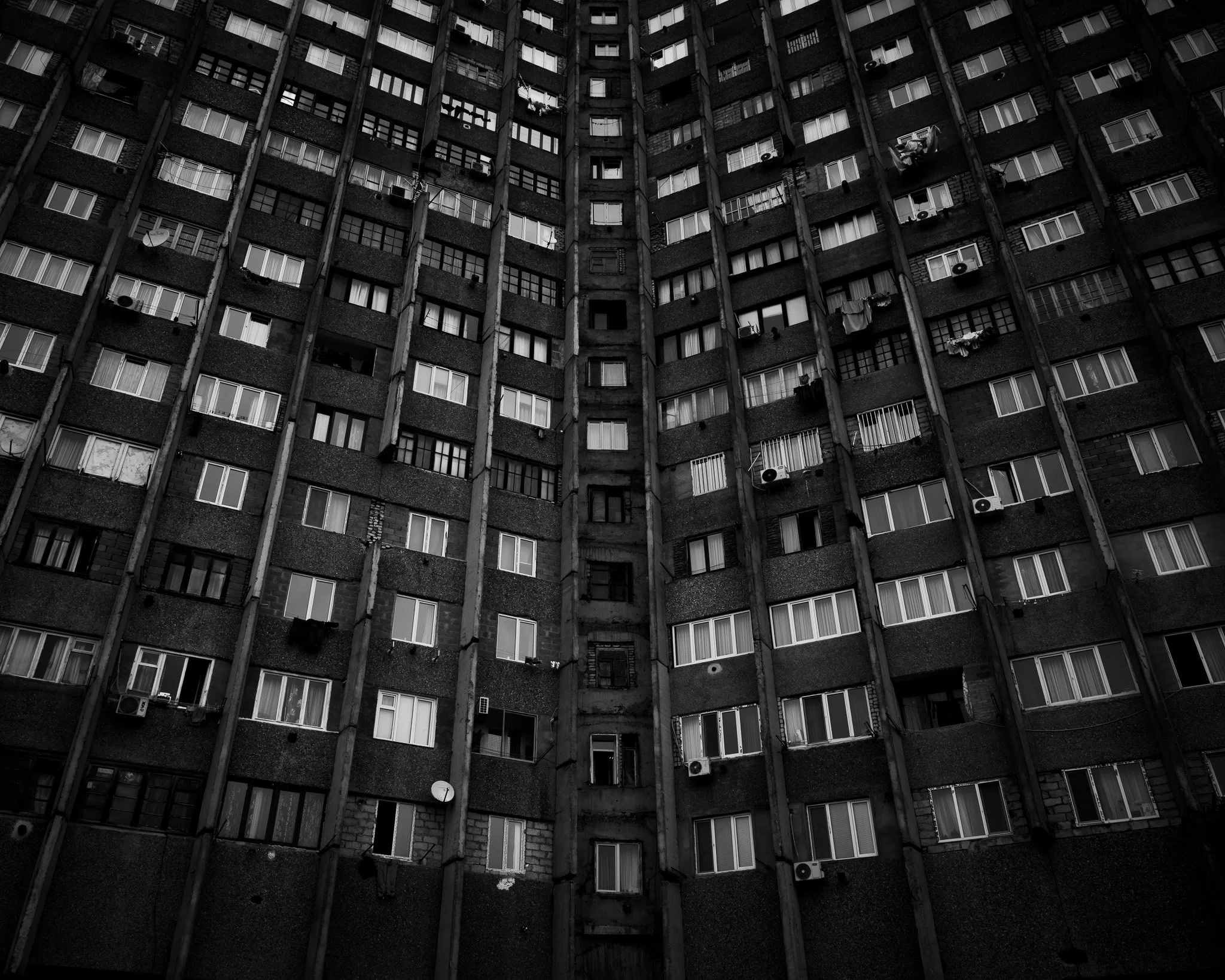
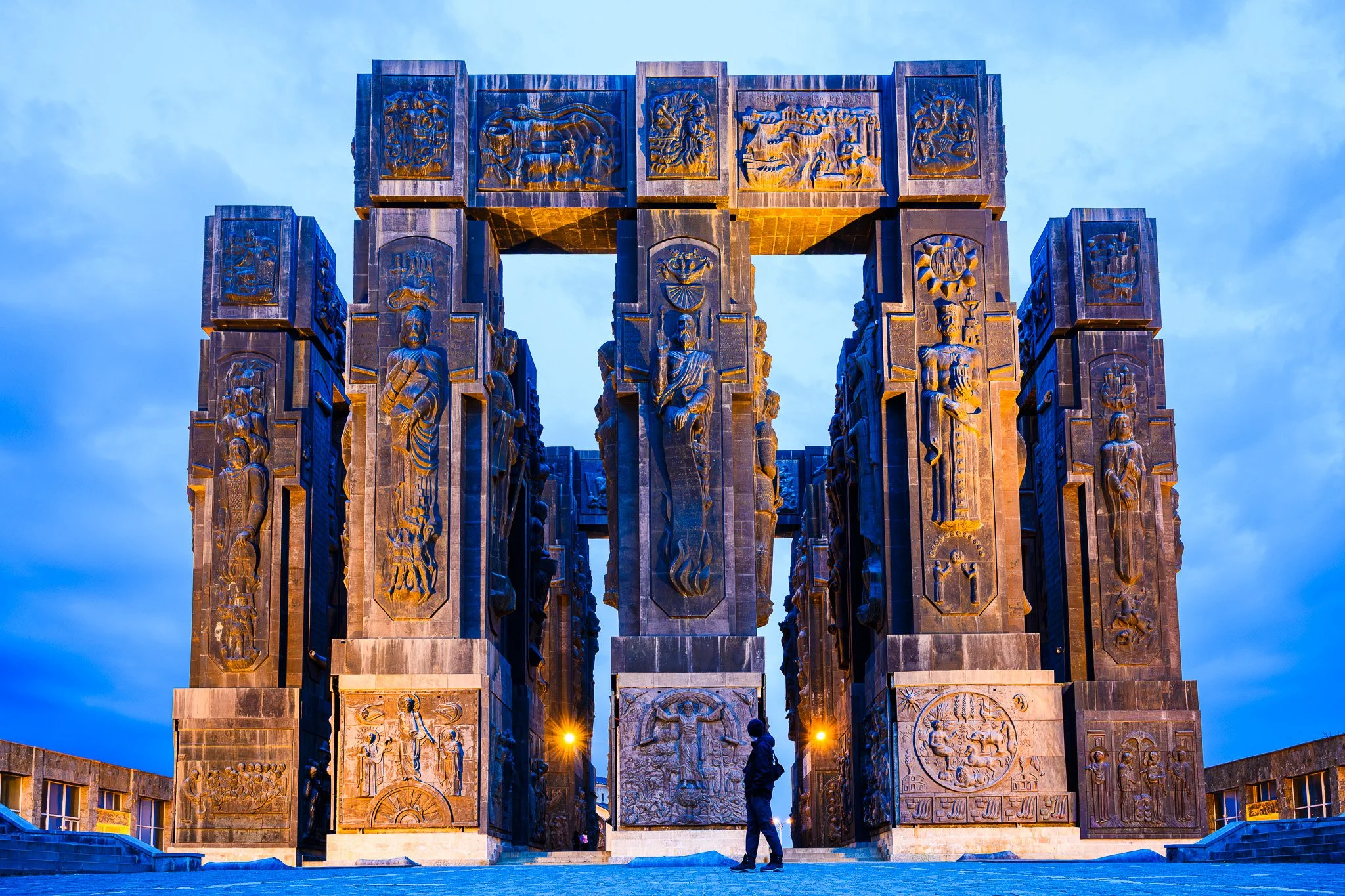
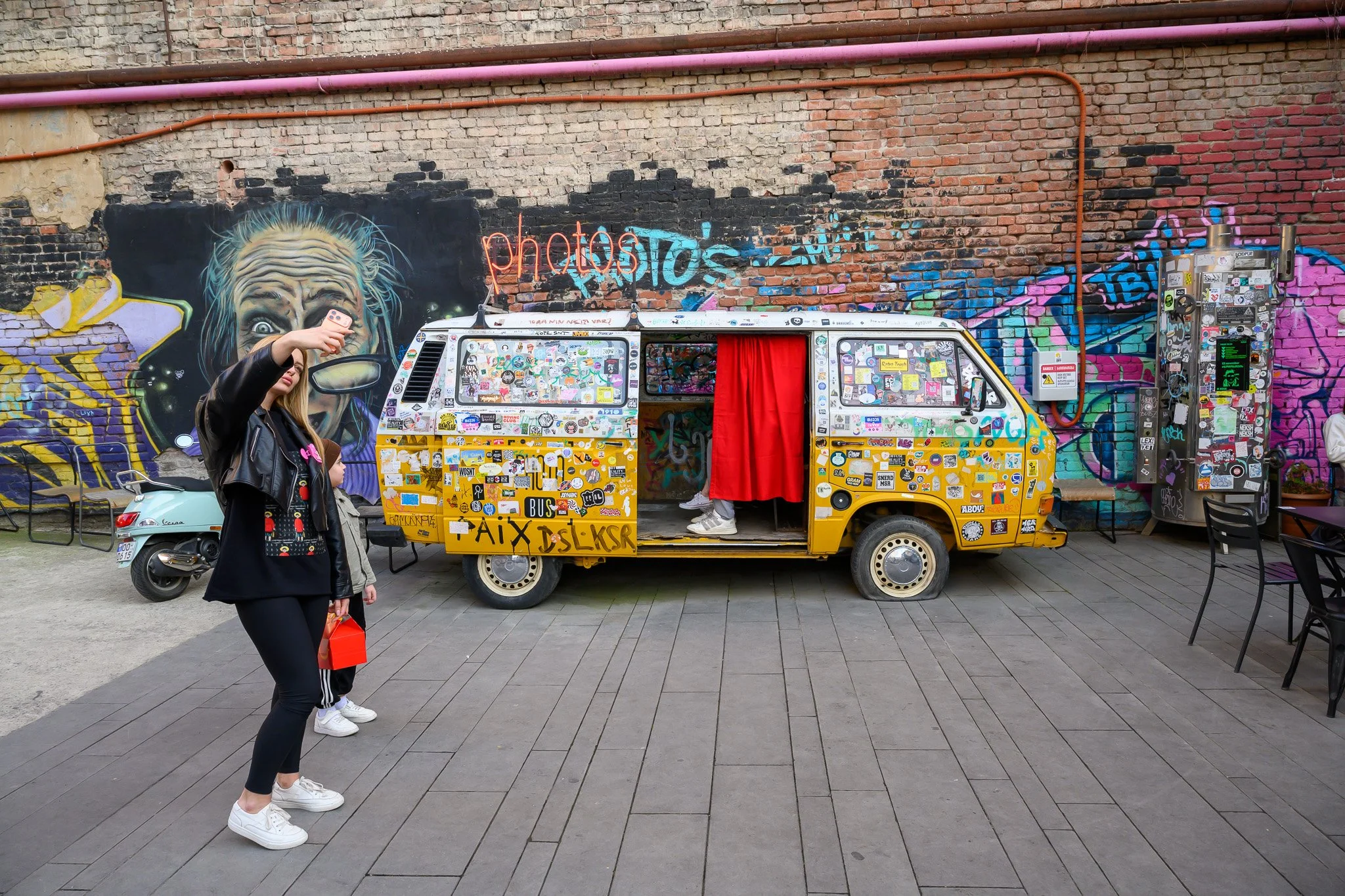
Practical notes
Camera gear: A fast prime — f/1.8 or faster — is essential for the metro stations and interior urbex work but you may miss a zoom and/or a wide angle. I only travelled with hand luggage so I took my 50mm f/1.8 for the street photography and my 24-70mm zoom. I did miss having my 14-30mm wide angle lens with me — especially at the Chronicles of Georgia and the Skybridge, where even 24mm was not enough to get everything in the frame. I took a mini tripod with me that was useful to get a sweeping view of the city during golden hour from the Mtatsminda view point.
Language: Georgian uses its own unique script and is not related to any Western European language, but English is widely spoken in central Tbilisi, particularly among younger people. A few words of Georgian go a long way in less central neighbourhoods — gmadlobt (thank you) and bodishi (excuse me/sorry) will serve you well.
Street photography etiquette: Georgians are hospitable and generally relaxed about being photographed. Asking with a gesture and a smile almost always gets a positive response. In markets and bus stations, stay alert and keep your gear close, not out of any particular danger but out of basic common sense.
Weather in March: Expect temperatures between 8–15°C, occasional rain, and bright spells. A light waterproof layer is sensible. The unpredictable cloud cover can actually work in your favour, producing dramatic skies over the brutalist architecture and softening the midday light in the backstreets. Conditions during my stay ranged from a sunny day in the high teens to drizzle and overcast skies.
Food: You have to try the Kinkhali, the typical Georgian dumplings that come with a variety of savoury and sweet fillings. Be aware that the minimum order is five pieces of each flavour and they are quite stodgy. This is more than enough if you are on your own. Khachapuri is an eye-shaped pizza-like concoction filled with cheese and served with an egg cracked into the centre. The crispy dough is as good as that on any pizza. The best meal I had by far was at Saxlis Gemo — a tiny place with no more than 12 covers where you can peek into the kitchen and the food looks and tastes genuinely home made. I had the Ojakhuri which was generously served and came out on a sizzling plate. Coupled with some local Georgian wine it was delicious.
Is Tbilisi worth it for a photography trip?
Unreservedly, yes. It is one of the most visually diverse cities I have visited: the Soviet-era residential districts and the medieval old town, the gritty bus terminals and modern bars, the mosaic-clad metro stations, the brutalist towers linked by aerial walkways and the organic forms of glass bridges and concert halls. All of it is within reach of a photographer willing to get up early, do the research and resist the pull of the obvious shot.
The separate articles below explore the specific subjects in detail. Start there, and build your own version of this trip around the light.
Related articles:— Soviet Tbilisi: Inside the city's brutalist architecture tour— Early mornings in Tbilisi: Markets, bus stations and honest expectations— Golden hour and beyond: Modern Tbilisi and the classic shots
Koutoubia Mosque: Chasing the light in Marrakech
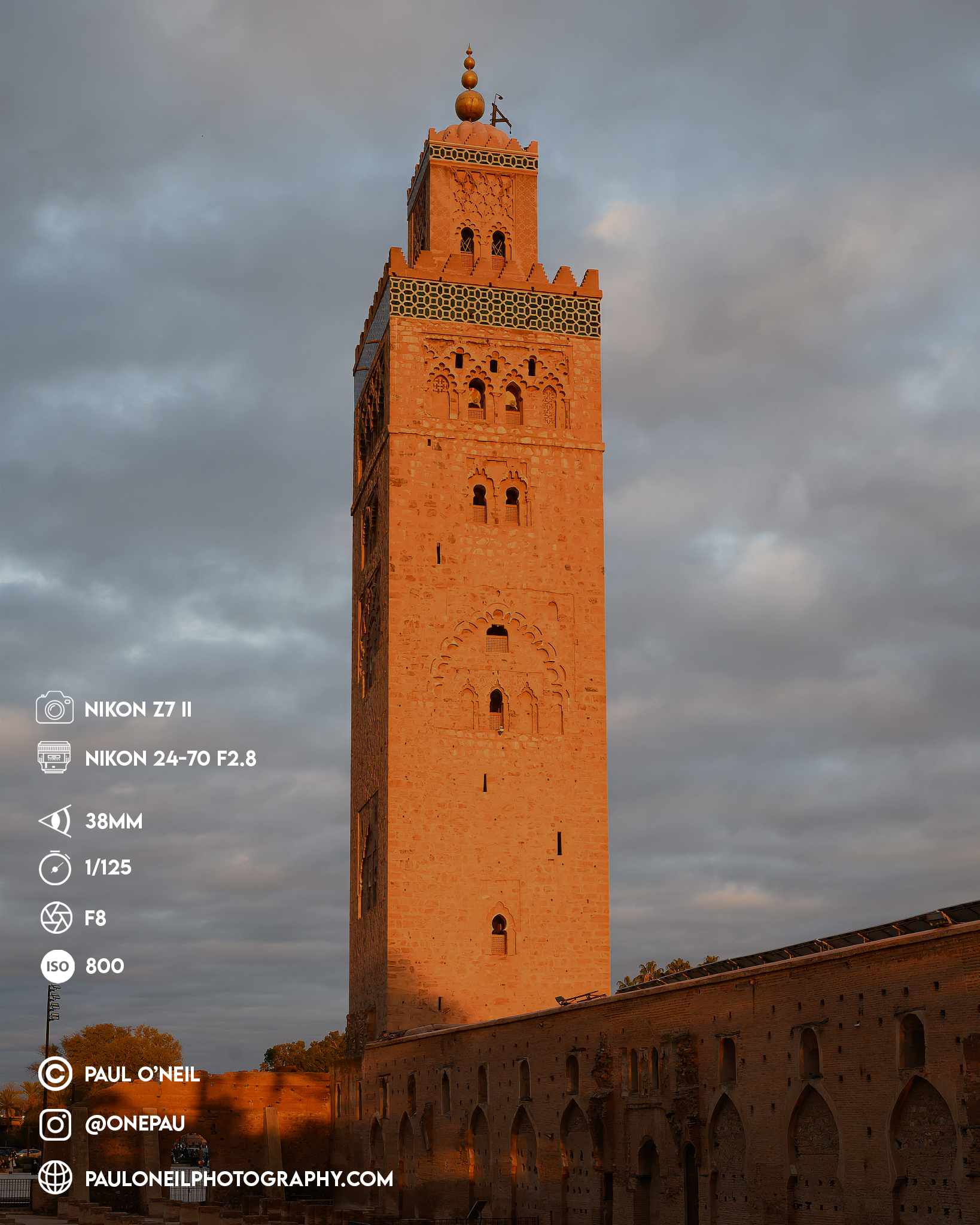
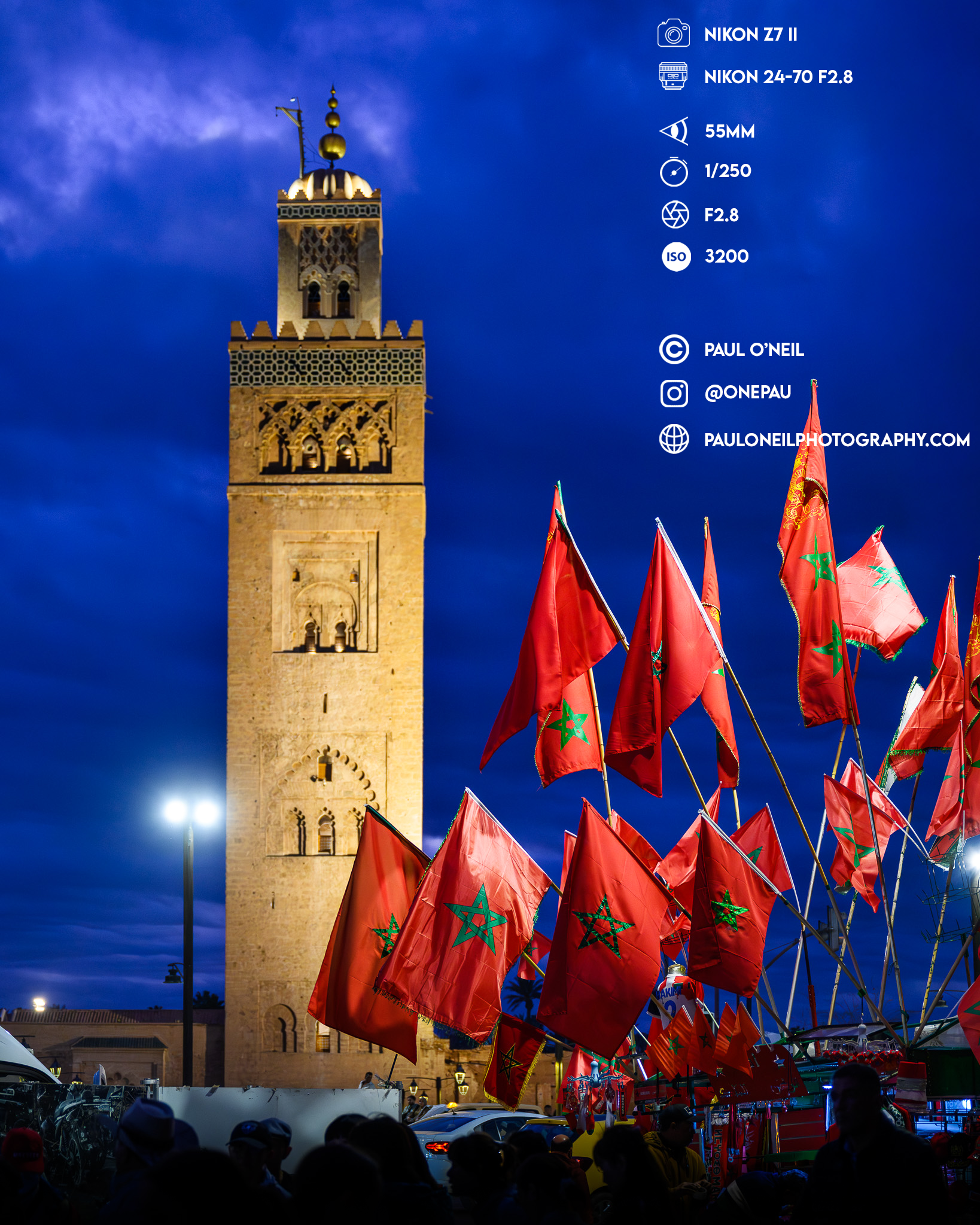
Rising 70 metres above the rooftops of Marrakech, the minaret of the Koutoubia Mosque is one of the most recognisable silhouettes in all of North Africa. Whether you're shooting at the blue hour before dawn or watching it blush in the warm amber of a desert sunset, this extraordinary structure rewards photographers who are willing to plan, wait, and return again and again.
A Brief History
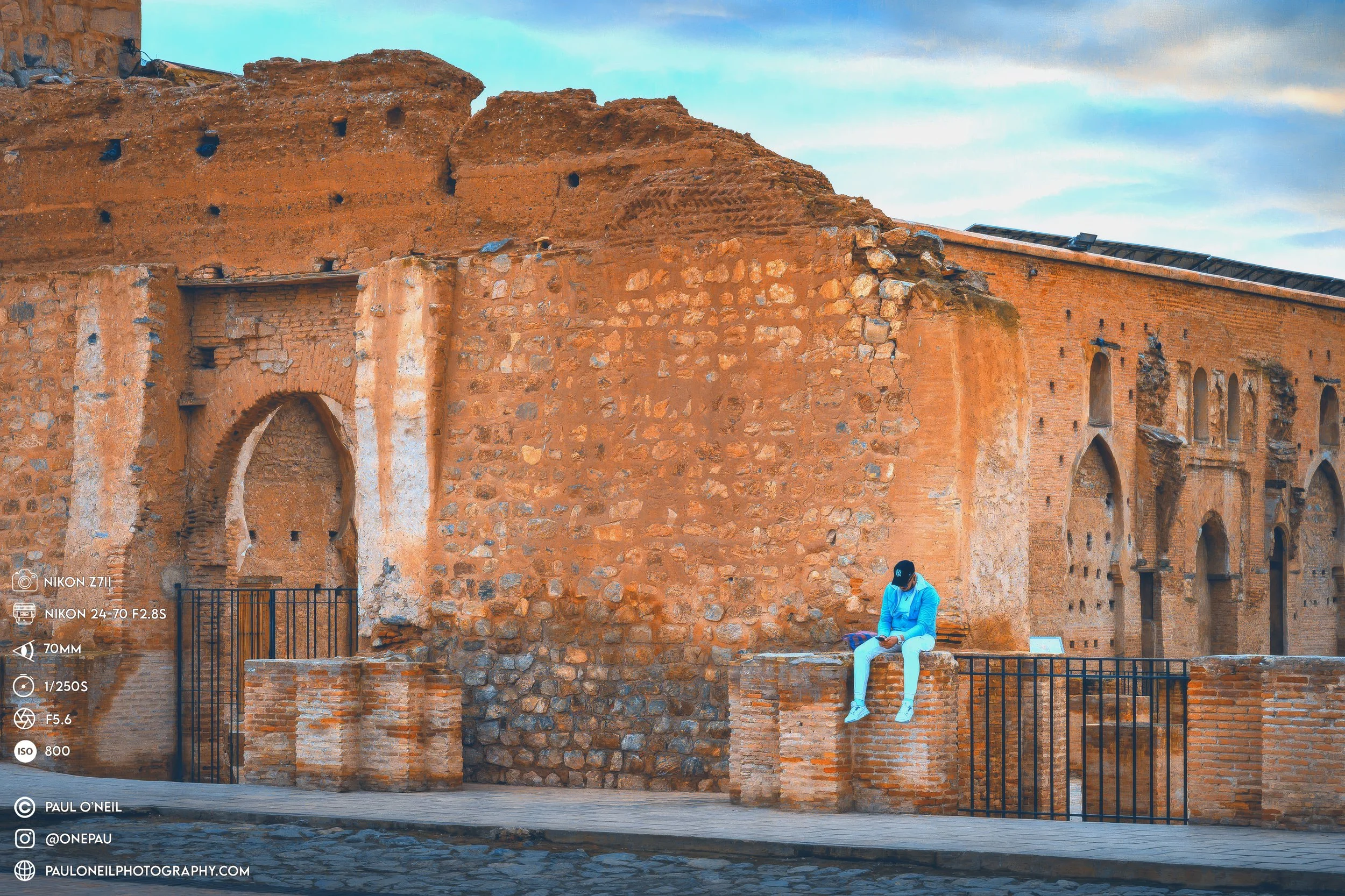
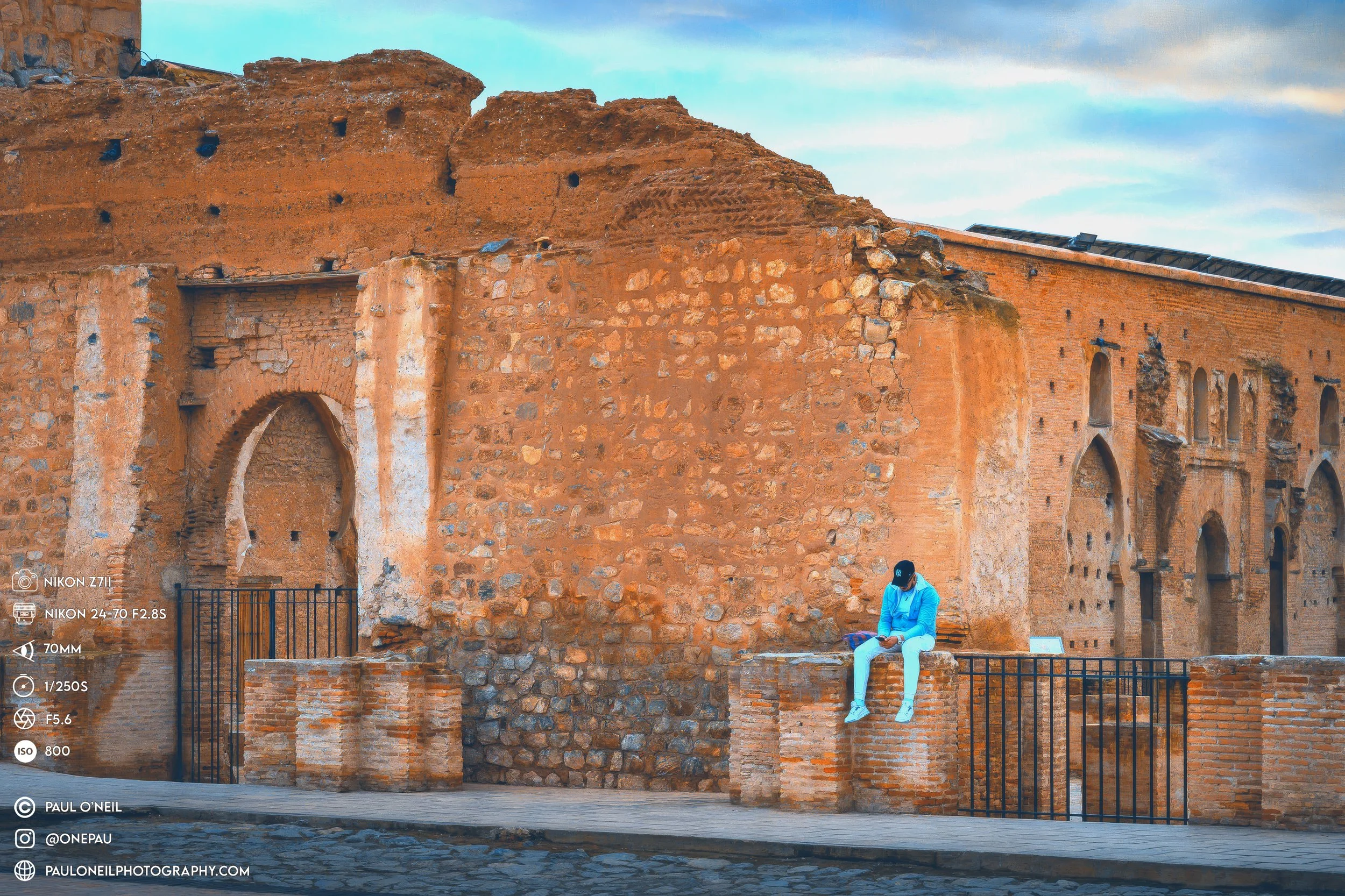
The Koutoubia was built during the Almohad dynasty in the 12th century, with its construction completed around 1158 under the reign of Sultan Abd al-Mu'min. Its name derives from the Arabic word for booksellers — kutubiyyin — a nod to the manuscript market that once thrived at its base. The mosque actually sits on the remains of an earlier, slightly misaligned mosque, sections of which are still visible beside the current structure. The minaret itself served as the architectural template for two other great towers: the Giralda in Seville and the Hassan Tower in Rabat, making it one of the most influential pieces of Islamic architecture ever constructed.
Where to Find It
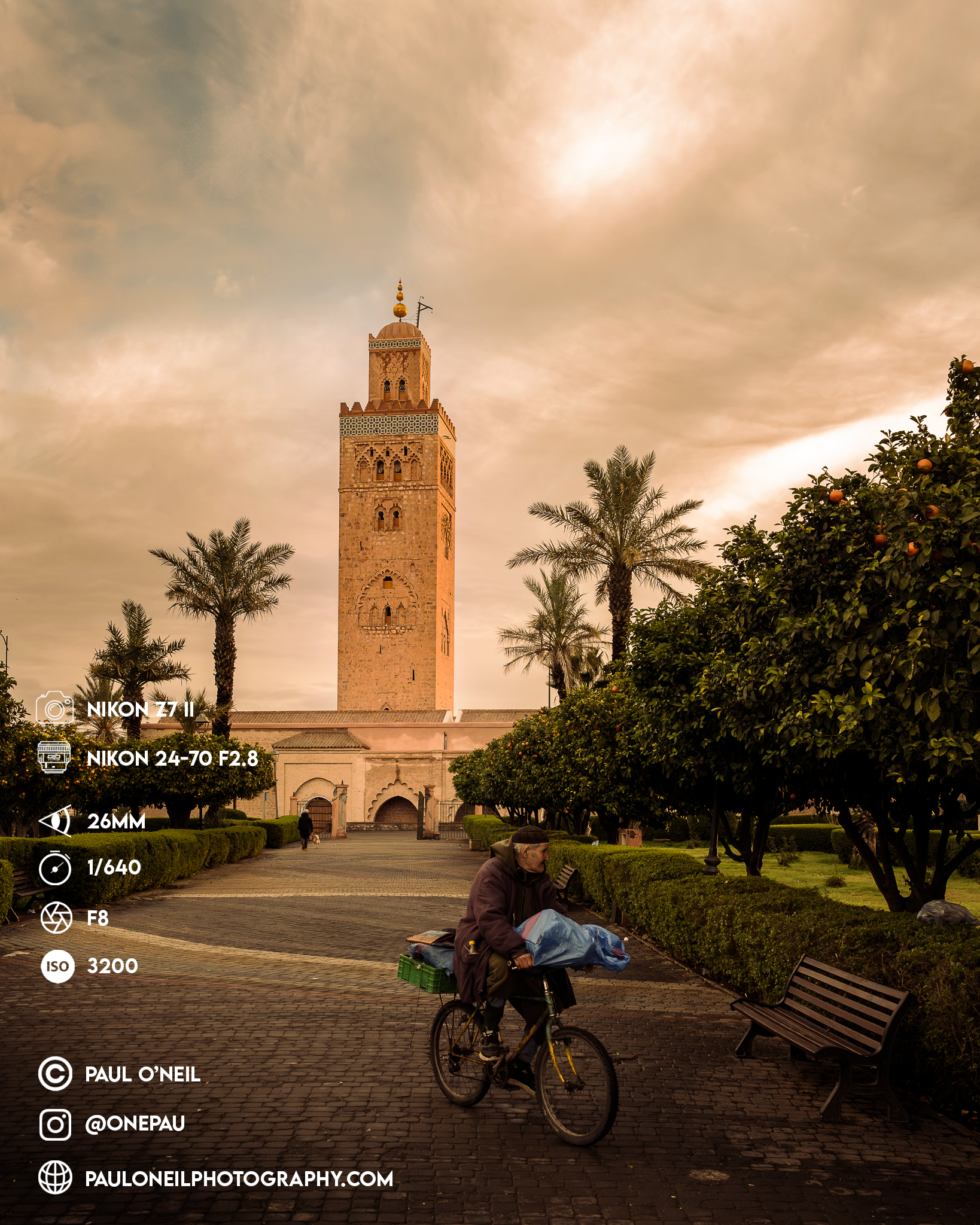
The mosque sits at the south-western edge of the Djemaa el-Fna square, making it the natural anchor of Marrakech's medina. It is surrounded by a large garden of rose bushes and palm trees, which provides a generous amount of space to compose your shots — a rarity in the tightly packed streets of the old city. Non-Muslims are not permitted to enter the mosque itself, but the gardens and surrounding paths are freely accessible throughout the day.
Photography Tips
The Koutoubia is at its most dramatic during the golden and blue hours, which is precisely why I've structured this series around those transitional moments of light. At sunrise, the eastern light grazes the ornate stonework of the minaret and picks out the decorative sebka lattice in extraordinary detail — a long lens in the 200–300mm range will isolate these upper sections beautifully. By contrast, sunset throws the minaret into warm silhouette against a deepening sky, ideal for wide compositions that include the palms below.
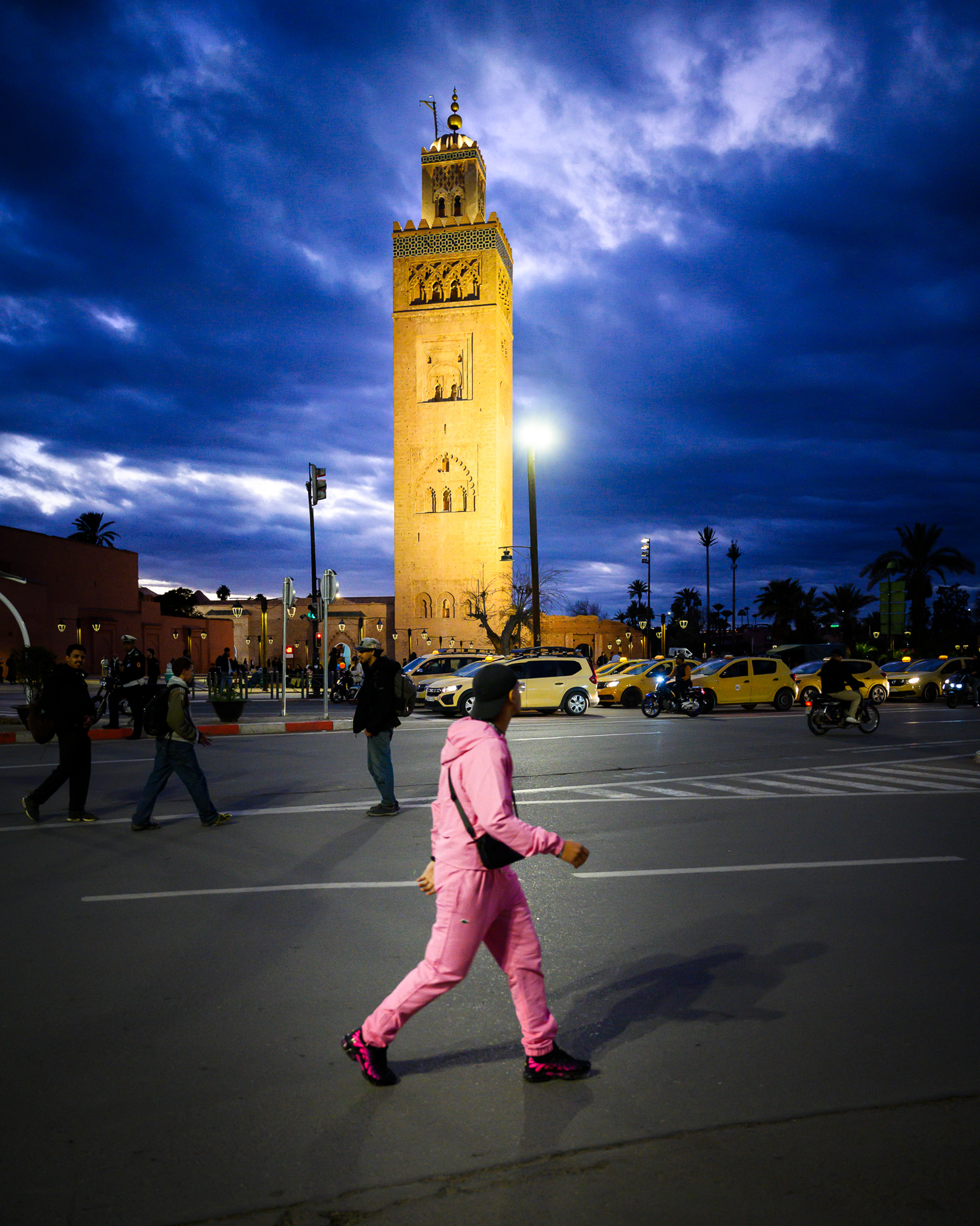
For night shots, the mosque is tastefully floodlit, giving you a clean, evenly lit subject to work with. A sturdy tripod is essential here. Shoot from the northern end of the gardens to include the reflecting pool in your foreground for a natural mirror effect when conditions are still.
Suggested settings to experiment with:
At golden hour, try ISO 100–200, f/8 for sharpness across the full height of the minaret, and adjust your shutter speed to expose for the sky. In low light and at night, drop to ISO 400–800 and lengthen your exposure — anywhere from 2 to 15 seconds depending on your desired sky effect. A remote shutter release will keep things crisp.
Come prepared to stay a while. The Koutoubia is not a single-shot subject — it is a study in patience, and the light will always surprise you.

Lighthouses of Nova Scotia: A photographer’s journey along Canada’s Atlantic coast
I recently booked myself a trip to Nova Scotia, Canada, bringing along all my camera gear. As with my earlier island-sojourn in Malta, there’s something irresistible about being near the sea when you live in landlocked Switzerland. Nova Scotia isn’t quite an island, but with its thousands of kilometres of rugged coastline, it evokes that same sense of escape and horizon.
From a photography perspective, one of the joys of the coastline is witnessing a proper sunset. In Switzerland I’m lucky to see golden-hour skies from my living room, but I rarely watch the sun drop behind the horizon over open water. On Nova Scotia’s shores, I waited through golden hour, watching the fiery red ball descend, while the sky shifted through orange, purple, and red—always looking for a lighthouse to frame in the foreground.
Below are some highlights and lessons from photographing Nova Scotia lighthouses on my trip.
Peggy’s Cove Lighthouse (Peggy’s Point)
Peggy’s Cove is iconic—the lighthouse is one of the most photographed in Nova Scotia and indeed in Canada.
On my second evening, I arrived well before sunset to scout for a reflection in a tidal pool. I then paused for dinner at the Sou’Wester (which sits on the car park), hoping timing would align. It did—but in classic travel fashion, I forgot exactly where the pool was. I found a spot near another photographer and captured a sliver of the lighthouse’s reflection.
Tourists milled about, strolling in front of my vantage point and asking me to snap photos of them. (Always an amusing reminder: yes, my expensive gear is for lighthouses, not human portraiture!). As light faded, I leaned on modern post-processing to remove distractions. The sky turned from orange to deep violet and red, and I nearly missed the stunning sky behind me until someone kindly pointed it out.
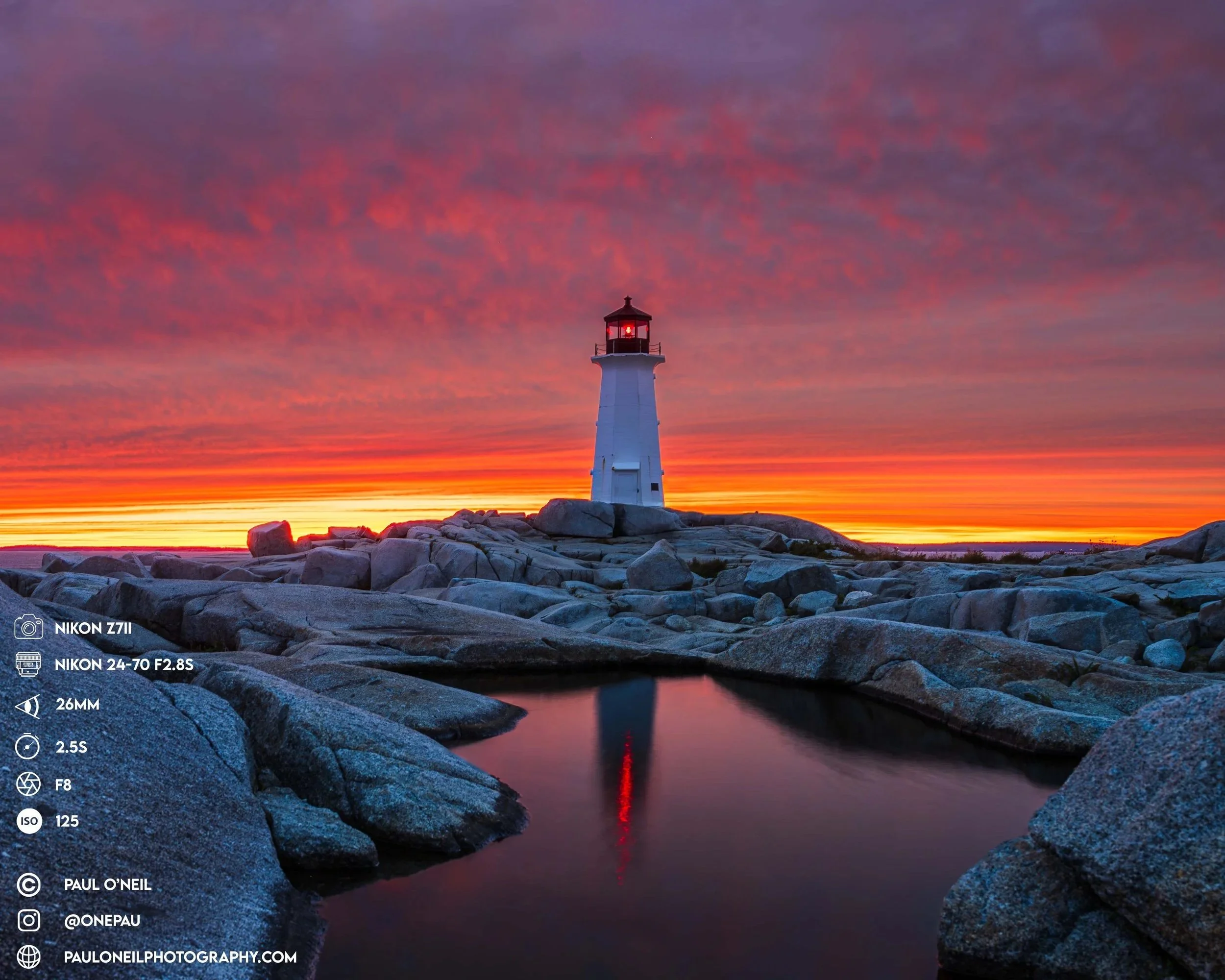
Peggy’s Cove lighthouse
Shot at dusk during September with the lighthouse reflected in a tidal pool
Baccaro Point Lighthouse
A couple of hours’ drive from Halifax lies Baccaro Point Lighthouse, near the southernmost tip of mainland Nova Scotia (in Cape Sable). I stayed in Barrington Passage at the charming Salty Shores Inn & Café (only two rooms—quaint but comfortable). After a lobster dinner at Kat’s Lobster Shack, I drove ~20 minutes to Baccaro Point.The site is relatively uncluttered: apart from a radar station and occasional cars, there isn’t too much to distract. I composed with care and waited as the sun first appeared behind the tower, then later sank into the sea behind it. I captured two distinct moods in the same location.

Gilbert’s Cove Lighthouse
I photographed Gilbert’s Cove during daylight. This lighthouse is lower and squat in stature, which presents compositional challenges. Shooting from the car park gives little variety, and in the morning, the sun’s angle (behind and to my right) was not ideal—even with a polarizer. I tried shooting from the beach with seaweed piles in the foreground, but none of the shots resonated with me. Sometimes, a location simply doesn’t yield the magic you hope for.
Gilbert’s Cove lighthouse, Nova Scotia
Kidston Island Lighthouse (Baddeck)
In Baddeck, I aimed for Kidston Island Lighthouse, which lies on an island in the Bras d’Or Lakes. Wikipedia The lighthouse is only accessible by boat (a ferry operates in summer). I found a land vantage point (via the Location Scout app) across the lake. One complication: the boardwalk was damaged and fenced off, so I set up along the roadside path.I tried multiple compositions. Fortunately, light hit one side of the lighthouse beautifully, so I focused on that. The golden hour itself was somewhat subdued, but I was glad to have explored alternate angles earlier.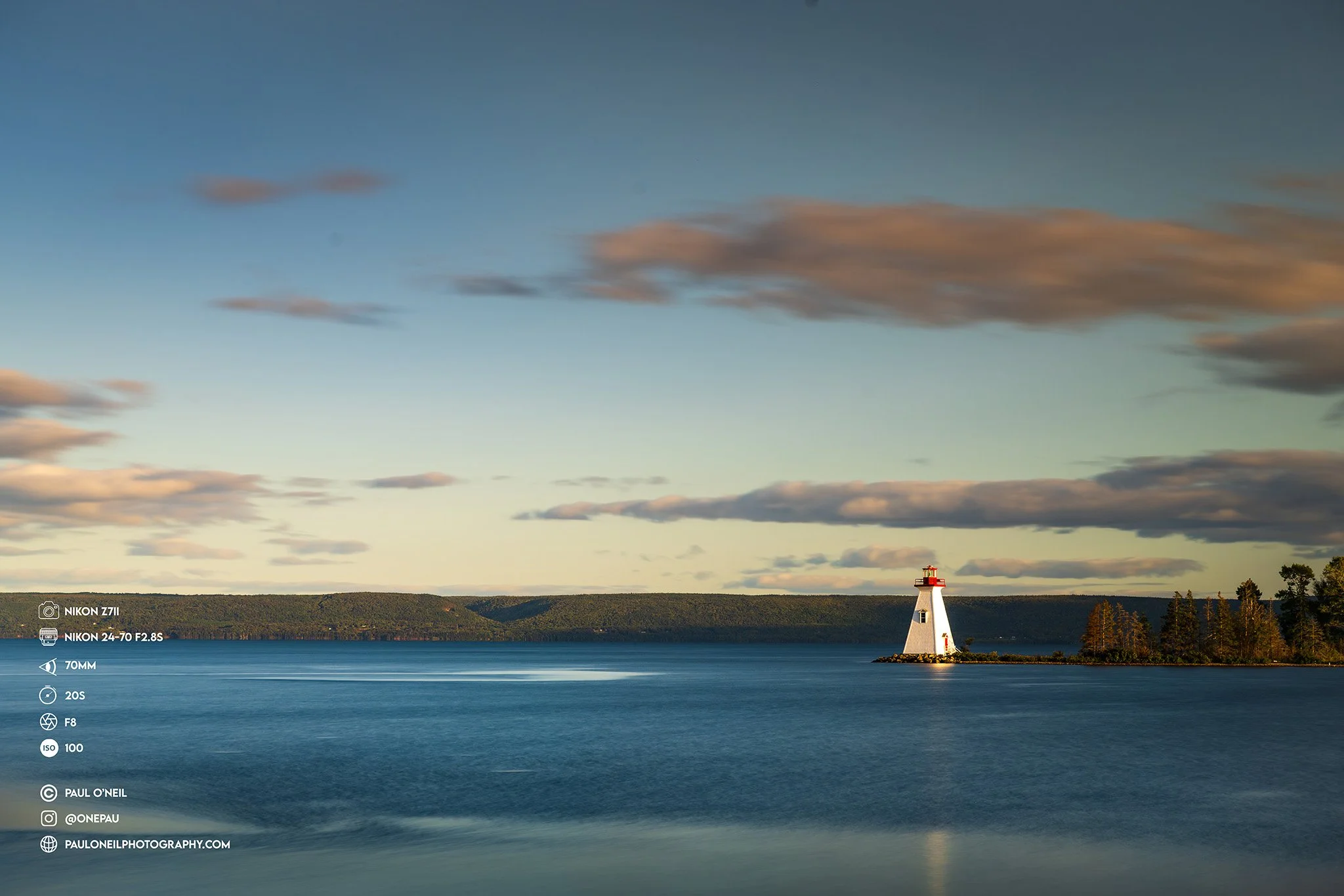
The lighthouse at Kidston Island, in the Bras d’Or Lake just across from Baddeck, in Nova Scotia
Louisbourg Lighthouse
While visiting the Louisbourg Fortress Museum, I also photographed the nearby lighthouse. This is a fairly busy site: it's within day-trip range of Sydney (and cruise ships), so coach loads of tourists arrive early. But many tours leave on schedule, giving you windows of relative solitude.I used Location Scout again to identify a spot that was a little off the beaten path—one that many visitors won’t notice. There are also a pair of red wooden chairs there that can serve as compositional anchors.
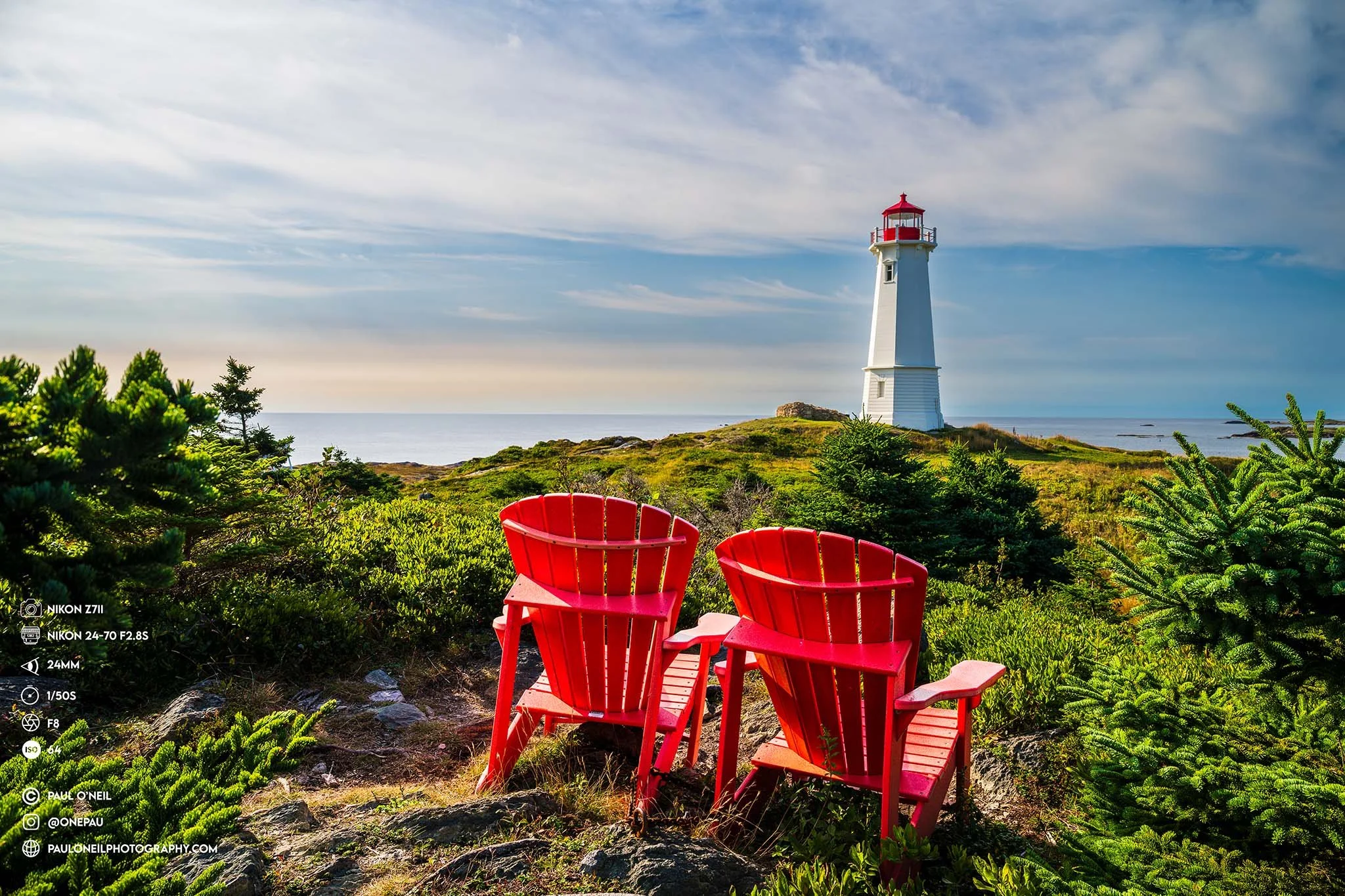
Louisbourg lighthouse
Low Point Lighthouse
Low Point is more remote and harder to locate (you park at the end of a road and hike). But that also means fewer crowds at sunset—although I still saw local and Canadian tourists and some ATV riders. Composing was a bit tricky: wide angles revealed undesired trails and vegetation. Still, I captured a shot where the last rays of sun reflected off the terrain as the sun dipped below the horizon.
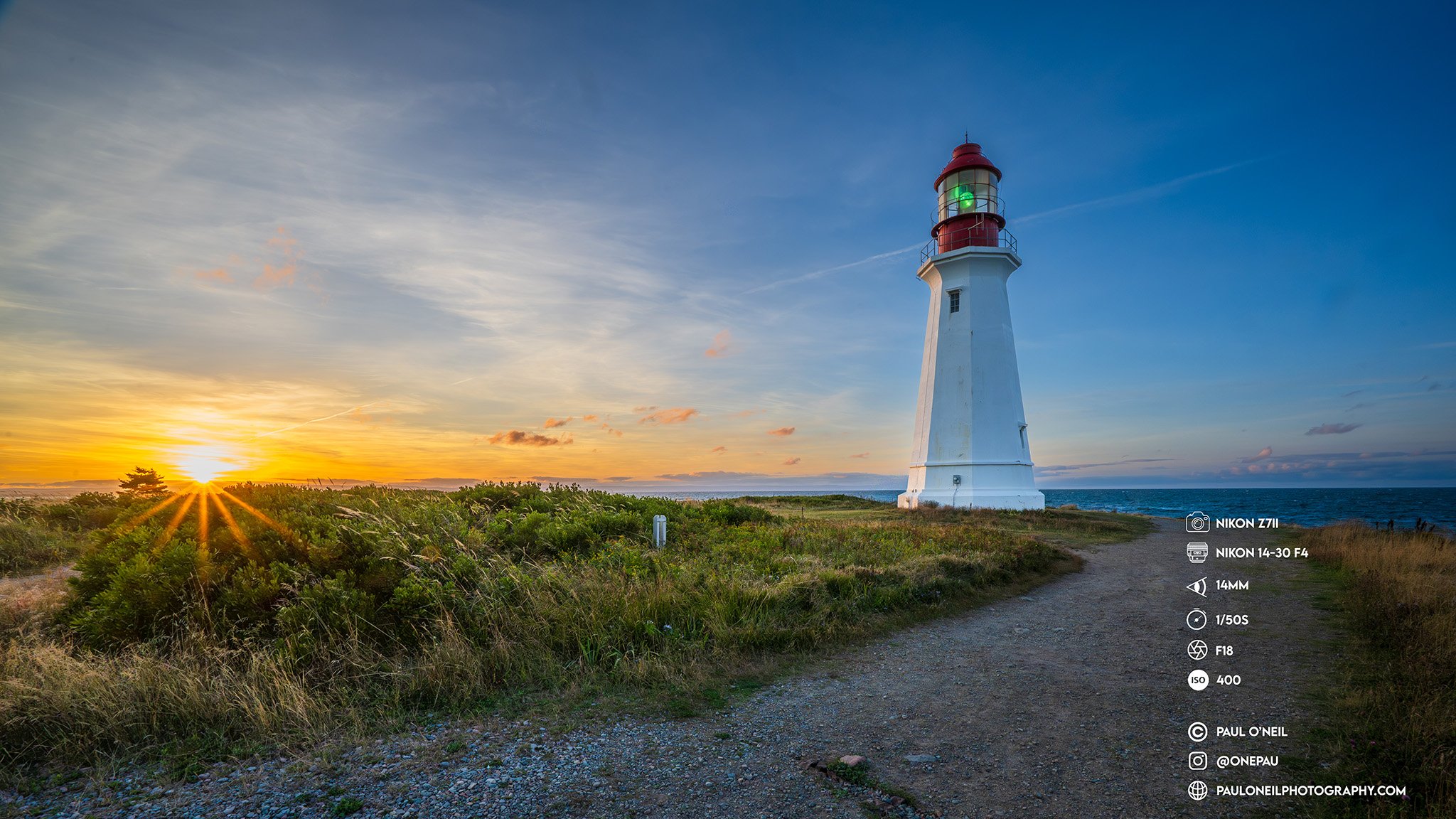
Low Point lighthouse at sunset
Nova Scotia lighthouse photography tips
Tripod
Yes, it's a no-brainer for landscape photography but it can be a pain if you're travelling - especially long haul. I have a quite big and heavy (despite the carbon) Rollei C6 model that has stood me well over time. Remember, however, that you are going to be shooting on the coast and it can get very windy. In these situations, even a tripod is not much use. Unless you are looking to capture shots like the last two above, where the shutter speed is not too slow, a tripod in the wind is not going to help you get a sharp shot (unless you carry around separate sandbags to weigh it down with). In these cases you are better of cranking up the ISO and going for a faster shot. Forget about long exposures to flatten choppy waters!Filters
I always carry a selection of filters with me and my filter adapter attaches to a screw-on circular polariser. I have mixed feelings about the polariser: sometimes it's great for adding saturation, other times it just gets in the way by darkening only a portion of the sky. You really need to have the sun hitting the lens at just the right angle for it to work. I have a lot more success with my graduated ND filter for the kind of shots shown above. Even at sunset and during golden hour, the sky will still be lighter than your foreground, so it is great to be able to compensate for that. Addtional ND filters (ND8, ND 64 and ND1000 in my case) allow you to cut out the light and smooth water.CCleaning gear
I am my own worst enemy out in the field. I switch lenses without paying attention to wind or dust (the Nikon is a pain here as, unlike the Canon, the sensor is exposed when you change lenses unless you follow the cumbersome procedure of removing the battery while the camera is on, in which case the curtain covers the sensor) and when I open up the aperture beyond F11 I often see the results of my carelessness in the form of dust spots on my shots. Look after your lenses and your camera's sensor and pay extra attention when switching lenses in the field, particularly when you are in windy, salty or dusty environments.Planning
This is the most time-consuming but the most crucial aspect. I had a schedule and a rough idea of what I wanted to shoot but was subject to the weather. So if the weather is good you need to be ready to go, set up and shoot without worrying about anything else. I use the Location Scout application to find spots. The contributors sometimes give you useful tips for shooting a particular location and there is always a map showing where the sun rises and sets. As a avid Photopiller, this app is my go to for a number of things: sunrise and sunset planning, moon phases, night AR view for the Milky Way and exposure calculations when shooting long exposures with filters.

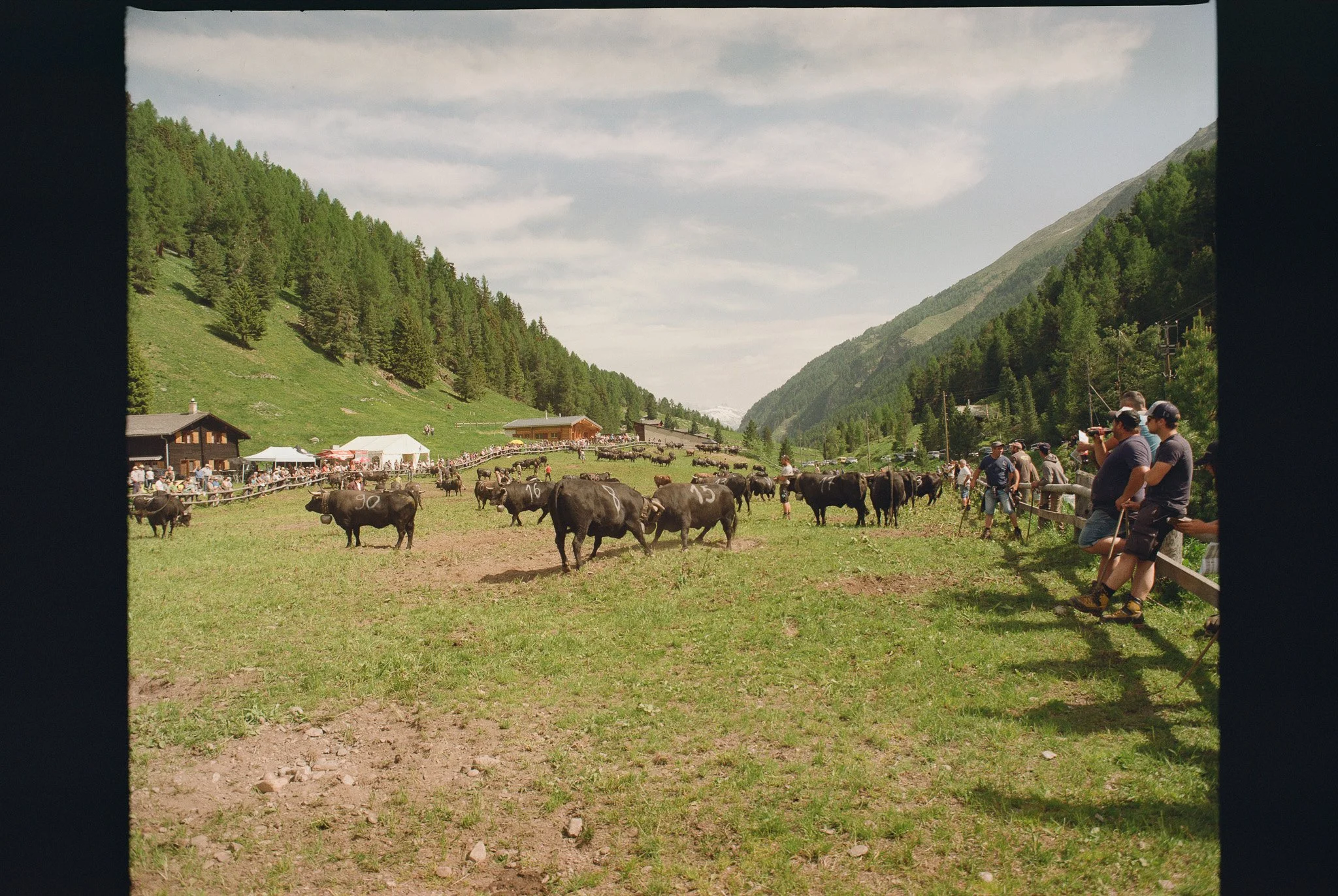
Photos of the Combat des Reines in the Turtmanntal
Discover the timeless allure of the combat des reines in the secluded Turtmanntal through evocative black and white photography. Explore its history, cultural significance, and why monochrome was my deliberate choice to capture these majestic bovine duels.
Nestled high in the Swiss Alps, the Turtmanntal valley is one of Switzerland’s best‑kept secrets—closed off to traffic in winter, home only to a single family‑run hotel, and connected by a humble minibus linking Oberems to Senntum. Here, each spring brings an age‑old spectacle: the combat des reines, or “queen fights,” where cows from the Val d’Hérens breed test strength and hierarchy.
What Is the Combat des Reines?
Originating in the Valais region centuries ago, the combat des reines pits cows against one another in friendly yet fiercely contested bouts. Rather than mere entertainment, these contests determine the natural pecking order of the herd—ensuring that only the strongest queens lead each pasture. Unlike conventional bullfights, there is no human involvement; the animals lock horns and gently but firmly push until one yields.
A History Rooted in Alpine Tradition
First documented in the 15th century, these contests were used by herders to manage breeding stock and preserve the hardiest traits of the Valais breed. By the 19th century, neighboring hamlets turned these informal skirmishes into seasonal celebrations. Today, the combative gatherings remain tightly woven into regional identity, attracting photographers, agritourists and locals.
Cultural Significance in the Turtmanntal
The Turtmanntal combats stand apart for their intimate scale. With no grandstands or commercial fanfare, spectators perch on alpine meadows under open skies. The surrounding pines and granite ridges form a natural amphitheater—an authentic reminder that nature still reigns supreme here. For local families, these fights reaffirm communal bonds and herald the end of winter’s isolation. As with almost any event in the Valais, even in this relatively remote area there is no shortage of wine and cheese to sustain the crowds during a relatively long day.
Why Black and White Photography?
After reviewing my shots, I felt the combat des reines was portrayed best in monochrome. Here’s why I chose black and white photography for this story:
Timeless Atmosphere: Stripping away color returns us to the valley’s storied past—where medieval herders first watched their queens duke it out.
Textural Emphasis: The deep black hide of the cows is emphasised in black and white and the green of the fields and surrounding forests tended to distract from the scene. Switching to black and white draws the attention more towards the subjects in the frame: the cows and their herders, who are always standing nearby ready to intervene if a third cow decides it wants a piece of the action while two others are duelling.
Personal Reflections on the Turtmanntal
I try to visit the Turtmanntal at least once a year, but even that is not easy. The road into the valley usually opens only in late May, then closes again some time in October. I’ve hiked up to the Turtmannhütte, circled back to the Hollenstein chapel with its fantastic views back down the valley, done an early-morning hike up to the Meidsee, visited the sheep protection dogs with a breeder and now seen a natural “combat des reines”, where locals parked all along the side of the narrow road, even though there is a grass car park only a few hundred metres away (a nice quiet spot for motorhomes and, with clear skies and a new moon, a fantastic spot for stargazing).
Tips for Photographing the Combat des Reines
Arrive Early for Light: My advice for any shoot. Getting there early gets you the best light but also the best parking spots and a chance to scout the location.
Use a Fast Prime Lens or a telephoto: I shot with a 24-70 but a 70-200 or a fixed telephoto would let you get in close (the arena is closed off) and give you amazing shots. The cows dig out holes in the field, which throws up clouds of soil on a dry day, adding an extra touch of drama to your shot.
Capture the Details: From mud‑caked horns to dust rising with each shove, get low or zoom tight to spotlight the grit of the ritual. Try to include the colourful characters of the herders and spectators.
Tripod not necessary: I always have my tripod with me but on this occasion it was more of a hindrance than a help. I even shot handheld on my Mamiya RB67.
Embrace the Monochrome Moment
Beyond mere documentation, my black and white portfolio of the combat des reines invites viewers to witness an alpine tradition in its purest form. No color can replicate the elemental power, the textural richness, or the fleeting sparks of dust and muscle that define these bovine duels.
Whether you’re a culture seeker, an agritourist, or a fellow black and white photography enthusiast, the Turtmanntal’s queen fights offer an unforgettable blend of history, community, and raw natural beauty. Plan to visit between late spring and early summer, pack a sturdy tripod, and prepare to be transported—back in time and deep into the soul of Switzerland’s hidden valleys.
Useful tips
Check the Alpe Rötigen Facebook Page to find out when it’s happening.
Take public transport if you can - it will save you a lot of time compared with driving all the way up from Turtmann to Oberems
Don’t forget to stop by the farm shop to take home some cheese!


Street Photography in Valletta, Malta: Early Starts & Hidden Gems
Some tips and ideas for street photography in Valletta, Malta, based on my own experiences from a trip in 2025. Valletta offers original photo opportunities beyond the overcrowded tourist hotspots if you arrive early and are prepared to head off the beaten track and get a little bit lost.
Street photography in Valletta, Malta, is a dream for any photographer seeking authenticity, history, and striking light. With its narrow limestone alleyways, colourful balconies, and baroque architecture, Valletta offers a rich canvas for storytelling. But to capture the city’s true essence, timing and location are everything.
Avoiding the crowds is crucial for powerful street photography in Valletta. Cruise ships and day-trippers can fill the main streets by mid-morning, so getting there early is essential. Aim to arrive just after sunrise, when the golden light hits the stone facades and the city begins to stir. You'll find locals opening shops, street sweepers finishing their rounds, and a calm, cinematic atmosphere perfect for candid shots.
To elevate your street photography, get off the beaten track. While Republic Street and Merchant Street are iconic, they’re often saturated with tourists. Instead, wander into the quieter side alleys and residential quarters like the lower parts of St. Ursula Street or the back lanes near Hastings Gardens. Here, you'll encounter everyday Maltese life—residents chatting on doorsteps, kids heading to school, or fishermen repairing nets.
For truly original results in your street photography, look beyond the obvious. Focus on shadows, textures, and fleeting expressions. Valletta’s layered history and changing light offer endless compositions for creative street photographers willing to explore.
Remember, patience and presence are key. The best street photography in Valletta isn’t found in guidebooks—it’s captured in those unscripted, quiet moments when the city reveals itself.
So grab your camera, get there early, avoid the crowds, and let Valletta’s hidden corners inspire your next photographic story.
Check out the results of my early morning trip in May below. There are shots of the colonial heritage (obligatory for me as a Brit) with the postbox and phone box. I saw examples of the post box on the web and thought that some AI had been used because the reflection on the left of the box looks weird. But this is indeed what you get early morning when the light is bouncing off the wall on the left back on to the left-hand side of the box. The shot of the balconies was an attempt to capture the architecture without any of the hustle and bustle below, so look up! The model photoshoot was sheer luck. I spotted her approaching, then saw the photographer so just held back and took some discreet shots. The final shot is a door that is so unused that dust has gathered on it an people have started writing messages in it. The square of light shining off it shows just how much variation in light you can get throughout the day. It’s probably no coincidence that the shots are all vertical. I shot horizontal photos as well in Valletta but the narrow streets mean that vertical shots naturally work better.


Five must-see photo locations in Malta and Gozo for 2025: Hidden gems and iconic views
Explore the best photography spots in Malta and Gozo for 2025, including Il-Karraba Ridge, Valletta's architectural marvels, and the Marsalforn Salt Pans. Perfect for landscape and architectural photography lovers.
I visited Malta and Gozo in early May. For someone who lives in a landlocked country, the opportunity to explore an island that measures less than 30km long and 15km wide, plus the smaller island of Gozo, offers numerous opportunities to combine coastal landscape photography with historical architecture and some unusual urban photography. Despite iconic photo locations such as the Azure Window collapsing in recent years due to natural erosion, Malta and Gozo continue to captivate photographers with their natural beauty. If you're planning your 2025 photo journey through these Mediterranean gems, here are five must-visit photo locations based on my own experience on-location.
1. Il-Karraba Ridge, Għajn Tuffieħa – Sunset Spectacle by the Sea
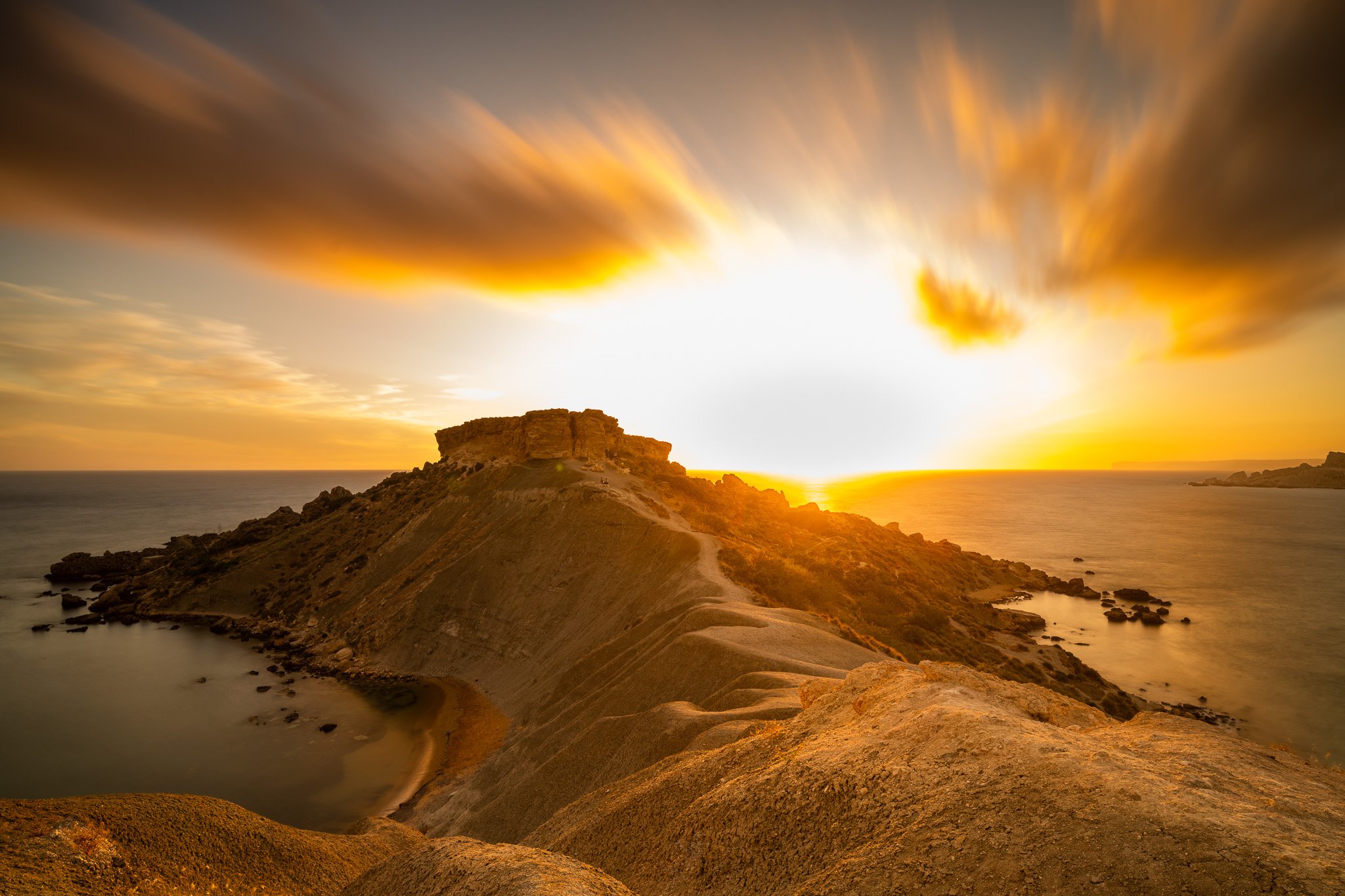
Il-Karraba ridge at sunset. Nikon Z7ii, 14-30mm f4. Shot at @20mm, f8, ISO 100, 25 seconds.
Nestled between Għajn Tuffieħa Bay and Ġnejna Bay, Il-Karraba Ridge offers one of Malta's most breathtaking coastal landscapes. This clay cliff formation is a dream for sunset photography. The unique terrain, combined with the golden Mediterranean light, provides endless compositional opportunities—from minimalist silhouettes to sweeping wide-angle shots. The cracked soil in particular offers endless opportunities to create leading lines. I faced the usual challenge of an underexposed foreground and an overexposed background, adding my own layer of complexity by shooting long exposures. A tripod and filters are essential here, and my trusted graduated neutral density filter helped to take out some of the highlights. In my final edit I deliberately kept some of the blown highlights for a pretty aggressive look. As this spot faces west, it attracts a lot of people for the sunset. Get there early, take some time to scout for a good spot and then wait. I stayed in the same spot for around an hour.
2. Parliament Building, Valletta – Architectural Geometry
Designed by renowned architect Renzo Piano, Valletta's Parliament Building is a masterpiece of contemporary architecture harmonizing with Malta’s traditional limestone aesthetic. Its bold geometric façade creates compelling patterns, perfect for architectural and abstract photography. The stairs on the right-hand side of the building offer great potential for some candid street photography if you can catch people at the right time as the sun casts a diagonal shadow across the stairs. Unfortunately, the hordes of tourists groups and cruise ship visitors seem to head straight down the main street and miss this architectural marvel. I did all my Valletta shots relatively early in the morning and the light was great. I deliberately take only my 50mm prime lens for street photography because it forces me to consider my composition. In this case I honed in on the façade to highlight the intriguing shapes and geometric patterns.

A close-up of the façade of the Parliament Building in Valletta. Nikon Z7ii, 50mm f1.8. Shot at f8, ISO 160, 1/640 seconds.
3. Marsalforn Salt Pans, Gozo – Ancient Grids at Golden Hour

The salt pans at Marsalform shot at sunrise. Nikon Z7ii, 14-30mm. Shot at 30mm, f8, ISO 64, 1/250 seconds.
Located on Gozo’s northern coast, the Marsalforn Salt Pans are not only culturally significant but also visually mesmerizing. Carved into the coastal rock and still in use today, these salt pans offer a striking checkerboard pattern that reflects the changing sky. The coast here runs east to west and I got there in time for sunrise. There was not much in the way of a golden hour but if you have a polarising filter you can catch the early-morning sun reflecting off the pools. This is a protected site so you cannot simply wander around the salt pans looking for the best composition. There is a concrete pathway half-way along the coast where you can set up to look east for the sunrise. But as always with sunrises, don’t forget to look behind you as the sun lights up the coast looking westwards.
4. Typical Maltese architecture
You cannot fail to notice the typical style of Maltese appartment blocks with their distinctive coloured protrusions. Taking a street photography approach and armed only with my 50mm prime lens, I wanted to capture only this essential element of the Maltese style, without any extraneous details. If you wander around Valletta early in the morning and frame your shot looking upwards, even if you are surrounded by tourists and traffic, you can capture a moment in time that features none of them.

No self-respecting building in Malta is complete without a brightly painted wooden extension pinned to its façade. Look up, find the colours and shoot. Nikon Z7ii, 50mm f1.8. Shot at 50mm, f8, ISO 160, 1/640 seconds.
5. The red tower and sunset by an old NATO radar station
If you plan well and scout your locations in advance, you can get two good golden hour and sunset shots here. The first is the striking St. Agatha’s Tower, whose dark red adobe-style finish comes alive in the orange glow of golden hour. Head further down the road to the very end and, if you wander around a bit, you can find several composition to catch the setting sun.

An evening shot of the Red Tower in Malta, Nikon Z7ii, 50mm f1.8. Shot at 50mm, f8, ISO 64, 1/250 seconds.

Sunset with a ramshackle hut in the foreground. Nikon Z7ii, 50mm f1.8. Shot at f8, ISO 64, 1/250 seconds.
Malta has a great bus network but if you’re planning sunrise and sunet shots it probably won’t help you much. I hired a car from the airport, where there is a good selection of companies with reasonable rates. The weather while I was there was not great and included a day of torrential rain and as the population is neither used to that or equipped for it I found myself behind a car whose tyres did not have enough profile to drive up a gentle hill in the rain! Driving in the centre of Valletta is not easy, even with your choice of Apple Car Play or Google Maps, so be warned. The ferry to Gozo runs 24 hours, however, so you can get a very early morning crossing to catch the sunrise locations.
Let me know in the comments if you’ve been or if you plan to go and what you thought/think.

Canonet QL 17 review and sample images
A story of me getting to grips with the Canonet QL17 film camera after well over a decade of shooting entirely digital. This post explains how I found the camera, how I got used to shooting with it and what the results from the first successfully sho roll of film were like.
Can you “rediscover” film photography if you never really discovered it in the first place? My experience of photography in my childhood amounted to nothing more than using a 110 cartridge film camera with precisely no functions or controls other than not letting you wind more than one frame at a time (a basic function that the Holga 120N lacks, but which also gives you more freedom for creative expression.
I still have many of the prints from these cameras in albums that date back to the late 1990s and early 2000s. The “unique” look of film that is so often touted by fans of “analogue” photography is certainly there, but so are the clear results of an inability to take any control of the camera, such as unwanted blur and over or under exposure.
After gaining all my knowledge and experience on digital cameras, I thought it was about time to see whether the new-found interest in analogue cameras was worth looking into. My experiments with the Holga 120N, which started from a simple desire to try out “Holgaramas” left me disappointed. You get what you pay for, which in the case of the Holga is not very much. At least as far as the camera is concerned. Buying and developing 120 film is an entirely different matter when you may only get two or three frames from a 16 shot roll that might be usable. So my attention wandered to an affordable 35mm camera with a full manual mode and I inevitably stumbled across the Canonet QL17, also known as the “Texas Leica”.
Finding a Canonet QL17
I scoured my annual second-hand photo fair in Vevey, Switzerland and found precisely zero Canonets. The best place to look if you are serious is on Ebay, where second-hand cameras are big in Japan. All the listings are by professional companies that deal solely in second-hand camera gear and have their own temperature controlled warehouses. They have a clear grading scale so that you know the condition of what you are bidding on before you start looking at the photos. I would recommend taking a good look at the product shots, however, as there may be a tiny defect visible on the camera or the lens (although this is usually indicated).
You’ll find a choice of the original steel housing with exposed brushed steel or an all-black version. I opted for the latter in a near-mint version, which cost me around 200 Swiss francs plus delivery and a further 20-30 francs of import duty for which I received a separate invoice from Fedex a few weeks after buying the camera. It came well-sealed in a protective packaging and is in pretty good condition.
Using the canonet QL17
After watching some Youtube videos and given that the QL in the Canonet QL17 stands for “quick load”, I thought that using the camera would be easy. Perhaps it is for someone who has a bit more patience and common sense than me but I ended up ruining the first two rolls of film I shot; the first by not pressing the button on the underside of the body before rewinding the roll and then wondering what that horrible tearing sound was; the second by somehow not even managing to load the film correctly.
Once you’ve got the hand of loading and unloading film, there is not much more you need to know. Set the film speed using the finnicky switch on the lens and you’re good to go. You can get an expensive adapter so that you can use pen cell batteries for the auto exposure mode, but where’s the fun in that? I tried to stick to the “Sunny 16” rule for my first few rolls, using the reciprocal of the film speed at f16 in sunny conditions, then stepping down according to the light. The big challenge here is determining what is actually sunny and what isn’t (see the sample photos below). I’m used to shooting digital on a tripod, so long exposures are my thing, which meant it took some getting used to the more limited range of shutter speeds.
The rangefinder focussing was also something new for me but it’s pretty intuitive: move the focus ring to line up the centre image with the surrounding image and bingo! Or, unless you are shooting something quite close up and with a large depth of field, just leave it on infinity.
Sample images from the canonet ql17
The good


The mixed


The bad


The story behind the shot - Hotel Belvedere at night
The story behind my night photo of the Hotel Belvedere with light trails on the Furka pass road. This is a popular photo location on Switzerland’s Grand Tour due to its being right on the road up to the Furkapass and opposite the car park when you can access the ice tunnel under the Rhone glacier. At night and out of season, however, the place can be deserted, giving your creativity for night shots free reign.
The Hotel Belvedere is a must-see photo opportunity for any trip on Switzerland’s Grand Tour, but it can be difficult to photograph due to the proximity of the road, the traffic and - depending on the time of year - the tourists stopping to photograph the hotel and visit the nearby ice grotto inside the Rhone glacier.
Yes it’s an Instagram magnet and yes it’s probably been shot thousands of times from every angle. But that was a great reason to head up there just to see if I could do something different. So, on a cold late autumn night, I headed down from the Grimselpass after the golden hour failed to materialise and then up the Furkapass road to the unmistakable hairpin bend that is dominated by the long-abandoned Belvedere Hotel.
A cold autumn night is actually one of the best times to photograph this hotel. Night falls early and nobody is around (there was just a German-registered motorhome on the car park when I arrived). If you’re using a wide-angle lens, you can stand right by the side of the road opposite the Hotel Belvedere and frame your shot low. But there is a risk that the lights from the car park behind you might cast a shadow in front and spoil your composition.
The shot I had in mind was a straight on shot with the camera low to the ground (something like this) but the light from the car park was indeed a problem, casting a shadow of me right in the middle of the shot. Nevertheless, with some tripod adjustment and some careful cropping, I managed to get a decent shot of the Hotel Belvedere against the backdrop of a cloudless starry sky.

Attempt no. 1: Straight on, low down, nice starry sky in the background.
Having just posted the photo in here and looked at it again, it doesn’t look too bad. The noise reduction in Lightroom might be a bit much and you can see the reflection of the light from the carpark on the front door and the first floor boarded-up windows (although this does make it look a bit like there is a light on in a bedroom).
By this time I had had a few chances to work on settings to get the light trails right. I could see and hear the cars coming from a long way away, which gave me plenty of time to prepare. After a few attempts where either the ISO or shutter speed were too high, blowing out the highlights, I got it more or less right.
Then I changed my position to the left-hand side of the hotel. I knew I wouldn’t get any leading lines, as the road moves up and away from the hotel, but the 14mm lens could get all of the side of the hotel in and all of the road sweeping around. Unfortunately, I had a lot less warning about traffic coming down the hill, so an unexpected late-night postbus caught me by surprise.

Attempt no. 2: The postbus passing. Blown out highlights on the left, impossible to vertically align and a halo above the Hotel Belvedere (corrected here slightly).
It’s not the first time I’ve tried to get light trails from a bus on a hairpin bend, but it’s not an easy shot. The two layers of light trails can be nice, but the bus is travelling slower than other traffic and its bigger headlights can blow out the higlights. My tripod was quite low to the ground so that accentuates this and the framing of the shot at this point meant that it’s impossible to correct the vertical alignment without losing the light trails on the left.
But, after some tweaking and the time to prepare for a car coming up the hill, I managed to get something at least a little less formulaic. This more unusual shot of the Hotel Belvedere allowed me to capture the full length of the hotel and the full hairpin bend of the road, meaning that the light trails transition nicely from the headlights to the tail lights.

Attempt no. 3: The full hotel and the full hairpin bend visible (cropped as a square shot).