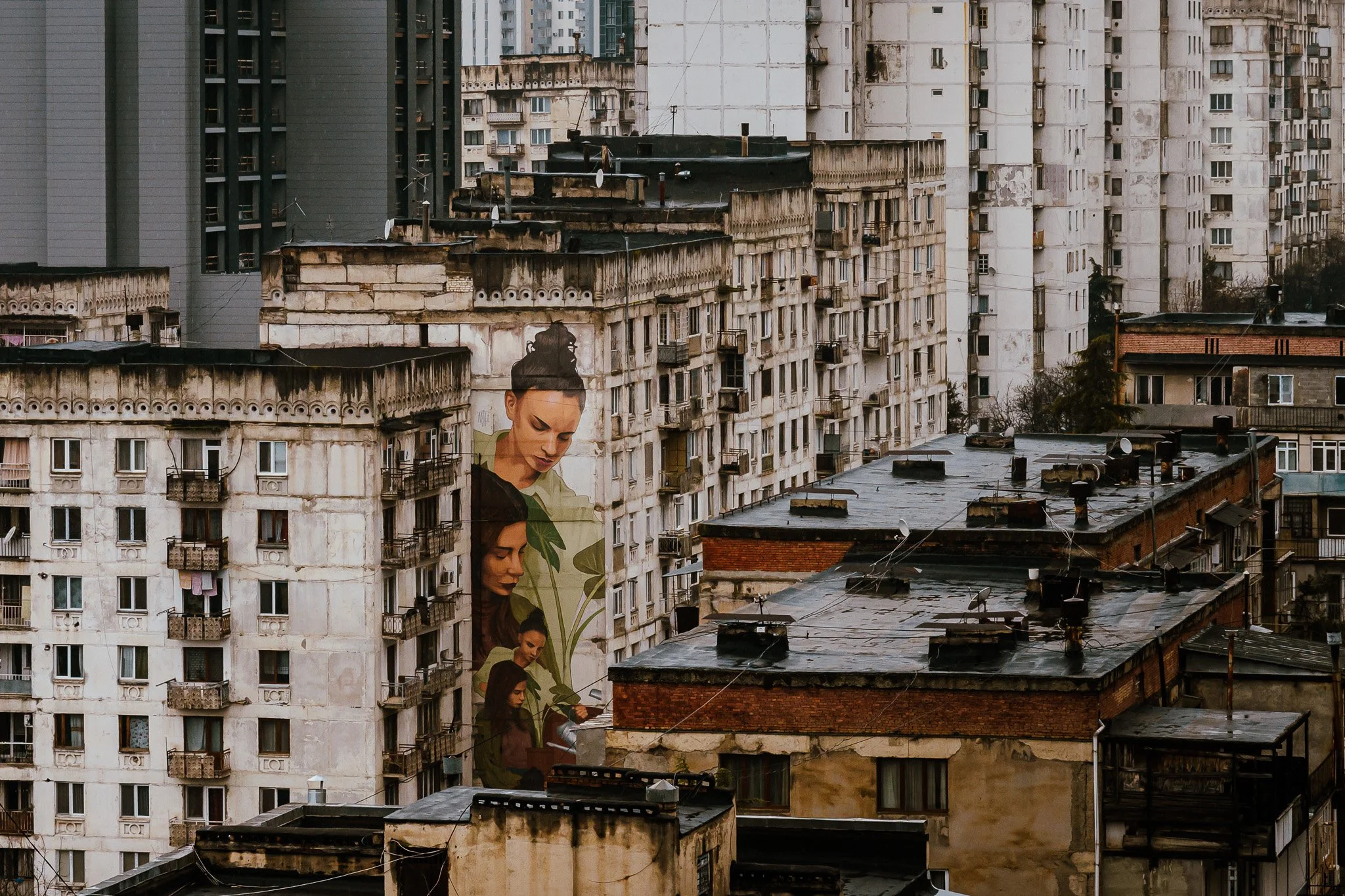
Soviet Tbilisi: A different city hiding in plain sight
Most visitors to Tbilisi come for the old town. The cobblestone lanes, the carved wooden balconies, the domed sulphur baths — these are the images that fill the travel feeds and the guidebooks. They are not wrong, exactly. That part of Tbilisi is genuinely beautiful. But it is also restored, polished and increasingly built around the expectations of the people photographing it. If you want to understand what Tbilisi actually is — the full, contradictory, occasionally brutal sweep of it — you need to go looking for the other city. The one made of concrete.
My Soviet architecture day was the highlight of the trip, and I say that as someone who arrived with high expectations. What I did not anticipate was quite how alone I would be at most of the locations, nor quite how much the guide's knowledge would add to what I was seeing.
The tour
I joined the Urbex and Soviet Tour, bookable via GetYourGuide or directly through friendly.ge. It meets at the fountain outside Avlabari metro station, which is straightforward to find. As I was the only person who booked the tour on the day in question, the guide kindly offered to pick me up at the hotel. The tour is by private car with an English-speaking local guide — mine was excellent: deeply knowledgeable about the Soviet period, genuinely enthusiastic, and attuned to the fact that the photographers in the group needed time to compose, not just a moment to point and shoot.
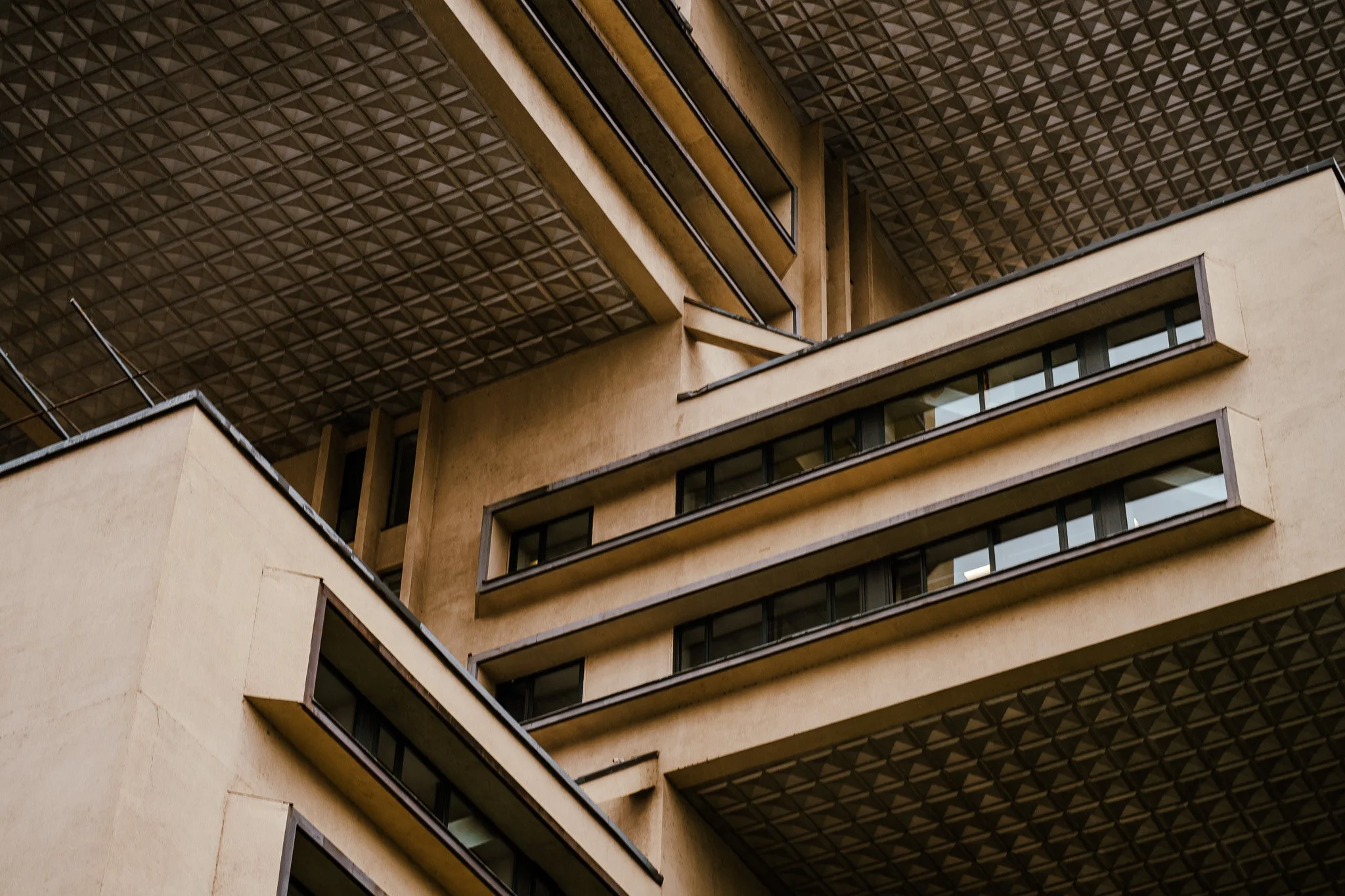
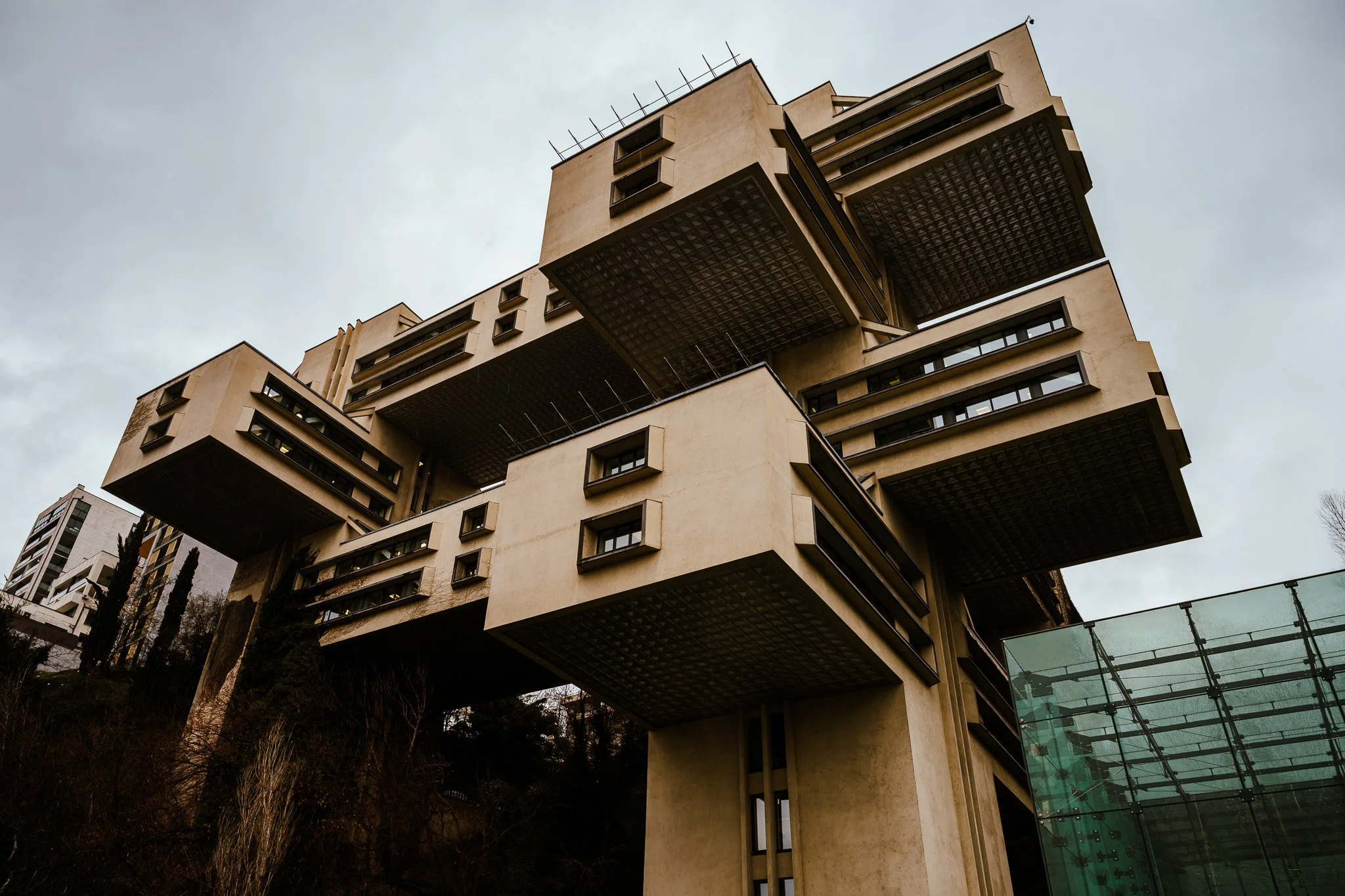
The itinerary covers a range of sites spread across the city, most of which you would struggle to find independently without local knowledge. These include the underground Bolshevik printing press — where the scale of the hidden operation only becomes apparent once you are standing inside it — the exterior of the former Ministry of Roads, a towering piece of Brutalist architecture that still looks like a building from a science-fiction film, the Skybridge towers (more on these below), and the Chronicles of Georgia monument at the edge of the city.
Allow a full half day. Budget roughly $50–80 per person.
What surprised me
The honesty of it. This is not a sanitised heritage tour. The guide does not present Soviet Tbilisi as quaint or merely photogenic — there is a real history here, involving real people, and it is told with nuance.
The other surprise was the solitude. At virtually every stop — the ministry building, the Skybridge, the peripheral monuments — we were the only people there. Not the only tourists. The only people. This is a city of 1.2 million and these extraordinary structures stand largely unvisited. For a photographer, that kind of access — unhurried, uncontested, with space to move around a subject and wait for the light — is rare.
The Chronicles of Georgia
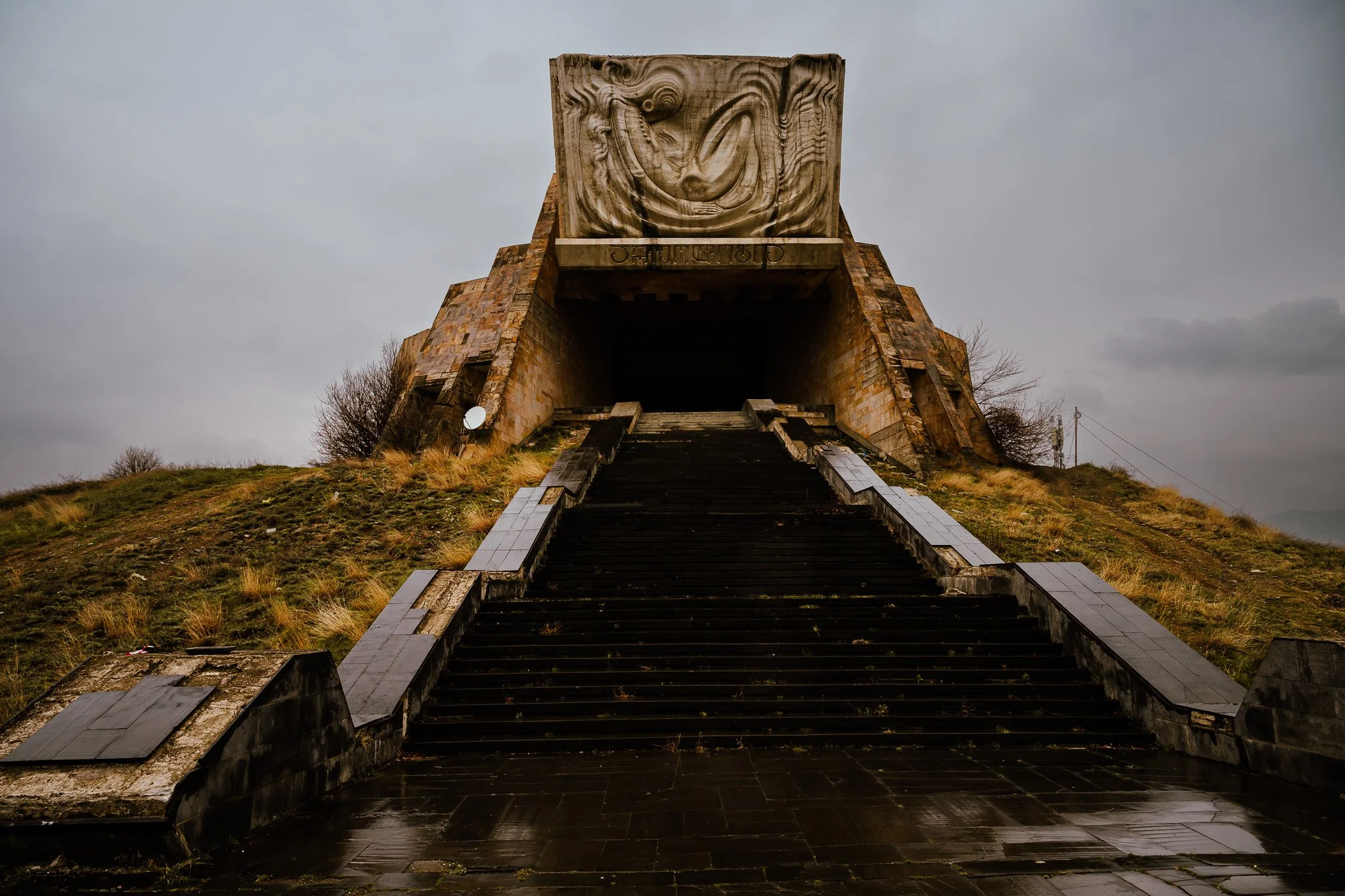
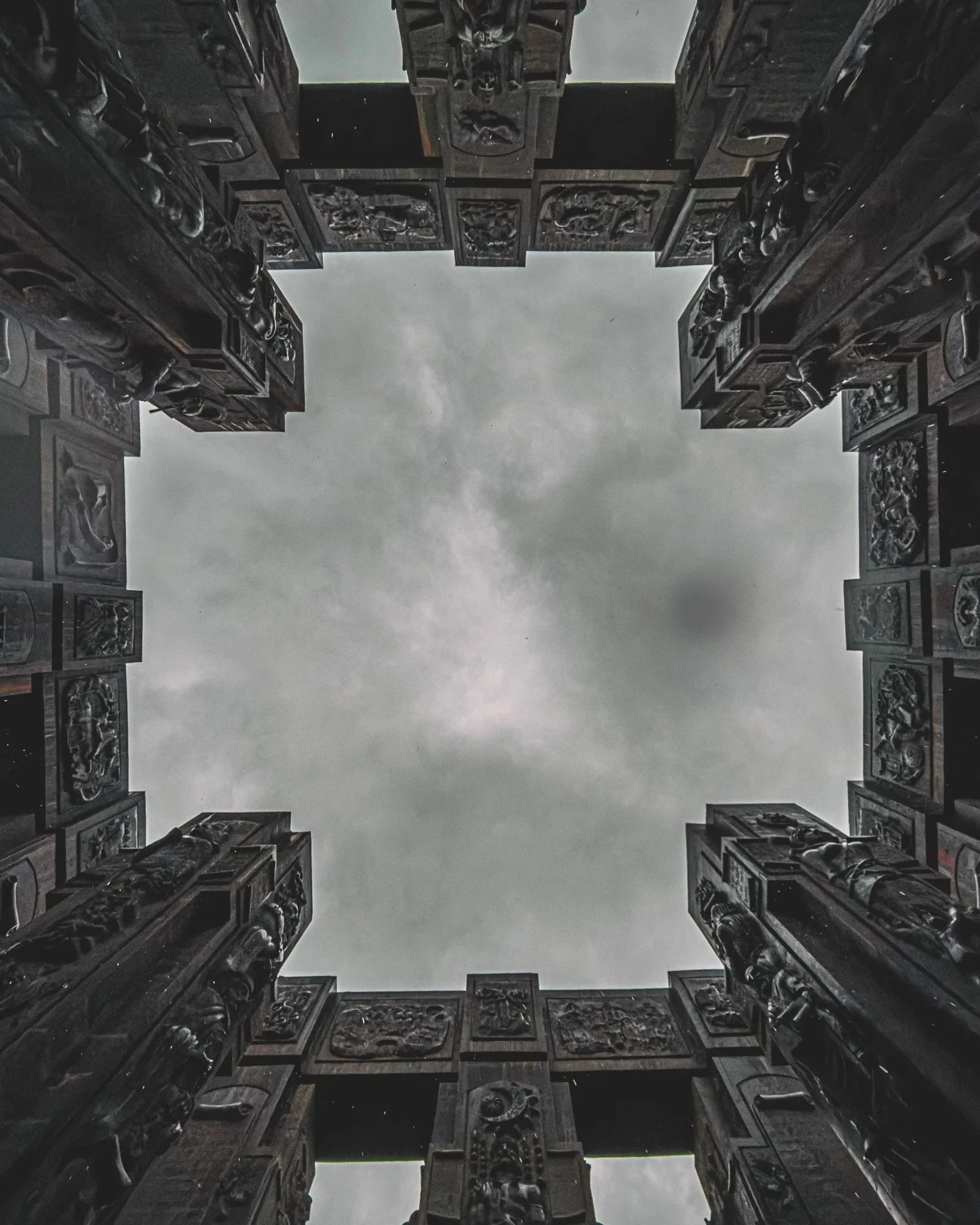
The one exception to that solitude was the Chronicles of Georgia and it is worth addressing directly because it changes the nature of the shoot. This is a monumental complex of 16 columns, each 35 metres high, carved with scenes from Georgian history and Orthodox Christianity. It is extraordinary. It is also, by some distance, the most visited site on the tour.
At the Chronicles, you will share the space with other visitors — a mix of Georgian families, tour groups, and other international travellers. The monument is open 24 hours and sits above the Tbilisi Sea reservoir with sweeping panoramic views. None of this diminishes its power as a photographic subject, but it does require a different approach. The standard reaction shots of people standing before the columns can be very good. So can tight abstract details of the carved stonework. But if you want the place to yourself, arrive at dusk when the day-trippers are thinning out, or return very early the following morning. In this case if you have a tripod, try some long exposures to remove any people in a completely natural way. I visited the Chronicles a second time independently of the tour to get the golden and blue-hour shots.
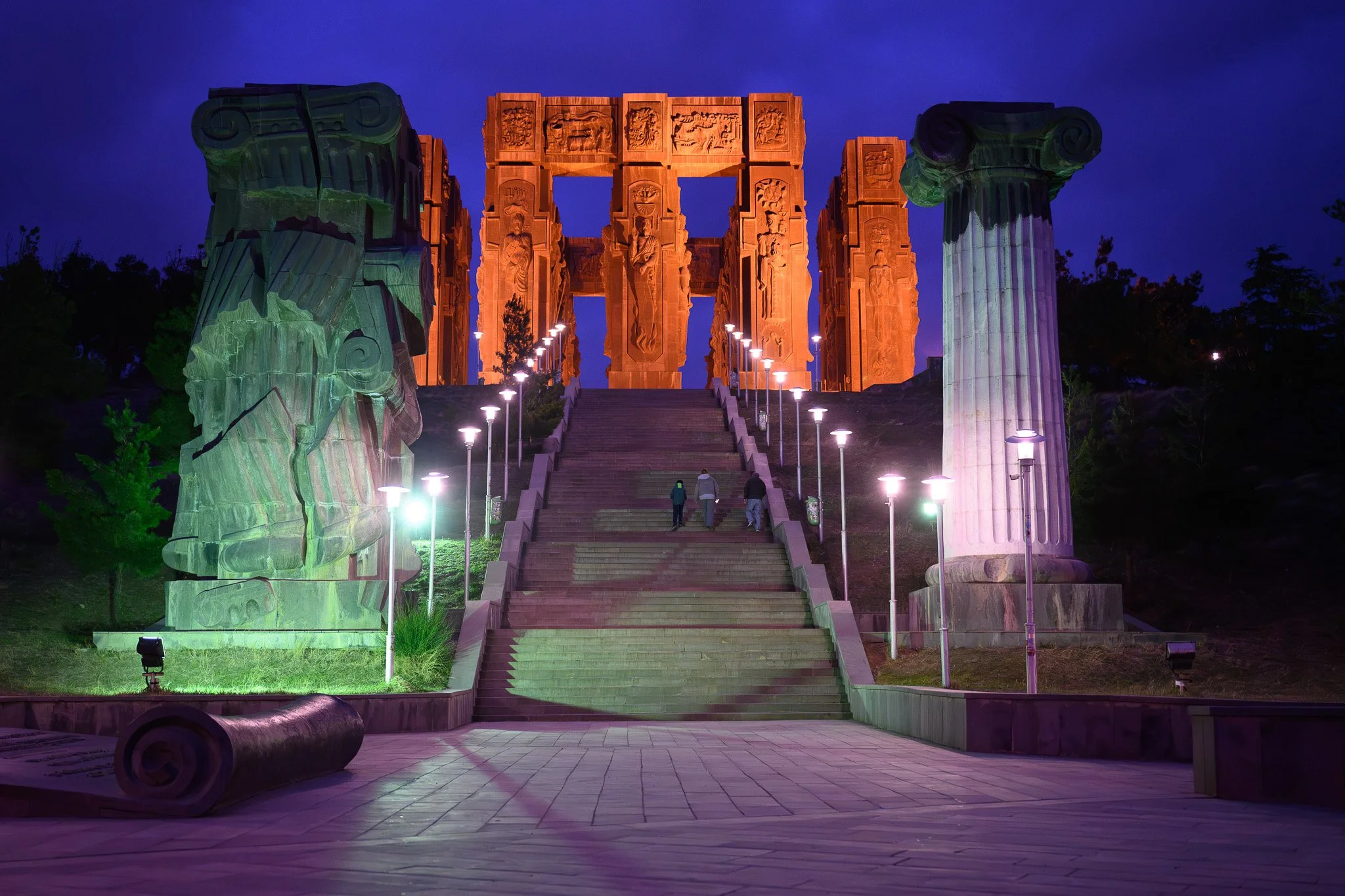
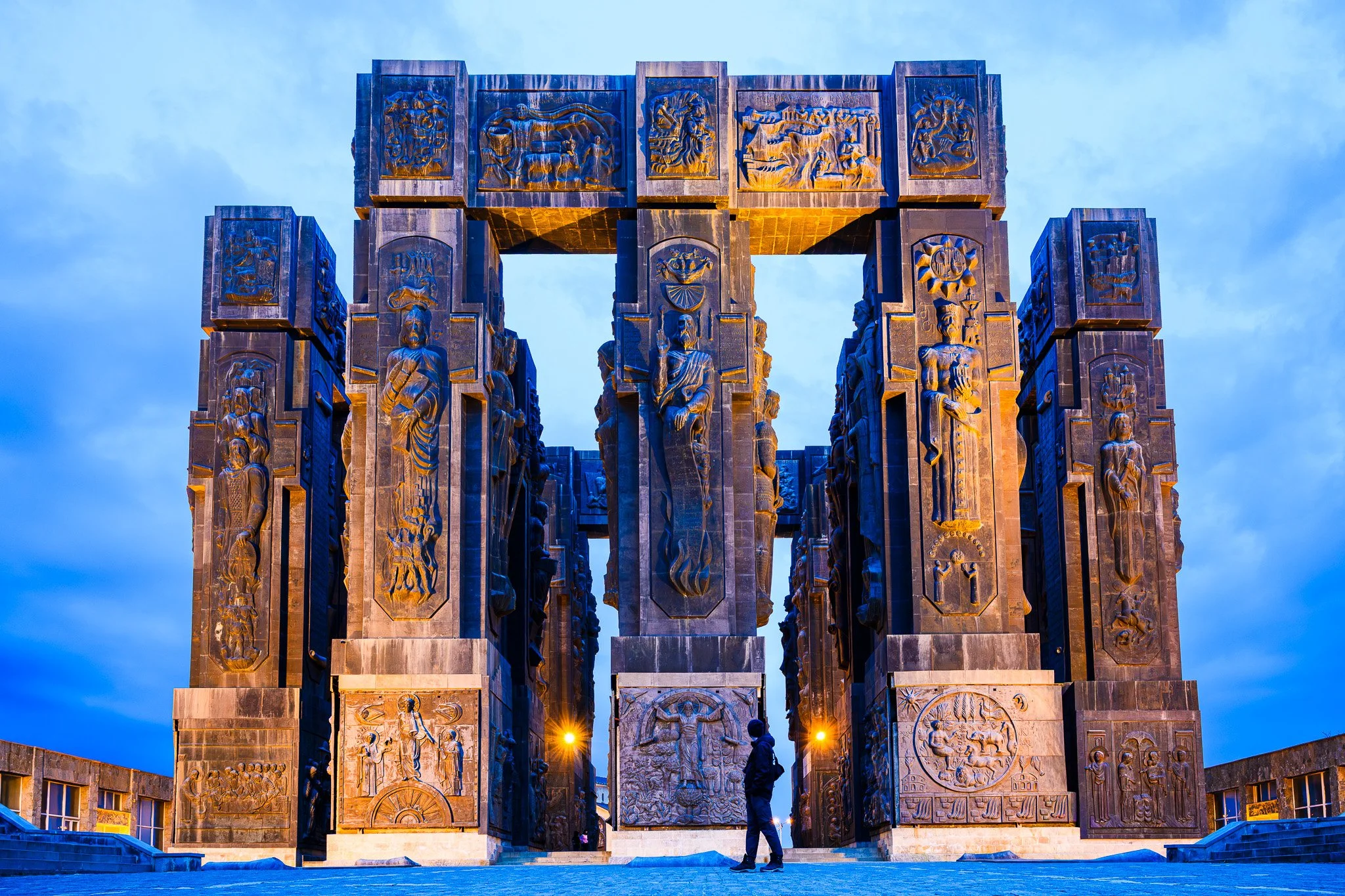
Suggested settings at the Chronicles of Georgia:
At golden hour, work around ISO 200, f/8, and expose for the stone rather than the sky — the sky will look after itself. For blue hour and night work, drop to ISO 400–800 and let your shutter run long: 4–20 seconds depending on your desired movement in the water below. A tripod is essential for the latter.
The Nutsubidze Skybridge
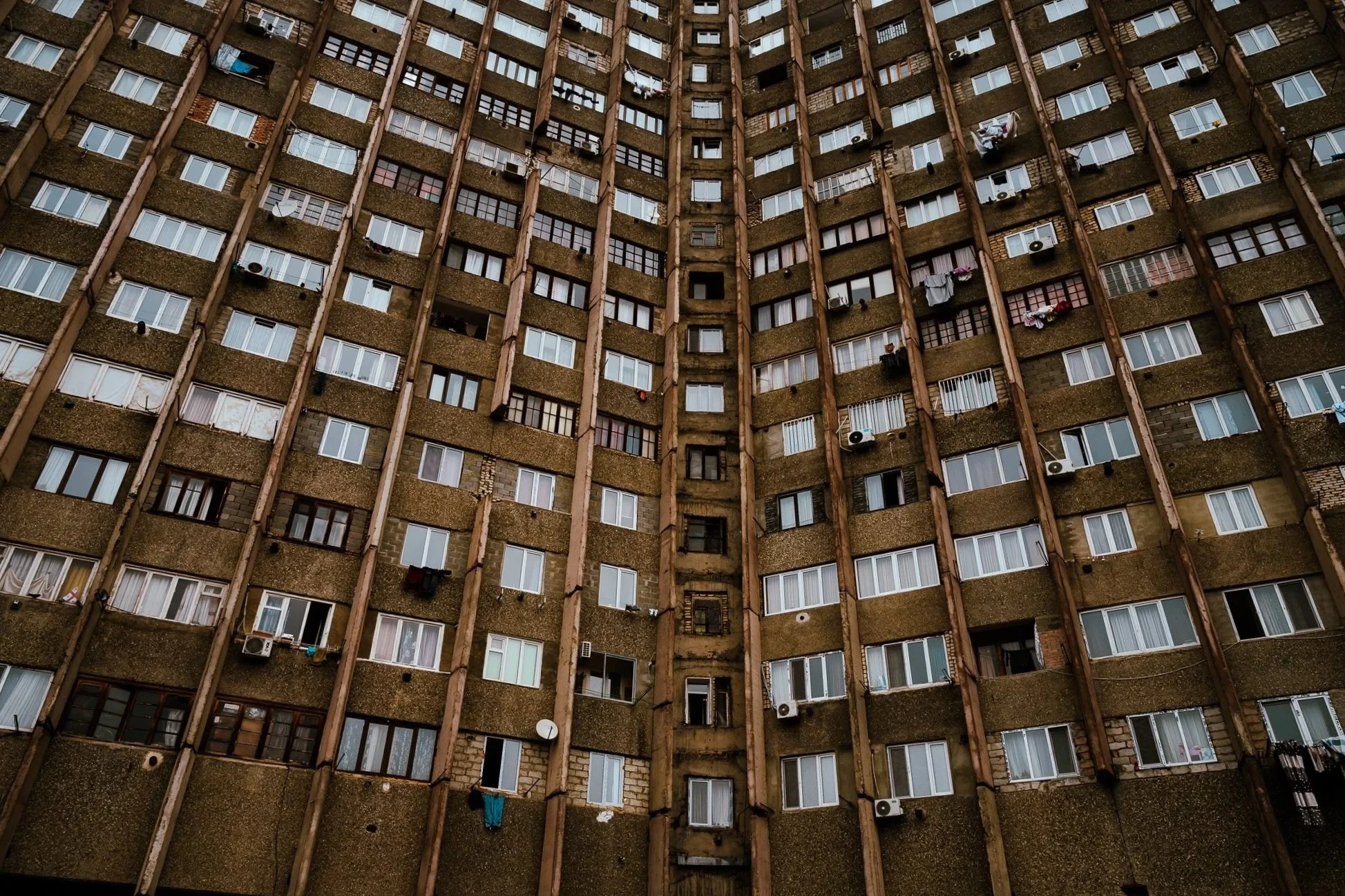
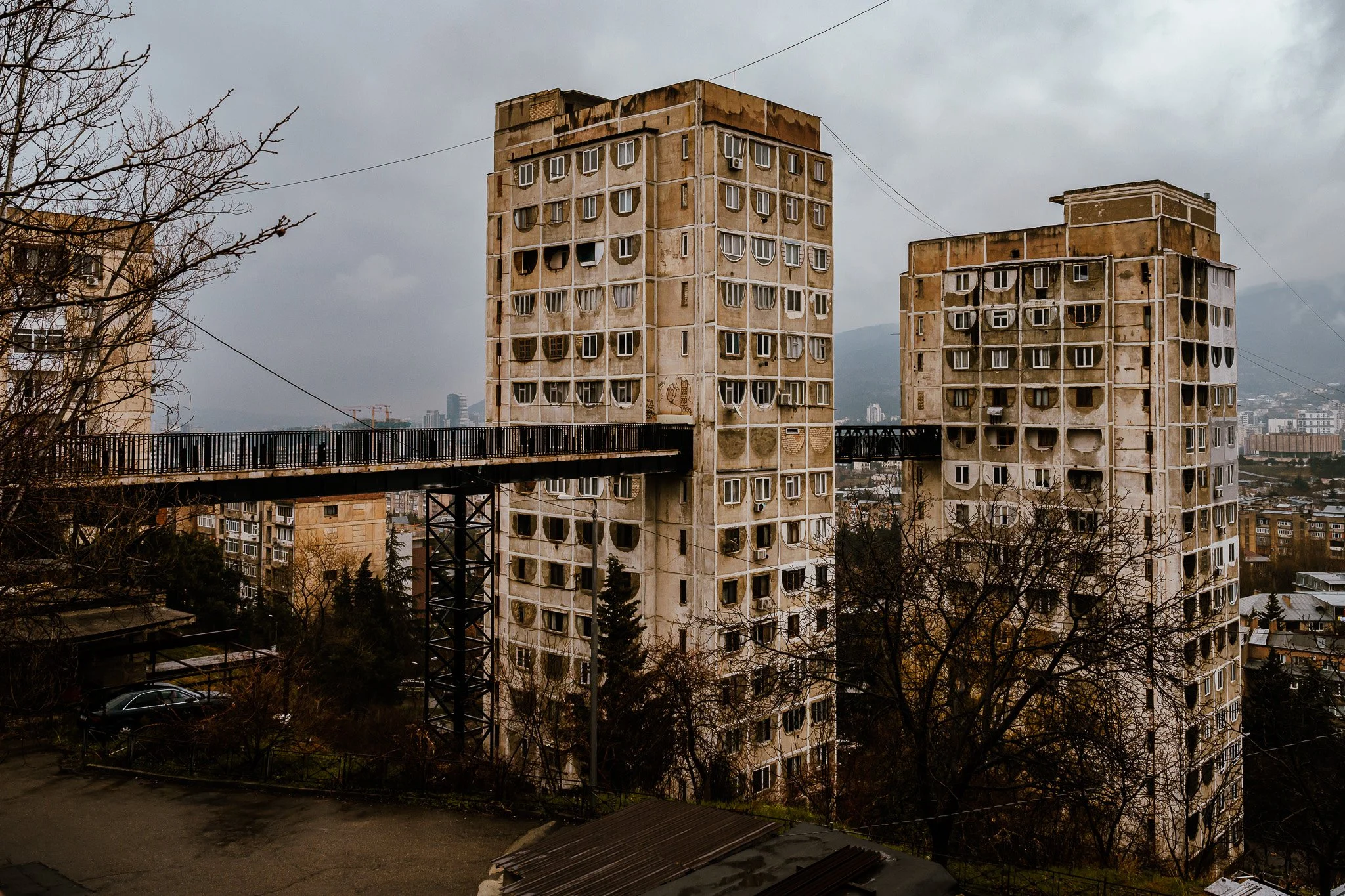
The Skybridge towers deserve their own mention, because they are unlike anything else in the city. Three identical 16-storey Soviet apartment blocks, built for employees of a research institute in the 1970s and 1980s, connected to one another by aerial walkways. From street level they are imposing; from the bridge walkway itself, the scale of the surrounding city opens up in a way that catches you off guard.
The guide may well include the Skybridge as part of the main tour. If so, go back independently in the evening. The towers at golden hour, with long shadows thrown through the connecting walkways and the mountain backdrop catching the last light, are worth the return trip. After dark, long exposures from street level — with the lit windows of the towers reflected in whatever wet ground you can find — produce something genuinely atmospheric.
A small, practical detail: there is a lift operator who lives in a tiny room next to the public lift. There used to be several operators working in shifts but now the lady does this all on her own and has essentially made her office her home, complete with a washing machine in the corridor. You have to pay to use the lift and the hint that other intrepid tourists have come before you comes in the form of English notices and the modern touch of a WhatsApp number if you need to contact the operator. I was lucky because the lift had only recently reopened after some maintenance, which required sending technicians from Turkey.
Why it matters
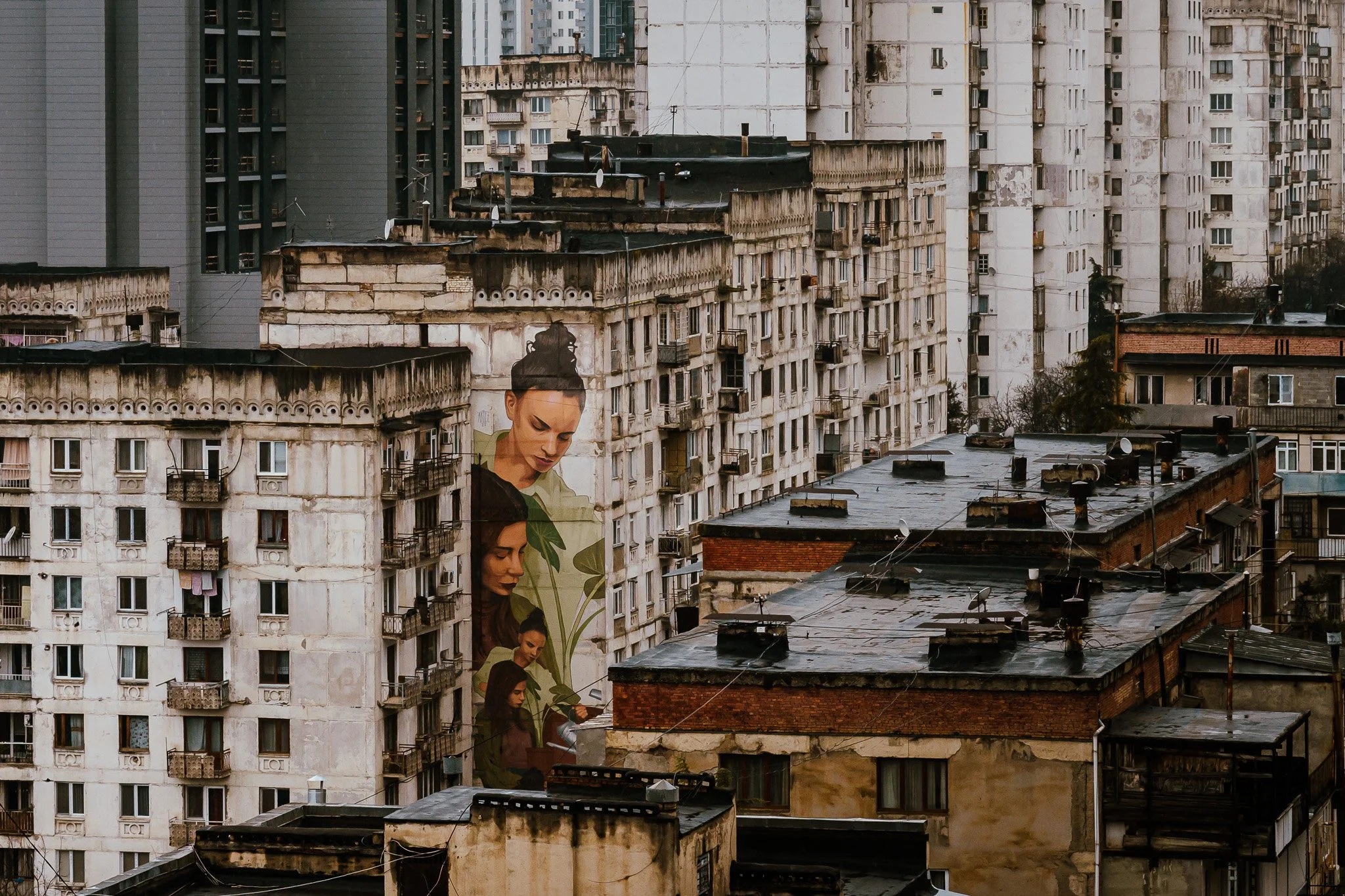
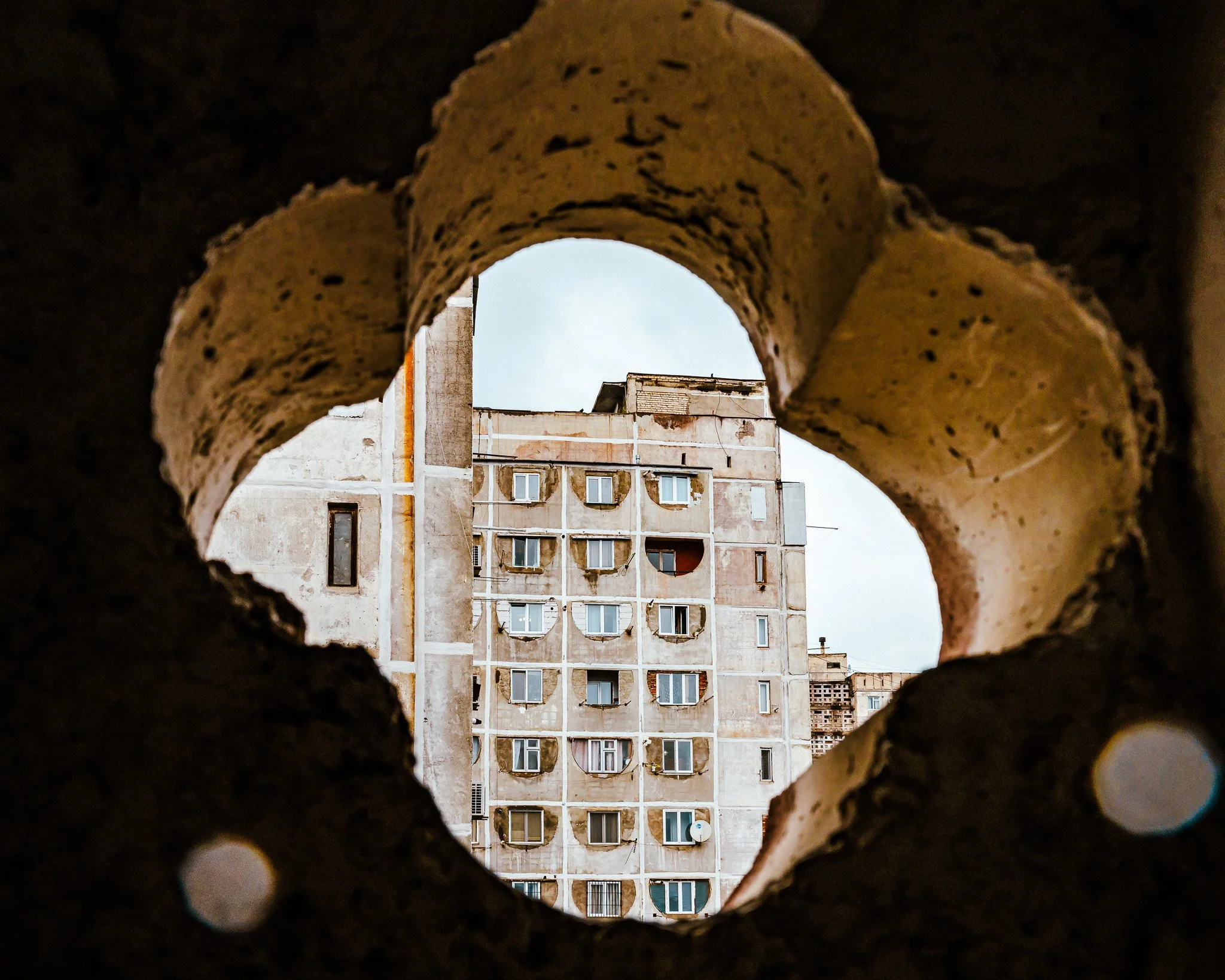
There is a tendency in travel photography to seek out the exotic or the beautiful, and to treat the ugly or the difficult as a backdrop rather than a subject. Soviet Tbilisi resists that tendency. The buildings are not picturesque in any conventional sense, yet on closer inspection at the Skybridge complex you can see inverted horseshoe shapes surrounding the balconies, which are a symbol of good luck, as well as decorative openings in the facade. The histories attached to them, however, are complicated. But that is precisely what makes photographing them worthwhile — and what makes this particular side to the city, with its crumbling concrete and its extraordinary human stories, worth your time.
You will come back with images that look nothing like anyone else's photographs of Tbilisi. That, in itself, seems reason enough.
Related articles:
— Tbilisi: A photographer's guide to Georgia's extraordinary capital
— Early mornings in Tbilisi: Markets, bus stations and honest expectations
— Golden hour and beyond: Modern Tbilisi and the classic shots

Five must-see photo locations in Malta and Gozo for 2025: Hidden gems and iconic views
Explore the best photography spots in Malta and Gozo for 2025, including Il-Karraba Ridge, Valletta's architectural marvels, and the Marsalforn Salt Pans. Perfect for landscape and architectural photography lovers.
I visited Malta and Gozo in early May. For someone who lives in a landlocked country, the opportunity to explore an island that measures less than 30km long and 15km wide, plus the smaller island of Gozo, offers numerous opportunities to combine coastal landscape photography with historical architecture and some unusual urban photography. Despite iconic photo locations such as the Azure Window collapsing in recent years due to natural erosion, Malta and Gozo continue to captivate photographers with their natural beauty. If you're planning your 2025 photo journey through these Mediterranean gems, here are five must-visit photo locations based on my own experience on-location.
1. Il-Karraba Ridge, Għajn Tuffieħa – Sunset Spectacle by the Sea
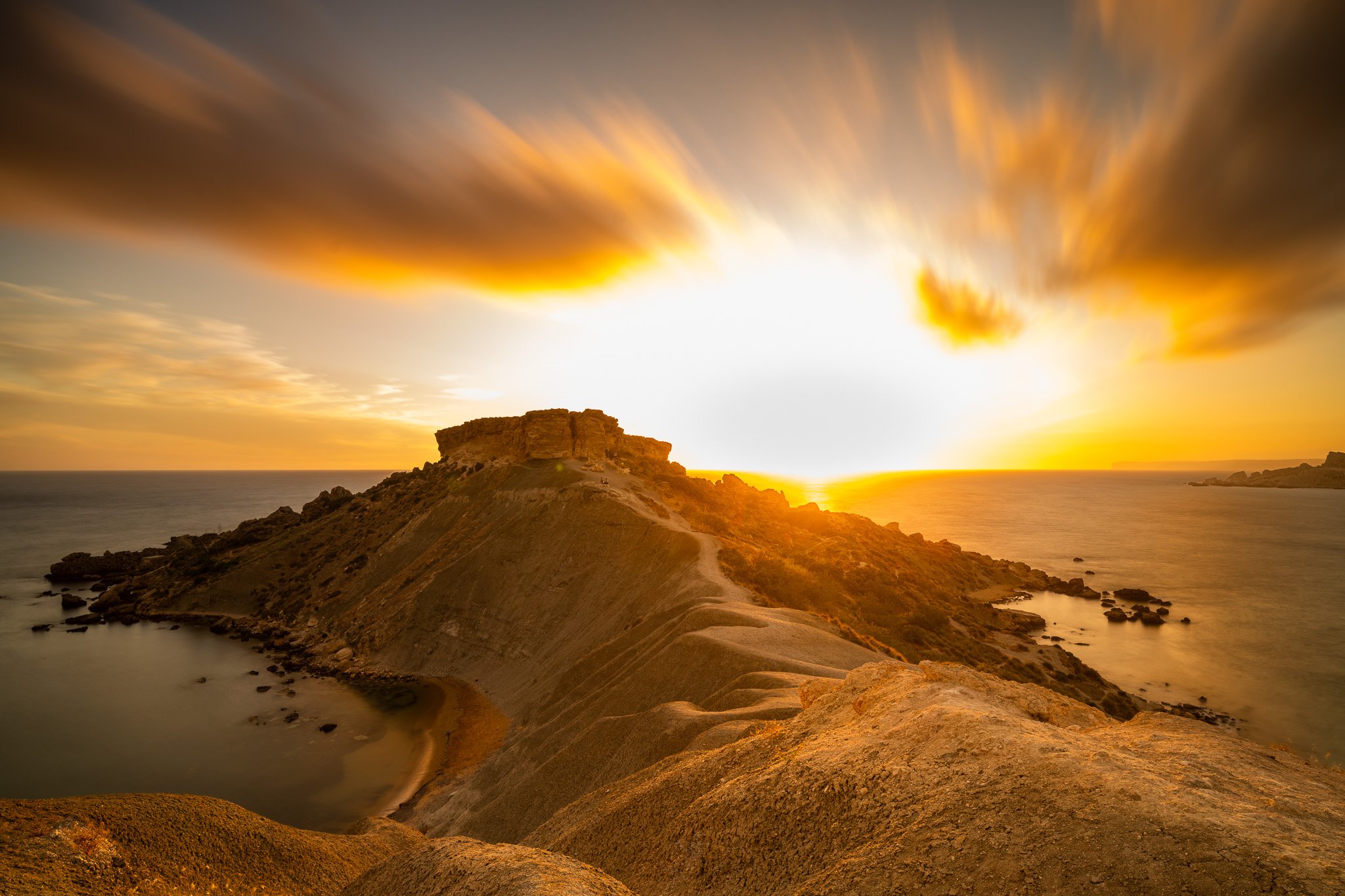
Il-Karraba ridge at sunset. Nikon Z7ii, 14-30mm f4. Shot at @20mm, f8, ISO 100, 25 seconds.
Nestled between Għajn Tuffieħa Bay and Ġnejna Bay, Il-Karraba Ridge offers one of Malta's most breathtaking coastal landscapes. This clay cliff formation is a dream for sunset photography. The unique terrain, combined with the golden Mediterranean light, provides endless compositional opportunities—from minimalist silhouettes to sweeping wide-angle shots. The cracked soil in particular offers endless opportunities to create leading lines. I faced the usual challenge of an underexposed foreground and an overexposed background, adding my own layer of complexity by shooting long exposures. A tripod and filters are essential here, and my trusted graduated neutral density filter helped to take out some of the highlights. In my final edit I deliberately kept some of the blown highlights for a pretty aggressive look. As this spot faces west, it attracts a lot of people for the sunset. Get there early, take some time to scout for a good spot and then wait. I stayed in the same spot for around an hour.
2. Parliament Building, Valletta – Architectural Geometry
Designed by renowned architect Renzo Piano, Valletta's Parliament Building is a masterpiece of contemporary architecture harmonizing with Malta’s traditional limestone aesthetic. Its bold geometric façade creates compelling patterns, perfect for architectural and abstract photography. The stairs on the right-hand side of the building offer great potential for some candid street photography if you can catch people at the right time as the sun casts a diagonal shadow across the stairs. Unfortunately, the hordes of tourists groups and cruise ship visitors seem to head straight down the main street and miss this architectural marvel. I did all my Valletta shots relatively early in the morning and the light was great. I deliberately take only my 50mm prime lens for street photography because it forces me to consider my composition. In this case I honed in on the façade to highlight the intriguing shapes and geometric patterns.

A close-up of the façade of the Parliament Building in Valletta. Nikon Z7ii, 50mm f1.8. Shot at f8, ISO 160, 1/640 seconds.
3. Marsalforn Salt Pans, Gozo – Ancient Grids at Golden Hour

The salt pans at Marsalform shot at sunrise. Nikon Z7ii, 14-30mm. Shot at 30mm, f8, ISO 64, 1/250 seconds.
Located on Gozo’s northern coast, the Marsalforn Salt Pans are not only culturally significant but also visually mesmerizing. Carved into the coastal rock and still in use today, these salt pans offer a striking checkerboard pattern that reflects the changing sky. The coast here runs east to west and I got there in time for sunrise. There was not much in the way of a golden hour but if you have a polarising filter you can catch the early-morning sun reflecting off the pools. This is a protected site so you cannot simply wander around the salt pans looking for the best composition. There is a concrete pathway half-way along the coast where you can set up to look east for the sunrise. But as always with sunrises, don’t forget to look behind you as the sun lights up the coast looking westwards.
4. Typical Maltese architecture
You cannot fail to notice the typical style of Maltese appartment blocks with their distinctive coloured protrusions. Taking a street photography approach and armed only with my 50mm prime lens, I wanted to capture only this essential element of the Maltese style, without any extraneous details. If you wander around Valletta early in the morning and frame your shot looking upwards, even if you are surrounded by tourists and traffic, you can capture a moment in time that features none of them.

No self-respecting building in Malta is complete without a brightly painted wooden extension pinned to its façade. Look up, find the colours and shoot. Nikon Z7ii, 50mm f1.8. Shot at 50mm, f8, ISO 160, 1/640 seconds.
5. The red tower and sunset by an old NATO radar station
If you plan well and scout your locations in advance, you can get two good golden hour and sunset shots here. The first is the striking St. Agatha’s Tower, whose dark red adobe-style finish comes alive in the orange glow of golden hour. Head further down the road to the very end and, if you wander around a bit, you can find several composition to catch the setting sun.

An evening shot of the Red Tower in Malta, Nikon Z7ii, 50mm f1.8. Shot at 50mm, f8, ISO 64, 1/250 seconds.

Sunset with a ramshackle hut in the foreground. Nikon Z7ii, 50mm f1.8. Shot at f8, ISO 64, 1/250 seconds.
Malta has a great bus network but if you’re planning sunrise and sunet shots it probably won’t help you much. I hired a car from the airport, where there is a good selection of companies with reasonable rates. The weather while I was there was not great and included a day of torrential rain and as the population is neither used to that or equipped for it I found myself behind a car whose tyres did not have enough profile to drive up a gentle hill in the rain! Driving in the centre of Valletta is not easy, even with your choice of Apple Car Play or Google Maps, so be warned. The ferry to Gozo runs 24 hours, however, so you can get a very early morning crossing to catch the sunrise locations.
Let me know in the comments if you’ve been or if you plan to go and what you thought/think.